You place a bet, it loses, and you cannot quite explain why you made it in the first place. That moment, more than any losing streak, is usually the clearest sign that something in the process needs to change. Smart betting helps solve that problem by creating a more disciplined way of making decisions you can actually stand behind afterward, win or lose, instead of ones you only remember once they go wrong.
It is not about finding a secret formula that guarantees a profit, and nothing in this guide will claim otherwise. It is about making decisions with the same care you would apply to any other financial choice, based on research, discipline, and a clear understanding of the numbers in front of you rather than a hunch or a gut feeling alone.

Many bettors struggle to see consistent results not necessarily because they lack knowledge of a particular sport, but because their approach to placing a bet often lacks a clear, repeatable process. They chase a feeling, follow a tip from a friend, or back a team purely out of loyalty. Smart betting replaces that randomness with a process, one that treats every wager as a decision worth thinking through rather than an impulse worth acting on.
This guide covers that process from the ground up: what smart betting actually means, how to start if you have never done any of this before, how to manage a bankroll and read value into the odds, the mistakes that quietly cost bettors the most, and how to choose a platform worth using in the first place. Whether you are placing your first bet this weekend or already have years of experience, the same core principles apply, even if the specific details you focus on shift as you gain experience.
If you have searched for smart betting tips before, you have probably noticed that most of them repeat the same handful of ideas. That repetition exists because learning how to bet smarter genuinely comes down to the fundamentals covered here, applied consistently, rather than a constant search for something new.
Smart betting is a process, not a prediction. Bettors who treat research, bankroll management, and betting discipline as seriously as their selections tend to make more consistent decisions over time than those chasing a single big win.
This guide is written and maintained by the Betting-Review editorial team and reviewed periodically for accuracy. It focuses on the decision-making process behind betting rather than tips, predictions, or promotional claims.

What Is Smart Betting and Why Does It Matter?
At its core, smart betting means treating every wager as a calculated decision rather than an emotional reaction. It involves understanding the odds you are being offered, knowing roughly how much you are willing to risk before you ever open a bet slip, and being honest with yourself about why you are placing a particular bet in the first place.
None of this requires a background in statistics or years of experience around a specific sport. It simply means slowing down enough to notice the difference between a bet you have genuinely thought through and one you are placing because it feels exciting in the moment. That distinction, repeated consistently across hundreds of decisions rather than applied only occasionally, is really what separates smart betting from everything else people casually do at a bookmaker.
What Separates Emotional Betting From Structured Betting
The difference between emotional betting and structured betting usually shows up in the small decisions nobody else sees. An emotional bettor doubles their stake after a loss to try to win it back immediately, or backs a favorite team purely out of loyalty without checking the price. A bettor practicing smart betting sticks to a plan they set before that losing bet ever happened, because one result says very little about whether an approach is actually working.
| Situation | Emotional Betting | Smart Betting |
|---|---|---|
| Managing bankroll | Uses random stake sizes depending on confidence or recent results | Uses a predefined staking plan and protects betting funds |
| Research before betting | Relies on opinions, headlines, or personal preferences | Reviews relevant information before making a decision |
| Comparing odds | Accepts the first price available without checking alternatives | Compares odds to identify better value opportunities |
| During a losing streak | Becomes frustrated and changes strategy immediately | Stays patient and reviews decisions objectively |
Key Questions to Ask Before You Confirm a Bet
Before confirming a bet, a bettor practicing smart betting works through a short set of questions rather than jumping straight to the bet slip. Is the price genuinely good value, or just a familiar name at a familiar price? What do I actually know about the teams or players involved right now, as opposed to what I remember from a few weeks ago? And how confident am I really, once I separate the facts from the excitement of watching a favorite team play?
Answering these honestly takes less than a minute, but skipping them is exactly how a casual bet turns into an impulsive one. If your confidence in a selection depends more on hope than on anything you could explain to someone else, that is usually a sign to wait rather than confirm. If you are still getting comfortable with the mechanics of placing a bet itself, our guide on how to bet on sports covers the practical side of the process, from reading odds to confirming a wager, before you start layering strategy on top of it.
This approach is often what separates casual betting from smart sports betting, where decisions are based on a repeatable process rather than short-term emotions. It simply means being aware of the process behind your decisions, so a losing streak feels like normal variance rather than a reason to panic, and a winning streak feels like a good outcome rather than proof that your process no longer needs attention.
Smart Betting vs Gambling: Understanding the Difference
Gambling and sports betting are often treated as different activities, but in a narrow sense they are not: both involve risking money on an outcome that is not fully known in advance. The real difference sits in how the decision gets made, not in the activity itself. Someone approaching a bet purely as gambling tends to focus almost entirely on the result, whether it won or lost, while the reasoning behind it, the odds on offer, and the actual level of risk involved often stay in the background or get ignored altogether.
Smart betting keeps that same underlying activity but changes the process surrounding it. It means weighing the odds against your own honest sense of probability before staking anything, treating bankroll and risk management as part of every decision rather than an afterthought, and basing the decision on research instead of how the last few results happened to go. Discipline sits at the center of this, since emotional decisions, chasing a loss or doubling down after a win, are exactly what a structured process is built to prevent.
None of this removes chance from sports betting. A well-reasoned bet can still lose, and a poorly reasoned one can still win, because probability describes a tendency across many decisions rather than a guarantee on any single one. What a disciplined approach actually changes is the quality of the decision itself, not the outcome of one particular bet. Smart betting is not about removing uncertainty, but about making better decisions within uncertainty, which is a genuinely different goal from trying to predict the future with certainty.

How To Start Smart Betting as a Beginner
If everything above feels like a lot at once, learning how to bet smarter really only requires a handful of habits, built one at a time rather than all together. None of them demand years of experience or any specialist knowledge, just a willingness to slow down before each bet rather than rushing straight to the slip.
The four habits below are deliberately basic. They also happen to make the biggest difference early on, since most of the mistakes covered later in this guide trace back to skipping one of them.
Understanding Odds Before You Place a Bet
Learning to read decimal, fractional, or American odds, and what they imply about probability, is the first skill worth building. Everything else in this guide assumes you can already look at a price and roughly judge what it is telling you about how likely an outcome is considered to be. This does not take long to pick up, usually just a handful of matches watched with the odds open alongside them.
Setting a Betting Budget You Can Actually Afford
Decide on a total amount you are comfortable using for betting, entirely separate from money needed for bills or savings, before placing a single wager. This one decision prevents most of the serious problems beginners run into later, since it removes the temptation to treat a losing bet as money that still needs recovering from elsewhere.
Avoiding Emotional Betting From Day One
It is far easier to build a habit of checking the price and the reasoning behind a bet from the very start than to unlearn emotional habits later. Treat your first few bets as practice for the process, not just for the outcome, and resist the urge to judge the whole approach based on how any single one turns out.
Tracking and Reviewing Your Bets
Even a simple note of the odds, stake, and result for every bet gives you something to look back on after a month or two, rather than relying on memory, which tends to remember wins more vividly than losses. Set a recurring time, once a month is enough, to review that record and ask what you would do differently. This single habit, more than any specific tip, is what separates beginners who improve from those who stay stuck repeating the same avoidable mistakes.
Smart Betting Checklist Before Placing a Bet
Everything covered so far comes down to a handful of habits worth running through before every single wager, regardless of the sport or the size of the stake involved.
- Checking odds value against your own honest assessment of the probability
- Reviewing relevant information, including team news, form, and injuries
- Confirming your stake size fits your existing bankroll rules
- Avoiding emotional decisions driven by a recent result or personal loyalty
- Evaluating possible risks, including what happens if this specific bet loses
Keep this checklist somewhere you will actually see it before placing a bet, such as a note on your phone. A rule you can review in the moment is far more useful than one you only remember after you have already broken it.
How to Evaluate a Smart Betting Strategy
Not every approach that calls itself a strategy holds up under scrutiny, so it helps to know what a genuinely sound one looks like before committing time or money to it. Many smart betting tips shared online skip straight to a bold claim without covering any of this groundwork, which is usually the first sign to read a little further before trusting one. This matters just as much for bettors who have been doing this for years as it does for anyone brand new to the idea.
A strategy worth following usually rests on five practical foundations rather than a single clever idea:
- A clear research process. Consistent, repeatable checks on team news, form, and context, rather than research that only happens when you feel like it.
- Odds comparison. A habit of checking prices across more than one bookmaker before confirming a selection.
- Market evaluation. An honest sense of which markets you understand well enough to price, and which ones you do not.
- Bankroll discipline. A fixed unit size and a separate pool of funds, applied consistently regardless of recent results.
- A responsible betting approach. Realistic limits, awareness of your own behavior, and a willingness to step back if betting stops feeling like entertainment.
A strategy that skips most of these in favor of a single bold claim, such as a guaranteed win rate or a hidden system nobody else has found, deserves real skepticism rather than immediate trust. Our broader sports betting strategy hub covers how these foundations apply across individual sports in more depth.
Proven Smart Betting Strategies to Make More Informed Decisions
Building a logical betting process starts before you ever look at a specific match or event: deciding, in advance, what kind of bets you are willing to place, how much research you expect to do, and what would actually change your mind about a selection. A smart betting strategy is built around this same principle, creating a repeatable framework where decisions are based on research, odds, and predefined rules rather than short-term emotions. Bettors who skip this step tend to make a different decision each time they face a similar situation, based purely on mood rather than any consistent reasoning.
Building a Research-Based Betting Routine
Research does not need to be complicated to be effective. Checking team news, recent form, and any relevant absences takes a few minutes and consistently improves decision quality more than any amount of guessing ever will, regardless of how long you have followed the sport in question. For bettors who want to go beyond the basics, our guide to using sports stats in betting covers which numbers are actually worth tracking and which ones are mostly noise.
For anyone building these habits from scratch, our guide to beginner betting strategy breaks the process down into a few manageable steps rather than trying to cover everything at once.
Practical Habits That Actually Work
A handful of practical habits consistently separate disciplined bettors from casual ones:
- Comparing odds between bookmakers. The same outcome is often priced differently across operators, and taking the better available price adds up over a season without changing a single prediction.
- Keeping betting records. Noting the odds, stake, and outcome of every bet turns isolated decisions into a pattern you can learn from, rather than results you only remember emotionally.
- Focusing on selected markets. Spreading attention too thin across unfamiliar markets makes it far harder to spot genuine value than sticking to a smaller number you understand well.
- Avoiding low-value bets. Passing on a market where the price does not represent good value is itself a smart betting decision, even though it feels like doing nothing.
- Reviewing previous decisions. Looking back over a batch of bets, win or lose, reveals whether a type of selection is genuinely working or whether you have simply been fortunate.
- Understanding closing odds. Comparing the price you took against the final price before an event starts is one of the clearest ways to judge whether you are consistently finding value.
Good habits also include knowing when not to bet. Recognizing a market you do not understand well enough to price accurately is as much a smart betting decision as finding one you do, since skipping a bet is itself a decision when the alternative is guessing. Many sports betting strategies you will come across elsewhere online are really just variations on this same theme, prepared properly and given enough time to actually prove themselves.
Essential Bankroll Management Strategies
Bankroll management is the part of smart betting that gets talked about the least and matters perhaps the most. It simply means treating the money you bet with as a separate, fixed pool of funds rather than an extension of your regular finances.
This separation is what actually protects you, not any specific number or formula. Once betting funds are kept apart from rent, bills, and savings, a loss stops being a threat to daily life and becomes just another data point in a longer process.
How Unit Betting Helps Protect Your Bankroll
Setting a realistic limit before you deposit anything removes one of the biggest sources of poor decision-making later on. Protecting that bankroll in practice usually comes down to unit sizing, sometimes called flat staking, where each bet risks a small, consistent percentage of your total funds rather than a random amount decided in the moment. Our guide to managing your betting funds goes into more detail on staking plans and adjusting unit size over time.
Why Consistent Stake Sizing Improves Betting Discipline
A unit represents a fixed percentage of your current bankroll rather than a fixed cash amount that never changes. As an illustrative example only, and not financial advice, the table below shows how a conservative and a higher-risk unit size compare across a few bankrolls, along with what ten consecutive losses, an entirely realistic possibility over time, would mean for each one.
A higher unit size grows a winning run faster, but it also makes a losing streak considerably more painful, which is worth thinking through before choosing a percentage rather than after a stretch of results forces the decision. For bettors who’d rather calculate that percentage mathematically instead of guessing between a conservative and aggressive unit size, the Kelly Criterion scales your stake to the actual size of your edge, rather than picking a fixed number upfront.
| Bankroll | Conservative Unit (1%) | Higher Risk Unit (3%) | Balance After 10 Losses at 1% | Balance After 10 Losses at 3% |
|---|---|---|---|---|
| £500 | £5 | £15 | £450 | £350 |
| £1,000 | £10 | £30 | £900 | £700 |
| £2,000 | £20 | £60 | £1,800 | £1,400 |
How to Create a Sustainable Betting Budget
Reviewing your bankroll on a set schedule, rather than only after a big win or a painful loss, keeps your unit size honest. A bankroll that has grown meaningfully over a few months can reasonably justify slightly larger units, while one that has shrunk calls for smaller ones. Avoiding emotional decisions is where this discipline is tested the most: a single bad week does not mean your entire approach is broken, and increasing stakes to chase back a loss almost always makes the problem worse.
Successful betting is often more about avoiding poor decisions than constantly searching for more bets to place. Skipping a bad opportunity protects your bankroll just as effectively as finding a good one grows it.
How Value Betting Helps You Find Better Betting Opportunities
Value betting means placing a wager only when you believe the odds on offer are better than the actual probability of that outcome happening. It sounds simple in theory, but it requires a genuinely honest assessment of probability rather than picking the outcome you would prefer to happen.
This is a different question from simply asking who is more likely to win. A heavy favorite can still be a poor bet if the offer price barely rewards the risk, while a genuine underdog can represent real value even though it loses more often than it wins.
Understanding Implied Probability in Simple Terms
Odds are really just a bookmaker’s opinion, expressed as a number, about how likely something is. Our explanation of how value betting works walks through converting odds into an implied probability and comparing it against your own assessment of a match.
If you genuinely believe a team has roughly a 50 percent chance of winning, but the odds on offer imply only 40 percent, that price represents value regardless of whether the team actually wins this particular match.
Why Bookmaker Margins Matter More Than Most Bettors Realize
Bookmakers build a small margin, sometimes called the overround, into every market to cover their own risk and secure a profit regardless of the outcome. This means the implied probabilities across all outcomes in a market usually add up to slightly more than 100 percent, and part of finding value is recognizing where that margin has not been applied evenly.
Occasionally, two bookmakers disagree sharply enough that the combined implied probability actually drops below 100 percent instead of above it, which is the exact gap our guide to arbitrage betting is built around, covering every outcome at once for a profit that doesn’t depend on the result at all. A correct prediction can still be a poor bet once this margin is taken into account, which is one of the more common reasons bettors plateau despite genuinely knowing their sport well, and it is exactly why price matters as much as the prediction itself.
Value Shifts, So Timing Matters Too
Odds shift as team news, injuries, and market activity change closer to an event, which means a price that looked fair an hour ago might represent genuine value now, or might have disappeared entirely. Checking odds again close to kickoff, rather than only when you first spot a market, is a habit a lot of casual bettors simply miss, and it costs them value they would otherwise have found without any extra research at all. That same principle carries into the match itself; our guide to live betting explains how to apply this same value-based thinking once odds start moving in real time.

Smart Betting Example: How to Analyse a Betting Decision
Theory is easier to absorb with a concrete scenario attached to it, so here is what this process looks like applied to a single, realistic match. Reading about odds, probability, and risk in the abstract only goes so far, and seeing them worked through together, in order, tends to make the whole idea click much faster than any explanation on its own.
Nothing about this scenario is unusual or requires special access to information. It is the same five-step sequence a disciplined bettor would run through for almost any match, adjusted only for the specific numbers in front of them.
Step 1: Reviewing the Available Odds
Imagine a football match where the home team is trading at odds of 2.10 to win. Before doing anything else, a disciplined bettor checks that price against two or three other bookmakers rather than accepting the first number they see.
Step 2: Comparing Implied Probability
Converting 2.10 into an implied probability gives roughly 47.6 percent. The next question is whether that figure genuinely matches the bettor’s own honest read of the match, rather than simply feeling right in the moment. Whenever a gap opens up between the price and your own estimate, that is exactly the signal value betting is designed to catch, and learning to spot it consistently, rather than by accident, is what separates a one-off good call from a repeatable process.
Step 3: Checking Team and Player Information
Recent form, head-to-head history, and any confirmed absences all feed into that probability estimate. A key player missing through injury or suspension can shift a team’s realistic chances more than the raw odds might suggest.
Step 4: Evaluating the Risks
Before confirming anything, it is worth asking what happens if this specific bet loses, whether the match carries unusual uncertainty such as a rotated squad, and whether the same information would change the answer for a bettor with a different bankroll.
Step 5: Deciding the Stake Size
Finally, the stake follows the bettor’s existing bankroll rules rather than how confident the selection happens to feel. A consistent unit size, decided in advance, removes the temptation to bet more simply because the analysis felt convincing.
None of these five steps takes more than a few minutes once they become routine, and none of them guarantees the bet wins. What they provide is a decision you can actually explain and learn from afterward, regardless of the result.
| Step | What It Involves |
|---|---|
| 1. Reviewing the odds | Comparing the price across two or three bookmakers |
| 2. Comparing implied probability | Converting the odds and checking them against your own estimate |
| 3. Checking team and player information | Reviewing form, head-to-head history, and confirmed absences |
| 4. Evaluating the risks | Assessing the realistic downside and any unusual uncertainty |
| 5. Deciding the stake size | Applying your existing bankroll rules, not how confident you feel |
Effective Betting Systems and How to Use Them Wisely
Betting systems can be a useful way to add structure to your decisions, particularly for bettors who find it difficult to stay consistent without a framework to follow. A system removes some of the moment-to-moment decision-making by setting clear rules in advance.
Why Betting Systems Create Structure
The benefit of a well-built system is consistency: it stops you from making a different decision each time you face a similar situation, based purely on how you feel that day. The limitation is that no system accounts for every possible scenario, and blindly following one without understanding why it works can lead to costly mistakes when conditions shift unexpectedly.
Flat staking, where every bet risks the same fixed unit, is one of the simplest systems and remains popular precisely because it removes guesswork. Progressive systems, which adjust stakes based on previous results, can work in specific contexts but are far less forgiving of a genuine losing streak, which is worth understanding clearly before adopting one as your default approach.
The Risks of Martingale and Aggressive Progression Systems
Martingale-style systems double the stake after every loss so a single eventual win recovers everything, plus a small profit. In practice, betting limits, bankroll limits, and losing streaks that are entirely normal in sports betting make this genuinely risky, since the stake required after just a handful of consecutive losses can grow far faster than most bankrolls can support, sometimes reaching unaffordable levels within a single unlucky evening.
If a system or seller claims a guaranteed win rate, treat it as a warning sign rather than a selling point. No legitimate betting system can promise guaranteed profit, and any approach that makes such claims should be viewed with caution.
Why Sample Size Determines Whether a System Really Works
Ten or twenty bets is nowhere near enough to judge whether a system has a genuine edge, since ordinary variance alone can produce a winning or losing streak of that length regardless of the underlying quality of the approach. Judging a system fairly usually requires results from several hundred bets, which is a far longer commitment than most bettors expect before concluding. Systems that fail often do so for the same reasons: markets becoming more efficient as more bettors adopt them, inconsistent application once it stops feeling exciting, or simply never having a genuine edge beyond a short, favorable sample.
Testing a system on paper, or with very small stakes, before committing meaningful money to it is a habit worth building regardless of which system you are considering. Our comparison of different betting systems covers several popular approaches and where each one tends to hold up or break down.
Smart Betting Risk Management Techniques to Reduce Losses
Risk management answers a different question than bankroll management does. Bankroll management decides how much you risk, through unit size and staking rules. Risk management decides which bets are worth the risk at all, regardless of how much money is actually involved in any single one.
Avoiding Poor Markets and Unnecessary Exposure
Combining too many selections into a single bet compounds risk considerably, since every leg needs to be correct for the bet to pay out. Markets with very few competing bookmakers, or an obscure event with limited information available, carry a level of uncertainty that no amount of careful staking can fully offset. Our practical techniques for reducing betting risk cover how to identify markets and bet types that carry more uncertainty than they are worth.
Spreading activity across a few different sports or markets, rather than concentrating everything on one competition, reduces how much a single bad week in one market can affect your overall results, without requiring any change to your actual unit size.
Managing Uncertainty You Cannot Research Away
Some information is simply unavailable no matter how much research you do, such as a late team news change or an injury that only becomes public after you have placed a bet. Responsible betting strategies focus on maintaining control and making decisions based on research rather than emotion, which includes accepting this kind of unknown rather than betting as if every outcome is fully predictable in advance.
Making controlled decisions ultimately means slowing down before you confirm a bet. Taking a moment to ask whether you would still make this exact selection tomorrow, with a clear head, catches a surprising number of impulsive wagers before they happen, and it costs nothing beyond a few extra seconds of thought.
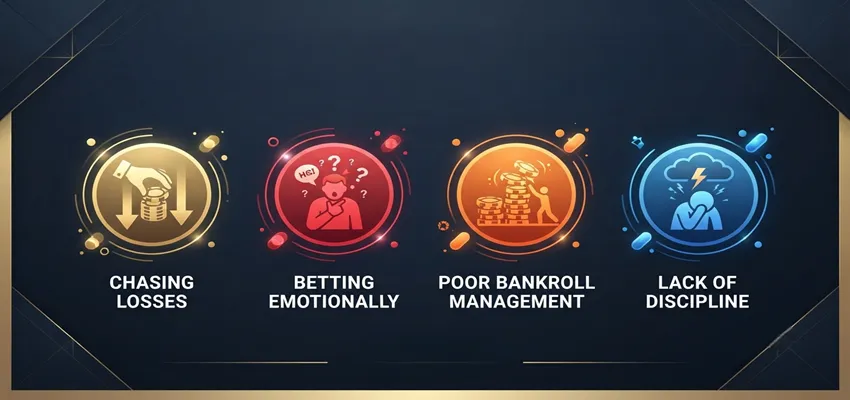
Common Betting Mistakes That Prevent Long-Term Success
Even experienced bettors fall into predictable traps, and recognizing these patterns in your own betting is usually more valuable than any single tip about a specific match, since the same handful of mistakes tend to resurface again and again regardless of the sport involved. Our full breakdown of common betting mistakes walks through each of these patterns individually, along with the smarter alternative for each one.
Why Emotional Betting Leads to Poor Decisions
Betting on a favorite team out of loyalty, or against a rival out of dislike, has nothing to do with genuine probability and everything to do with how you feel in the moment. It is the exact opposite of smart betting. Our detailed look at why bettors lose money covers this pattern and several others in more depth.
How Chasing Losses Damages Your Betting Strategy
Chasing losses, where a bettor increases their stake after a loss purely to recover it in a single bet, almost always compounds the original loss rather than solving it. It is one of the clearest signs that discipline has broken down, and it usually happens fastest right after the kind of result that already put a bettor in a frustrated, reactive frame of mind.
Why Ignoring Odds Creates Long-Term Problems
Betting purely on a prediction without checking whether the price represents fair value is another common mistake. A correct prediction at a poor price can still lose money over time, which is part of why odds knowledge matters as much as sporting knowledge. Poor bankroll decisions, such as varying stake size from one wager to the next without any consistent rule, round out the most frequent errors alongside these two. Most sports betting tips found online focus on picking winners, but avoiding these process mistakes usually has a bigger impact on your results than any single tip about a specific match.
| Common Mistake | Smarter Alternative |
|---|---|
| Increasing stakes after a loss | Keeping stake size consistent regardless of recent results |
| Betting purely on loyalty | Checking the price against your own probability estimate |
| Ignoring the odds entirely | Comparing odds across bookmakers before confirming |
| Betting inconsistent amounts | Using a fixed unit size for every wager |
| Overlooking a bet’s terms | Reading cash out and settlement rules before confirming |
| Placing bets without research | Reviewing relevant information such as form, injuries, and team news |
| Chasing losses with bigger bets | Accepting short-term losses and following a predefined betting plan |
| Betting on too many markets at once | Focusing on markets you understand and can evaluate properly |
How Betting Odds Knowledge Creates Smarter Betting Decisions
Understanding odds is one of the most practical skills a bettor can develop. Odds tell you two things simultaneously: how likely an outcome is considered to be, and how much a winning bet will actually return.
Comparing prices across different bookmakers is where a lot of quiet value gets found. Two operators rarely price the same event identically, and small differences add up across a season of similar bets, often without you ever changing a single prediction. If odds formats or the maths behind implied probability still feel unfamiliar, our full explanation of betting odds breaks down decimal, fractional, and American odds with worked examples.
Making better selections ultimately comes down to combining this odds knowledge with your own research, rather than treating either one in isolation. A bettor who only studies the sport but never checks whether the price is fair is leaving value on the table, while a bettor who only chases favorable odds without understanding the sport is really just gambling with extra steps. Neither habit alone consistently produces smart betting decisions, but the combination of both genuinely does.
Building Profitable Betting Strategies With Consistent Results
A long-term betting approach treats each wager as one data point among many, rather than a single event that needs to prove your entire approach is right or wrong. Building profitable betting strategies requires patience, research, disciplined staking, and regular performance reviews, rather than any single clever pick. This shift in thinking, from judging yourself bet by bet to judging yourself over a season, is one of the harder habits to build but also one of the more valuable ones covered anywhere in this guide. Our guide to consistent winning goes deeper into what separates bettors who sustain this mindset over the long run from those who abandon it after a single rough week.
Tracking performance makes this long-term view possible in practice, day to day. Recording the odds taken, the stake, and the outcome of every bet reveals patterns over weeks and months that are invisible if you are only ever thinking about your next wager. Our guide to building profitable betting habits explains how to read this kind of record honestly, including how to tell a genuine problem apart from ordinary short-term variance.
Setting a fixed review period, once a month is usually enough, gives your results time to accumulate into a meaningful sample before you conclude. When a review reveals a genuine pattern, such as consistently weaker results in one specific market, the right response is usually a small adjustment rather than an overhaul, since a consistent betting strategy tends to evolve gradually rather than through sudden changes. Patience matters more here than in almost any other part of this guide, since a full season of results tells you far more than any single confident week ever could.

Choosing Reliable Betting Sites for Smart Betting
The platform you use can either support or undermine everything covered so far. Even the sharpest approach is wasted on an unreliable site, since a poor platform can erode the value of good decisions through slow payouts, thin market coverage, or unclear terms.
Licensing should be the first thing you check, since a properly licensed operator is held to standards around fair odds and secure handling of customer funds that unregulated sites are not. Our comparison of licensed betting sites breaks down licensing and odds coverage across leading operators.
Security matters day to day too, particularly how your financial details are protected and whether two-factor authentication is available on your account.
Reputation is worth checking independently through trusted betting reviews rather than a platform’s own marketing, since a polished website says very little about how a site actually behaves once you have money on deposit.
Payment reliability rounds out what matters most: consistent, reliable payment methods and reasonable withdrawal times. A platform can offer excellent odds and still feel unreliable if getting your own winnings back takes days longer than it should.
Final Thoughts: Building a Smarter Betting Approach
Strip away the terminology and smart betting comes down to a handful of habits repeated consistently: research before you commit to a selection, a stake size that never depends on how you feel that day, an honest read of whether the price represents value, and the discipline to walk away from a bet that fails any of these tests.
None of it removes risk entirely, and no version of this guide can responsibly promise a profit. What it offers instead is a sturdier process, one built to hold up across hundreds of decisions rather than to explain away a single bad week or celebrate one lucky result as proof of skill.
Discipline beats intensity here. A modest, consistent approach applied for a full season tells you far more about whether you are actually improving than any single confident bet ever could.
If betting ever stops feeling like entertainment and starts becoming difficult to manage, it is important to recognise the signs and seek support. Free and confidential advice, information, and support resources are available through GambleAware, an independent charity focused on helping people make informed choices about gambling.

FAQs About Smart Betting
What does smart betting actually mean?
Smart betting means approaching every wager as a considered decision rather than a hunch. It combines research, realistic bankroll management, an understanding of odds, and enough discipline to stick with a plan even after a losing bet.
What is the difference between risk management and bankroll management?
Bankroll management focuses on how much you risk, through staking plans and consistent unit sizing. Risk management focuses on which bets are worth taking at all, including which markets to avoid. The two work together, but they solve different problems.
How can beginners start betting smarter?
The fastest improvement usually comes from fixing one habit: following a consistent process rather than varying stakes, research, and market choice from bet to bet based on mood or a recent result. Beginners who build this habit early tend to progress faster than those focused only on finding better tips or hot picks.
How much of my bankroll should I risk on a single bet?
Many disciplined bettors use small percentage-based staking approaches, keeping individual stakes low relative to their total bankroll. This keeps a normal losing streak from causing serious financial damage while you refine your approach.
What is value betting and why does it matter?
Value betting means only placing a wager when the odds offered are better than the true probability of that outcome. It matters because a correct prediction at a poor price can still lose money over time, while a well-priced bet can be worth taking even if it does not win every time, since the return over many similar bets is what actually counts.
Do betting systems actually work?
Betting systems can add useful structure and consistency, but no system guarantees profit on its own. Their value comes from the discipline of following clear rules, not from any hidden mathematical edge, and testing one with small stakes before committing serious money is generally a sensible precaution.
What are the most common betting mistakes to avoid?
The most common mistakes include betting emotionally, chasing losses with bigger stakes, ignoring the odds in favor of a gut feeling, and managing bankroll inconsistently from one bet to the next.
Can smart betting guarantee profits?
No. Smart betting improves the quality of your decisions and reduces avoidable mistakes, but it cannot guarantee a profit on any individual bet or over any specific period. Anyone marketing a strategy as a guaranteed route to profit is describing something that does not genuinely exist in sports betting.