The way people follow sport has changed more in the last decade than in the previous fifty years combined. You’re no longer stuck with a prediction locked in before kickoff, watching helplessly as it plays out. Live betting exists precisely for this shift, a market where the price in front of you can be worth acting on or ignoring within seconds.

Speed matters here, but discipline matters more. The same structure you’d apply to any other decision still applies, just applied faster. This guide walks through the strategies that hold up under real conditions, not just in theory. If you’re still getting comfortable with the fundamentals first, our beginner’s guide to sports betting is a good starting point before layering live strategy on top of it.
What Makes Live Betting Different From Pre-Match Wagers
Once a match kicks off, every screen price is reacting to something that’s already happening rather than something that might happen. That single shift changes almost everything about how you should approach a bet. Live betting rewards a calm read of the game far more than it rewards speed alone, and the bettors who treat it as a fast-paced version of pre-match research usually do noticeably better than the ones who treat it as a reflex test.
Building a Setup You Can Actually Rely On
Before any specific live betting strategy matters, the basics of your setup decide how much of that strategy you can actually execute. A slow connection or a single bookmaker account will quietly cap your results regardless of how sharp your reads are.
Why Multiple Bookmaker Accounts Matter
Sticking to one platform means accepting whatever price it happens to offer the moment you look, even when a market gets suspended after a goal or a card. Holding accounts with a few trusted betting platforms means you can compare live prices in real time and use whichever book reopens a market first or prices it more favourably.
Mobile Apps and Fast Execution
Live betting odds can move within seconds of a key moment, which makes a fast, well-built app far more valuable here than in pre-match markets. A pre-configured bet slip and a funded account remove the friction between spotting a price and actually confirming it, since hesitating even briefly can mean the number you saw is already gone.
Checking Reviews Before You Commit
Not every platform handles in-play markets equally well. Some suspend betting for longer after incidents, some settle bets more slowly, and some simply offer thinner live markets than others. Reading independent reviews before relying on a platform for live betting specifically, rather than judging it purely on its pre-match odds, saves a lot of frustration once you’re actually trying to act on a fast-moving price.

Stream Delay and Why It Matters
One detail that trips up a surprising number of bettors is the gap between what they’re watching and what the bookmaker’s own data feed is reacting to. Most streaming services, whether a TV broadcast or an app, run several seconds behind the actual live action, sometimes as much as thirty seconds depending on the provider and your connection.
Bookmakers, by contrast, typically work from official timing data or a direct feed from the venue, which means their prices can already reflect a goal or a card before you’ve even seen it happen on your screen. Betting the instant you see something occur, assuming you’re reacting to live information, can actually mean you’re placing a bet after the market has already adjusted.
Serious in-play bettors get around this by using low-latency streams where available, watching for market suspensions as an early signal that something has happened, or simply building in a habit of checking the live scoreboard feature on the betting platform itself rather than relying purely on a video feed. None of this eliminates the delay, but understanding it exists changes how you interpret a price that suddenly looks too good to be true.
Reading the Match: Core Live Betting Strategies
The sections below cover some of the best live betting strategies you can build into a repeatable process, rather than treating them as isolated tips. They all rest on the same idea: the market often reacts to what just happened rather than to what’s actually likely to happen next, and that’s usually where the value sits.
| Strategy | What You Look For | Main Risk |
|---|---|---|
| Trailing Favourite Strategy | A strong team whose odds drift after an early setback | Assuming every favourite will recover |
| Momentum Betting | Clear tactical or performance shifts not fully priced into the market | Confusing short-term pressure with real dominance |
| Closing Line Value Tracking | Comparing your entry price with the final market price | Ignoring long-term results in favour of short-term wins |
| Sport-Specific Angles | Using signals unique to football, tennis, basketball, or other sports | Applying the same approach to every market |
The Trailing Favourite Strategy
When a pre-match favourite concedes an early goal, live betting odds on them to win often drift out further than their underlying performance justifies. If your research still supports their quality, that drift can represent worthwhile value, since the scoreline reflects a moment of variance rather than a real shift in which team is actually better on the day.
Reading Momentum Shifts
Standard pricing models react to events, not to the pattern building up to them. A substitution, a tactical change, or a sudden change in tempo can shift a game’s realistic outcome before the live betting line has fully caught up. Watching for these qualitative signals, alongside whatever stats you’re already tracking, is one of the more reliable in-play betting skills to build over time.
Closing Line Value in Live Markets
Tracking how your in-play price compares to where the market eventually settles works the same way here as it does pre-match. Consistently getting a better number than the closing line is one of the clearer signs that your live reads are actually adding value rather than just producing occasional lucky results.
| Signal | What It Usually Means |
|---|---|
| Favourite concedes early | Odds often drift further than the shift in real probability justifies |
| Sudden tempo change | Market may lag behind a real shift in momentum |
| Market suspended after incident | Reopening price is often mispriced for a few seconds |
Sport-Specific In-Play Angles
The general principles above apply everywhere, but the specific signals to watch for shift depending on the sport in front of you. A tactical detail that matters enormously in football might be irrelevant in tennis, and vice versa, which is why building real familiarity with a handful of sports usually outperforms trying to read all of them equally well.
The Corner Kick Strategy in Football
A trailing team that abandons defensive shape in the closing stages typically commits more players forward, which pushes up the likelihood of corners well beyond what the pre-match totals line assumed. Our football betting strategy guide covers this kind of in-play adjustment in more depth.
Late-Game Tempo in NFL and NBA
Once a lead becomes large enough, teams in both sports typically shift into clock management, and scoring pace usually drops with it. Adjusting your live totals expectations for this pattern, rather than assuming the pace from earlier in the game continues, is a small edge that’s easy to miss if you’re not watching for it specifically.
Break Point Momentum in Tennis
Tennis rewards in-play attention more than most sports, since a single break of serve can shift the realistic outcome of a set far more than the overall score suggests. A player who’s just saved several break points often carries a psychological edge into the next few games that raw statistics won’t capture, while a player who’s just been broken after building momentum can visibly deflate for a game or two. Watching how a player responds immediately after these moments, rather than just tracking the scoreline, usually reveals live betting value that a purely numerical model misses.
Foul Trouble and Rotation Patterns in Basketball
A key player picking up early fouls changes a team’s rotation and defensive approach for the rest of the half, often well before it shows up meaningfully in the score. Coaches will frequently rest a foul-troubled starter earlier than usual, which can shift pace, spacing, and scoring efficiency in ways that pre-match models never accounted for. Tracking foul counts alongside the scoreline, not just the score itself, is a habit that pays off specifically for in-play basketball markets.
Session Momentum in Cricket
Cricket rewards patience more than almost any other in-play market, since a single session can completely reshape the realistic outcome of a match without the scoreboard looking dramatically different. A batting side accumulating steadily through the middle overs, without losing wickets, is often building toward a late acceleration that live totals haven’t fully priced in yet. Our cricket betting strategy guide goes deeper into reading these session-by-session shifts.
Power Play Situations in Ice Hockey
A power play compresses a huge amount of scoring probability into a short window, and live markets often move sharply the moment one is called. Tracking a team’s actual power play conversion rate this season, rather than assuming league-average efficiency, helps you judge whether the market’s reaction to a man advantage is proportionate or overblown.
Common Live Betting Market Types Explained
Live markets go well beyond simply backing a team to win from where the score currently sits. Knowing what’s actually on offer opens up strategies that aren’t available before kickoff.
| Market Type | What It Covers |
|---|---|
| Next Goalscorer or Next Point | Betting on who scores next, refreshed continuously as the match progresses |
| Correct Score From Here | Predicting the remaining score from the current point in the match, rather than the full-time result |
| Next X Minutes | Betting on what happens within a short upcoming window, such as the next ten minutes |
| Live Asian Handicap | A handicap line recalculated in real time based on the current scoreline and time remaining |
| Live Over/Under | A totals line adjusted continuously as goals, points, or games are completed |
Each of these rewards a slightly different skill. Next goalscorer markets favour bettors who track individual player form and positioning closely, while live totals reward a good sense of pace and how much game time is still left for scoring to happen. Getting comfortable with more than just the basic match winner market is usually where the more interesting in-play betting value shows up.
Live Betting on Esports
Esports live markets move on a completely different rhythm to traditional sport, since a single team fight, objective, or round can swing a match’s realistic outcome almost instantly. Gold and experience leads that look decisive on a stats overlay can evaporate within a couple of minutes if a team makes an aggressive play that pays off, which makes reacting purely to the in-game economy screen a risky habit.
Map and format knowledge matters enormously here too. A best-of-three series behaves very differently in-play depending on whether a team is up or down a map, since momentum and strategic adjustments between maps rarely show up in a simple win probability model. Our esports betting strategy guide covers the format-specific detail you should understand before relying heavily on live esports markets.
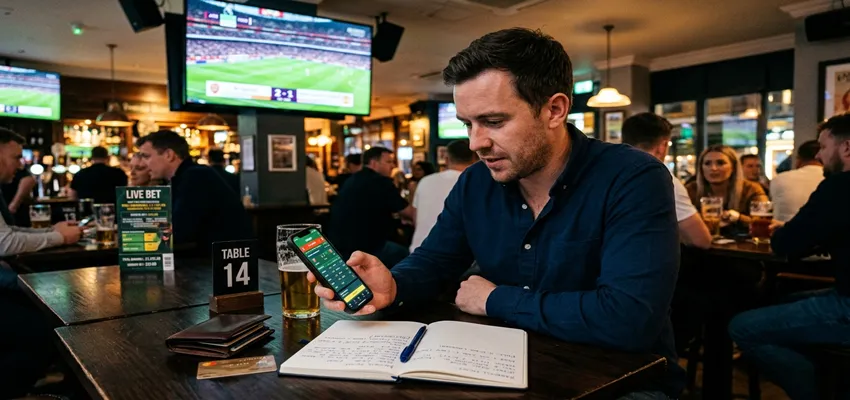
Discipline and Risk Management While the Game Is Live
Spotting an edge is only half the job. The habits below decide whether that edge actually translates into results over a full season, or slowly gets eroded by the same emotional patterns that undo pre-match betting too, just compressed into a much shorter window.
Sizing Stakes for a Faster Market
Many experienced bettors use smaller units for live betting than they do pre-match, simply because in-play markets carry more short-term variance. Our guide to reducing betting risk and our bankroll management strategy both apply directly here, just compressed into a much shorter decision window.
Avoiding the Chasing Trap
Using live markets to chase a loss from earlier in the day is one of the fastest ways to turn a manageable bad day into a genuinely damaging one. Chasing is an emotional reaction rather than a calculated decision, and it often overrides every piece of research you’d normally rely on.
Sticking to Your Pre-Match Read
If your pre-match analysis gave an underdog a legitimate chance, conceding an early goal doesn’t automatically undo that read. Abandoning a well-reasoned position after fifteen minutes of play, purely because the scoreline feels uncomfortable, usually says more about nerves than about anything that’s actually changed in the match.
Managing Fatigue During Long Sessions
Live betting demands constant attention in a way pre-match markets don’t, and decision quality drops noticeably once concentration starts to slip. If you have an open position and feel your focus fading, cashing out early is often the safer move rather than leaving a bet running while your judgement is compromised.
If you notice yourself placing bets just to stay engaged with the game rather than because you’ve spotted actual value, it is usually a clear sign that it is time to end the session.
Common Mistakes Bettors Make in Live Markets
Even bettors who understand the strategies above fall into predictable traps once a match is actually live. The four patterns below account for most of the value that gets given back, and none of them have much to do with a lack of knowledge.
| Mistake | Why It Happens | Better Approach |
|---|---|---|
| Betting after emotional moments | A goal, card, or missed chance creates an urge to react immediately | Check whether the price still represents value first |
| Ignoring stream delay | Viewers assume they are seeing events in real time | Understand that bookmakers may already have adjusted prices |
| Following the scoreboard only | The score feels like the complete picture | Analyse performance, tactics, and market movement together |
| Chasing losses | Fast markets encourage impulsive decisions | Follow fixed bankroll rules and session limits |
Following the Scoreboard Instead of the Full Picture
Placing live bets purely from a stats feed or scoreline, without actually watching the game, means missing the qualitative signals that make in-play betting worthwhile in the first place. A team that looks comfortable on the scoreboard can be visibly rattled on the pitch, and that difference is exactly what a scoreline alone will never show you.
The same habit shows up in a slightly different form once you do have the game on screen: it’s easy to let the scoreline dictate your emotional read of a match while ignoring what the odds themselves are telling you about how the price has already adjusted. If the number has already moved to reflect a goal, reacting to that same goal a second time is simply betting on old news at a worse price than it deserves.
Treating One Bad Passage of Play as a Trend
A team conceding a sloppy goal or missing a few open looks doesn’t necessarily mean their underlying performance has actually changed. Reacting to five minutes of bad luck as though it reflects the entire remaining match is one of the more common ways bettors talk themselves into a weak live bet.
Chasing Losses in a Faster Market
The gap between one live bet losing and the next opportunity to bet again can be a matter of minutes, sometimes seconds, and that compressed timeline makes chasing a much easier trap to fall into here than it ever is pre-match. Someone who loses a next-goalscorer punt can find themselves staring at three fresh live markets on the same fixture before they’ve even had a chance to think about what actually went wrong with the first one. A fixed pause after any loss, even a short one, is usually enough to tell the difference between a bet built on something you actually saw change in the match and one built purely on wanting the last stake back.
Why Bookmaker Margins Matter Even More in Fast Markets
Every price still has the operator’s margin baked into it, live markets included, and that margin doesn’t disappear just because the number is updating every few seconds. Understanding how online betting actually works under the hood makes it easier to judge whether a live price truly represents an edge or is just the market doing what it’s designed to do. This same disciplined approach is what our smart betting guide covers in more depth for decisions made outside live markets too. Following current sports betting trends can also help separate a real market overreaction from a price that’s actually well calibrated.
How Bookmakers Actually Price Live Markets
Understanding roughly what’s happening behind the scenes makes it easier to judge when a live price is mispriced rather than just moving normally. Most operators run automated trading models that continuously recalculate probability based on match state, time remaining, and recent event data, then adjust the price the moment any of those inputs change.
These models are generally very good at pricing the obvious: a goal, a red card, a big momentum swing, almost instantly. Where they’re weaker is in judging qualitative factors a human watching the match can actually see, such as a team’s body language after a decision goes against them, or a manager clearly preparing a tactical switch before it’s actually made. What the algorithm can measure and what an attentive viewer can see rarely line up perfectly, and that’s usually where the more durable live betting edges come from.
It’s also worth knowing that liability management plays a role here too. If an operator has taken heavy action on one side of a live market, they may shade the price slightly to balance their own risk, independent of what the true probability actually is. This is one more reason comparing live odds across honest bookmakers rather than relying on a single book consistently produces a better average price over time.

Building a Pre-Game Live Betting Routine
The bettors who perform most consistently in live markets usually arrive at kickoff with a plan already sketched out, rather than starting their analysis once the match is already underway.
| Before Placing a Live Bet | Questions to Ask |
|---|---|
| Match Situation | Has something actually changed, or am I reacting to the score? |
| Market Price | Do the current odds still offer value? |
| Information Quality | Am I watching enough of the match to make this decision? |
| Stake Size | Does this bet fit my planned bankroll rules? |
| Reason for Betting | Am I acting on analysis or simply trying to stay involved? |
Setting Scenarios Before Kickoff
Deciding in advance what you’d actually do if the favourite concedes first, if a key player goes off injured, or if the pace turns out slower than expected removes the pressure of forming a view in real time. You’re simply checking whether the scenario you already planned for has happened, then reacting according to a decision you made with a clear head.
Keeping a Live Betting Log
Recording the odds you took, the reasoning behind each live bet, and the eventual result reveals patterns a memory alone won’t catch, such as consistently overreacting to red cards or underestimating comeback chances in one particular sport. Reviewing this log periodically is the same discipline covered in our smart betting guide, just applied specifically to in-play decisions.

FAQs About Live Betting Strategies
What is live betting?
Live betting, also called in-play betting, lets you place wagers on a match after it has started, with odds updating continuously as the action unfolds.
Are live betting strategies actually effective?
They can be, provided they’re based on solid analysis rather than reacting purely to the scoreline. Strategies built around momentum, pricing lag, and disciplined bankroll management generally hold up better than pure instinct.
What are the best live betting tips for beginners?
Start with a single sport you already understand well, use smaller stakes than you would pre-match, and avoid betting just because the game feels exciting in the moment.
Why do live betting odds move so quickly?
Because the platform is repricing the match continuously based on events as they happen, a goal, a card, or a shift in possession can all move the number within seconds.
Is live betting riskier than pre-match betting?
It can be, mainly because there’s less time to think before confirming a wager. The underlying risk is manageable with the same discipline used pre-match, just applied faster.
What is the trailing favourite strategy?
It’s the practice of backing a pre-match favourite whose live odds have drifted out after conceding an early goal, provided your research still supports their underlying quality.
How is closing line value tracked in live markets?
By comparing the price you took during the match to where the odds eventually settled before full time, the same principle used to judge value in pre-match betting.
Do I need multiple betting accounts for live betting?
It helps significantly. Different platforms suspend and reopen markets at different speeds after an incident, so having more than one account gives you more chances to catch a fair price.
Should I use the same bankroll rules for live betting as pre-match?
Mostly yes, though many experienced bettors size live stakes slightly smaller to account for the faster pace and thinner decision-making window.
What’s the biggest mistake beginners make in live betting?
Chasing losses from earlier in the day using in-play markets. It replaces calculated decisions with emotional ones and often compounds a bad day rather than fixing it.
What’s the difference between live betting and cashing out?
Live betting is about placing new wagers while a match is underway. Cashing out is a separate feature that lets you settle a bet you already placed before the match finishes, for a value calculated from the current odds minus the platform’s margin.
Can the same live betting strategies apply across different sports?
The underlying principles reading momentum, respecting stream delay, and staying disciplined- apply broadly, but the specific signals to watch for change by sport, which is why building familiarity with one or two sports usually outperforms spreading attention across many.
Making Live Betting Work Long-Term
Live betting rewards the same habits that make any other betting strategy sustainable: research, discipline, and a willingness to walk away from a position that no longer makes sense, just applied to a market that moves considerably faster. Treating speed as a tool rather than the entire strategy is usually what separates bettors who do this consistently well from those who burn out after a rough session.
If live betting no longer feels enjoyable or starts becoming difficult to control, free and confidential support is available through GamCare. This independent UK charity offers advice and assistance via the National Gambling Helpline.