The landscape of horse racing betting is evolving rapidly in 2026. With advanced data analytics, real-time insights, and a more sophisticated approach to market movements, today’s bettors need more than just luck to succeed. Whether you are a newcomer looking for a comprehensive horse racing betting guide or a seasoned punter aiming to refine your horse racing betting tactics, understanding the foundational principles is paramount to long-term success.
Finding the right platform to execute your horse racing betting strategies is the first step. Many users rely on the best betting sites to gain an edge, often utilizing betting reviews to ensure they are working with the most efficient tools. By combining high-quality sportsbook reviews with a deep understanding of the sport, you can develop horse racing betting systems that are both robust and adaptable to the ever-changing odds found at trusted bookmakers.

This guide focuses on the bigger picture behind successful horse racing betting. Instead of looking at individual tips separately, it combines strategic thinking, sports betting fundamentals, and long-term discipline to create a more structured approach. Understanding why a strategy works is just as important as knowing which tactic to use, because consistent results come from a clear process rather than isolated decisions.
🐎 Master Horse Racing Betting Strategies in 2026
The key to mastering horse racing betting strategies is discipline and adaptability. Successful bettors constantly refine their methods based on results and new information. Instead of chasing short-term wins, focusing on long-term value and strategic decision-making creates a more sustainable and controlled betting experience.

How to Build a Winning Long-Term Strategy
Building a long-term winning approach requires a shift in mindset from “gambling” to “investing.” In 2026, successful horse racing betting tips emphasize the importance of data-driven decisions. Instead of betting on favorites blindly, professional bettors analyze the underlying math, seeking opportunities where the probability of an outcome is higher than the odds offered by the bookmaker.
To sustain your journey, consider visiting our value bets guide page to understand how to consistently find value. Consistency is the bedrock of any successful strategy; by documenting every wager, you create a feedback loop that allows you to identify your strengths and eliminate weaknesses in your decision-making process.
Key Principles of Successful Horse Racing Betting
The core of successful horse racing betting systems lies in discipline. It is easy to be swayed by the excitement of a high-profile race, but professional bettors stick to their predefined criteria. This involves strictly analyzing the field, assessing the track, and ensuring that the price justifies the risk. Always look for honest betting reviews to guide your selection of platforms, as the best venues offer data that helps you verify your internal analysis.
| Principle | Description | Importance |
|---|---|---|
| Discipline | Sticking to your betting plan | High |
| Data Analysis | Using statistics over intuition | Critical |
| Price Awareness | Getting the best odds available | High |
| Record Keeping | Tracking wins and losses | Essential |
Staying Consistent and Disciplined Over Time
Consistency is often the missing ingredient for amateur bettors. If you are struggling with discipline, exploring common betting mistakes can help you identify why you might be deviating from your goals. When you approach the races with a clear set of horse racing betting tactics, you remove the emotional element that leads to impulsive wagers.
In addition to discipline, utilizing reliable betting reviews allows you to choose platforms that facilitate better record-keeping and data tracking. Remember that the goal is not to win every single race, but to be profitable over a thousand races. If you find your discipline slipping, review why bettors lose money to reset your perspective.
🎯 Proven Horse Racing Betting Strategies
Proven horse racing betting strategies are built around identifying value rather than simply picking winners. One of the most effective approaches is analyzing past performance data, including finishing positions, speed figures, and consistency across different track conditions. These insights help identify horses that are undervalued by bookmakers.
Another important element is understanding how odds reflect public perception rather than true probability. By comparing implied probability with real performance data, bettors can identify value opportunities that are often overlooked. This structured approach leads to better decision-making and more consistent long-term results.
Value Betting in Horse Racing
Value betting is the concept of finding a horse whose actual probability of winning is higher than what the odds suggest. In the context of horse racing betting strategies, this is the most reliable way to achieve long-term profit. You are essentially looking for mispriced assets in the market.
By reading betting odds, you can determine if a bookmaker has undervalued a horse. If you calculate that a horse has a 33% chance to win (implied odds of 2.00), but the bookmaker is offering 2.50, you have found a value opportunity.
Form Analysis and Past Performance
Form analysis is the study of a horse’s previous runs. Modern horse racing betting tips suggest looking beyond the finishing position. Consider the strength of the previous field, the distance, and the class of the race. Many successful bettors use the best betting systems to organize these variables into a readable format. This helps turn raw race data into clearer betting decisions.
| Performance Metric | What it Tells You |
|---|---|
| Last 3 Runs | Recent momentum and fitness |
| Course Specialist | Does the horse like this track layout? |
| Distance Record | Can the horse sustain the required pace? |
| Class Progression | Moving up or down in competitive level? |
Track Conditions and Their Impact
Track conditions—often referred to as the “going”—drastically affect performance. A horse that dominates on firm ground may struggle on heavy or soft turf. Ignoring the going is one of the most frequent errors in horse racing betting tactics. Always verify the current weather reports and official track updates before placing your stake.
Some horses have a biological predisposition to certain surface types. Checking the breeding records or historical performance on specific surfaces is a vital part of your horse racing betting guide research. If a track is rated “heavy,” your selection process should pivot to horses with proven endurance and experience in mud.
Jockey and Trainer Statistics
The jockey and trainer combination is an underrated factor in many horse racing betting systems. A trainer who is “in form” has a higher strike rate, suggesting their horses are healthy and properly conditioned. Similarly, certain jockeys are masters at reading the pace of a race, which can be the difference between a win and a photo-finish loss.
Utilizing betting site reviews to find platforms that offer in-depth jockey/trainer stats is highly recommended. These data points can provide the confirmation needed to pull the trigger on a value bet.
📊 Advanced Horse Racing Betting Techniques
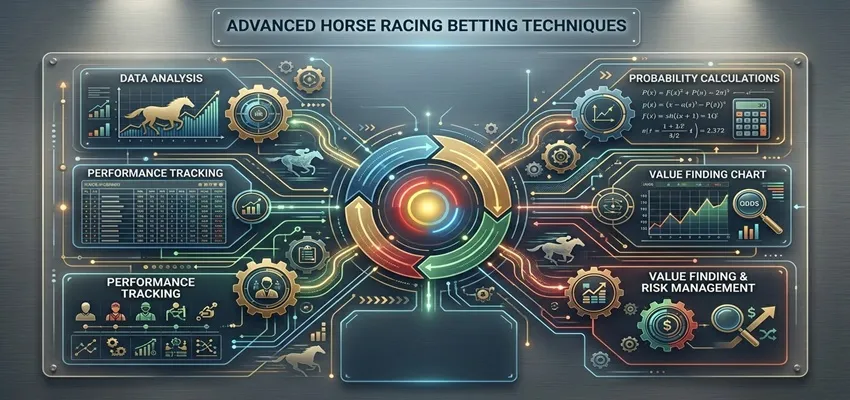
Advanced horse racing betting techniques go beyond basic form analysis and focus on deeper performance indicators. Handicapping methods, for example, help evaluate how different horses perform under specific race conditions, distances, and competition levels. This allows for more accurate predictions in complex races.
Another advanced method involves analyzing speed figures and sectional timing data. These metrics provide a clearer picture of a horse’s actual performance rather than just final results. Combining this with race replay analysis gives bettors a strong competitive edge in identifying hidden potential.
Handicapping Methods Explained
Handicapping is the process of assigning a numerical or qualitative value to each horse to predict their performance. Professional horse racing betting tactics involve creating your own “market” before looking at the bookmaker’s odds. By doing this, you avoid being biased by the crowd’s opinion.
For those interested in diversifying, similar analytical techniques can be applied to other sports, such as those discussed in football or basketball strategies, though the variables differ significantly.
Reading Racecards Like a Pro
A racecard is a wealth of information. Beyond the name of the horse and the jockey, it provides details on age, weight carried, and days since the last run. Mastering the racecard is essential for anyone following a strict horse racing betting guide.
| Racecard Element | Key Question to Ask |
|---|---|
| Age | Is this horse still developing or in their prime? |
| Weight | How does the handicap weight affect this horse? |
| Days Off | Is the horse “fresh” or lacking recent competition? |
| Draw | Is there a bias for inside or outside gates? |
Speed Figures and Data Analysis
In 2026, speed figures are standard in advanced horse racing betting systems. These figures normalize times across different tracks and surfaces, allowing you to compare a horse’s speed in one race to another. This objective data helps remove the guesswork from form analysis.
While data is crucial, remember that speed is not everything. A horse with the fastest speed figure might still lose if they lack the stamina for the distance or if the pace of the race does not suit their running style. Always use these figures as one part of a larger, multifaceted strategy.
🔴 Live Horse Racing Betting Strategies
Live horse racing betting strategies focus on making decisions during the race based on momentum shifts and race dynamics. Watching how a horse breaks from the gate, positions itself, and responds under pressure can provide valuable real-time insights that pre-race analysis might miss.
However, in-play betting requires discipline and quick judgment. Not every race offers clear opportunities, and overreacting to short-term movements can lead to poor decisions. The most effective live bettors wait for clear signals rather than acting on emotion or excitement.
In-Play Betting Opportunities
Live betting, or in-play wagering, is an exciting aspect of modern horse racing. For more information on the nuances of this, check out our live betting guide. The key is to spot moments where a horse’s current performance is better than what the market realizes.
Reading Race Momentum
Watching the race unfold provides insights that pre-race data cannot. You might notice a horse traveling comfortably, pulling clear of the pack, or demonstrating superior acceleration. However, use caution; the excitement of the live race can lead to poor decision-making.
When to Avoid Live Bets
Sometimes, the best horse racing betting tactics involve knowing when to stay away. If a race is too chaotic, the video feed is delayed, or the market is fluctuating too wildly, it is often safer to step back. Remember to use bookmaker reviews to find platforms with the lowest latency on their live feeds to ensure you aren’t at a disadvantage.
💰 Bankroll Management for Horse Racing
Bankroll management is one of the most important parts of long-term success in horse racing betting. Setting a fixed budget and dividing it into controlled stakes helps prevent large losses and keeps betting sustainable. Without proper bankroll control, even strong strategies can fail over time.
A common approach is percentage-based staking, where each bet represents a small portion of the total bankroll. This ensures that losing streaks do not significantly damage overall funds. Consistency in stake sizing is more important than chasing big wins in individual races.

Setting a Smart Betting Budget
Your bankroll is your most precious resource. Never bet money you cannot afford to lose. A solid foundation for any horse racing betting guide is the implementation of strict bankroll management. Please refer to bankroll management for detailed frameworks on how to preserve your capital.
Stake Management Systems
The percentage of your bankroll you wager on each race (the “unit size”) is critical. Whether you use a fixed-unit system or a Kelly Criterion-based approach, consistency is vital. Avoiding the trap of increasing stakes after a loss is essential for long-term survival.
| Stake Strategy | Risk Level | Benefit |
|---|---|---|
| Fixed Unit | Low | Prevents large drawdowns |
| Percentage of Bankroll | Medium | Adjusts to wins/losses |
| Kelly Criterion | High | Theoretically maximizes growth |
Emotional Betting Traps to Avoid
Emotional betting is the primary reason most bettors fail. When you are frustrated by a loss, you may feel the urge to “chase” it by placing larger, unresearched bets. This is a fast track to zeroing out your account. If you feel your emotions taking over, it is time to take a break and reduce risk by stepping away from the screen.
Another important aspect is recognizing emotional triggers before they affect your decisions. Many bettors underestimate how quickly frustration or excitement can override logic, which leads to impulsive betting behavior. Developing a strict, pre-defined strategy and sticking to it regardless of short-term results is the most effective way to stay in control.
⚠️ Common Mistakes in Horse Racing Betting
One of the most common mistakes in horse racing betting is chasing losses after a losing bet. This emotional reaction often leads to larger, more reckless wagers, increasing overall risk rather than recovering losses effectively. Staying disciplined is essential to avoid this cycle.
Another frequent error is overvaluing favorites without considering race context. While favorites win often, they do not always offer value. Ignoring factors such as track conditions, competition strength, and recent form can lead to overconfidence and poor betting decisions.
Chasing Losses
Chasing losses is the most dangerous habit in horse racing betting. It happens when you deviate from your established horse racing betting systems to try to win back money quickly. Always remember that each race is an independent event.
This behavior usually leads to even larger losses because decisions become emotional rather than analytical. The best way to avoid this is to stick strictly to your staking plan and accept that losing streaks are a natural part of betting variance.
Overestimating Favorites
The public often overestimates favorites, leading to “short” odds that do not offer value. In many cases, the favorite is simply not the best bet from a mathematical standpoint. Always compare the odds against your own calculated probability.
Professional bettors often look for value outside the favorite because the market tends to inflate their price due to popularity. By focusing on overlooked runners with stronger underlying metrics, it is often possible to find better long-term betting value.
Ignoring Track Conditions
As mentioned previously, the track surface is a massive variable. A horse that is a champion on dry, hard ground may be useless on a wet track. Checking the “going” should be the first step in your analysis every single day. Ignoring this factor can lead to completely misleading race predictions.
Track conditions can also change rapidly during race meetings, which makes ongoing assessment important rather than a one-time check. Successful bettors always adjust their selections based on real-time ground updates and historical performance on similar surfaces.
❓ Horse Racing Betting FAQs
Is horse racing betting profitable?
Yes, horse racing betting can be profitable if it is approached with discipline, research, and proper bankroll management. Long-term success depends on making value-based decisions rather than emotional or random bets.
What is the best strategy for beginners?
Beginners should focus on a single niche and prioritize value betting instead of betting on every race. This helps build experience while reducing unnecessary risk and improving long-term decision-making.
How do horse racing odds work?
Horse racing odds show the implied probability of an outcome and determine potential returns. For example, decimal odds of 3.00 mean a $1 bet returns $3 in total if successful, including stake.
Where can I find reliable data?
Reliable data can be found on official racing authority websites like the British Horseracing Authority and trusted statistical platforms. These sources provide accurate form, results, and track condition information.
How often should I bet?
You should only bet when there is a clear value opportunity that fits your strategy. Betting too frequently without strong analysis increases risk and reduces long-term consistency.
Are favorites always the best option?
No, favorites are not always the best choice because they are often overbet by the public. In many cases, better value can be found by analyzing other horses in the field.
What is the most important skill for a bettor?
The most important skill is emotional control combined with strict bankroll discipline. Staying consistent and avoiding impulsive decisions is key to long-term betting success.

🏁 Final Thoughts on Horse Racing Strategies
Success in horse racing is a marathon, not a sprint. By utilizing the strategies discussed in this horse racing betting guide, you are positioning yourself ahead of the casual bettor. Continue to refine your methods, utilize the data available at the best betting sites, and always keep your bankroll secure.
Stay objective, keep your emotions in check, and consistently look for value. By applying these horse racing betting tactics, you can improve your decision-making and enjoy a more rewarding experience in the world of horse racing. Remember that the market is always changing, so remaining flexible and curious is the hallmark of a true professional. Consistency in your process will inevitably lead to more sustainable results over the long term. Trust in your data, respect the variance inherent in the sport, and treat every race as a fresh opportunity to apply your expertise.