A 162-game season means a single result tells you almost nothing on its own. Baseball produces more usable data than any other major sport, on pitchers, bullpens, batting orders, ballparks, and weather, and that depth is exactly why baseball betting strategies work best when they are built on repeatable analysis rather than a hot streak or a recognisable name in the lineup.

Football and basketball bettors often lean on team-level form, since a relatively small rotation of players drives most of what happens on the field. Baseball works differently. A single starting pitcher can shift a game’s probability more than almost any individual player in another team sport, which is exactly why baseball betting strategies built around matchup research consistently hold up better than ones built around reputation. Before narrowing in on baseball specifically, it helps to already be comfortable with broader sports betting strategies, since bankroll discipline and value-based thinking apply here just as directly as they do anywhere else.
This guide focuses on the analytical and long-term side of baseball betting: how to analyse baseball bets properly, where value tends to hide in MLB markets, and how disciplined bankroll habits keep a six-month season from wearing down your bankroll faster than it wears down your patience.
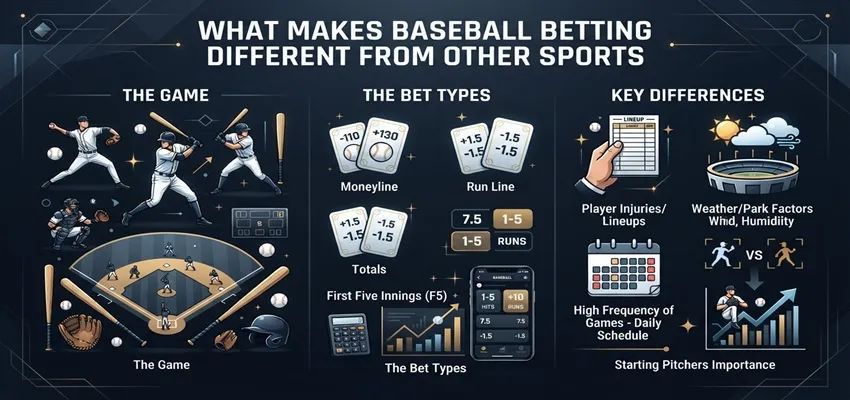
What Makes Baseball Betting Different From Other Sports?
The MLB regular season runs 162 games per team, spread across roughly six months. That length changes how you should think about form. A five-game losing streak that would look alarming in a 38-game football season is a completely normal stretch of variance across a full baseball campaign, and reacting to it as though it means something structural is one of the fastest ways to make a poor decision.
Individual matchups carry unusual weight in baseball. Two starting pitchers effectively set the terms of the game before a single pitch is thrown, and their recent form, pitch mix, and history against the specific lineup they are facing often say more about the likely outcome than either team’s overall record. Bullpen quality adds another layer on top of that, since modern MLB games frequently involve four or five pitching changes, and a shaky relief corps can undo a strong start in a handful of innings.
All of this is why baseball rewards a statistics-driven approach more than most sports. The volume of historical data available on every pitcher, hitter, and ballpark gives bettors who actually use it a genuine research advantage over those who do not.
The length of the MLB season and the weight carried by individual starting pitchers mean baseball betting strategies need to be built around matchup-level analysis rather than team reputation or short-term results.
The Best Baseball Betting Strategies for Long-Term Success
There is no single best baseball betting strategy that fits every bettor, but a handful of shared habits separate those who treat baseball as a long-term exercise from those betting on impulse. None of them are complicated in isolation, but applied consistently across a season, they form the backbone of nearly every durable baseball betting strategy.
Analyse Starting Pitchers Before Placing Bets
Starting pitcher analysis is the foundation almost everything else in this guide sits on top of. ERA gives a broad sense of run prevention, but it is heavily influenced by the defence playing behind a pitcher and by a certain amount of luck on balls in play, so it should never be read in isolation. WHIP, which measures walks and hits allowed per inning pitched, is often a steadier signal of how much traffic a pitcher is likely to allow on the bases, regardless of how those baserunners are eventually stranded or scored.
Strikeout rate and walk rate matter just as much as the headline ERA number. A pitcher missing bats at a high rate while limiting walks is generally more reliable going forward than one riding a low ERA built on weak contact that has not yet caught up with him. Recent starts, ideally the last three to five outings rather than a full season average, tell you far more about current form, particularly if a pitcher is working through a mechanical adjustment or nursing a minor issue that has not been publicly confirmed.
Pitch count and fatigue trends are worth checking too. A starter who has been going deep into games on short rest, or who threw a high pitch count in his last outing, may not have his usual command or velocity available. Matchup history against the specific opponent, particularly against a lineup stacked with hitters who see his fastball well, rounds out the picture before you compare any of it against the odds on offer.
Experienced baseball bettors often analyse pitching matchups before looking at team popularity. Checking who is actually on the mound comes before any opinion about which team “feels” stronger on paper.
Study Lineups and Offensive Matchups
Batting order construction affects how many at-bats a team’s best hitters realistically get in a given game, which matters more in close, low-scoring contests than casual bettors tend to assume. A lineup missing its usual three-hole hitter to injury or rest is a materially different offensive unit, even if the rest of the roster is unchanged.
Platoon splits, which measure how a hitter performs against left-handed versus right-handed pitching, are one of the more underused pieces of information in casual baseball betting analysis. A lineup stacked with right-handed hitters can look significantly stronger or weaker depending on which side the opposing starter throws from. Offensive consistency is worth checking too: some lineups score in bursts and go quiet for stretches, while others produce runs more evenly, and that pattern shapes how reliable a totals bet on that team actually is. Home and away splits close out the picture, since certain offences perform very differently once you account for the ballpark they are playing in that night.
Use Baseball Statistics Instead of Emotions
Advanced metrics exist precisely because traditional stats like ERA and batting average are shaped by factors a pitcher or hitter does not fully control. Baseball’s statistical depth is arguably the richest of any major sport, and bettors who use that depth properly hold a real advantage over those relying on box scores and gut feeling alone.
Sample size discipline matters as much as the metrics themselves. A pitcher’s numbers over his last two starts can look dramatic in either direction purely by chance, and treating a small sample as a settled trend is one of the more common errors in baseball betting analysis. Cross-referencing a short-term number against a full-season or multi-year baseline is usually the difference between spotting a genuine shift and reacting to noise.
| Metric | Why It Matters For Betting |
|---|---|
| ERA | A useful baseline for run prevention, but shaped by defence and batted-ball luck, so it should be cross-checked rather than trusted alone. |
| WHIP | Measures baserunners allowed per inning, often a steadier indicator of sustained pressure than ERA alone. |
| FIP | Strips out fielding and luck, focusing only on outcomes a pitcher directly controls: strikeouts, walks, and home runs. |
| Bullpen ERA | Reflects how reliably a team can protect a lead once the starter exits, which matters heavily in close, late-inning markets. |
| wOBA / OPS+ | Gives a fuller picture of offensive production than batting average, since it accounts for walks and extra-base power. |
| Park Factor | Quantifies how much a specific stadium inflates or suppresses scoring, which directly affects totals markets. |
Finding Value With Baseball Betting Analysis
Reading the right statistics only pays off once you turn that research into an actual comparison against the price a sportsbook is offering. This is where baseball betting analysis moves from theory into a repeatable process. A pitcher’s underlying numbers might point toward a genuine edge, but that edge only means something once it is measured against the actual odds on the board. Treating research and pricing as two separate steps, rather than blending them into a single gut call, is what turns solid analysis into a real baseball betting strategy rather than an interesting observation with no practical outcome.
How To Identify Baseball Value Bets
Baseball value betting means the odds on offer imply a lower probability of an outcome than your own honest research actually supports. Public bettors tend to gravitate toward well-known, big-market franchises regardless of the actual pitching matchup, which can leave mid-week games involving less-followed teams priced more generously than they should be. Comparing the same fixture across two or three sportsbooks before confirming a wager is one of the simplest, most repeatable habits for capturing that value once you have found it. Bettors looking to identify pricing errors can use value betting strategies to compare their own probability estimates against the market before deciding whether a price is genuinely worth taking.
Understanding Baseball Odds and Market Movement
Baseball leans more heavily on the moneyline than most sports, since a straight winner market is simpler to price than a point spread in a game where a single run can decide the outcome. The run line functions as baseball’s version of a handicap, typically set at 1.5 runs, and totals markets reflect the combined runs both teams are expected to score.
Odds shift quickly once a starting lineup or starting pitcher is officially confirmed, sometimes just an hour or two before first pitch, which is why checking a price again close to game time matters more in baseball than in sports where team news is confirmed further in advance. If the maths behind implied probability still feels unfamiliar, it is worth revisiting before comparing prices across sportsbooks.

Advanced MLB Betting Strategies
Once the fundamentals of pitcher and lineup analysis feel familiar, a few additional MLB betting tips separate a solid baseball betting strategy from a genuinely sharp one.
| Factor | What To Check | Betting Impact |
|---|---|---|
| Starting Pitcher | Form, FIP, K%, BB%, pitch count | Early-game win probability |
| Bullpen | Recent workload, ERA, key relievers | Late-game reliability |
| Lineup | Platoon splits, injuries, batting order | Run-scoring potential |
| Opposing Lineup | Recent production, pitcher matchups, handedness | Offensive matchup quality |
| Weather | Wind, temperature, precipitation | Total runs and home runs |
| Ballpark | Dimensions, park factor, roof status | Scoring environment |
| Home / Away Splits | Team performance by venue and pitching side | Situational matchup strength |
| Umpire | Strike zone tendencies, walk and strikeout rates | Pitching and totals markets |
| Market Price | Opening odds, current price, implied probability | Potential betting value |
Analyse Bullpens Before Betting
Bullpen ERA over the past two to four weeks is often more useful than a season-long average, since relief pitching usage shifts constantly with trades, injuries, and workload management. Checking which relievers have actually been available in recent games matters just as much as the raw ERA number, since a bullpen missing its closer or top setup arm for a few days is a meaningfully weaker unit than its full-strength version. Late-inning leverage situations, close games in the seventh inning or later, are exactly where bullpen quality shows up most directly in the final result.
Use Weather and Ballpark Factors
Wind direction and speed have a measurable effect on fly-ball carry, particularly at stadiums known for swirling conditions, where a strong wind blowing out can turn routine fly balls into home runs and push a total well past what the pitching matchup alone would suggest.
Temperature plays a similar role, since warmer air allows the ball to travel further, which is part of why day games in peak summer heat tend to trend toward the over more often than cooler evening starts. Stadium dimensions matter on top of both of these: a park with a short outfield porch inflates power numbers relative to a deep, spacious one, and factoring this in is a core part of any serious baseball betting strategy for totals markets.
Follow Line Movement Carefully
Opening lines are set by oddsmakers based on early models and typically shift as more information arrives, whether that is confirmed lineups, weather updates, or the weight of professional betting activity. A sudden, sharp move usually signals genuinely new information entering the market, while a slower drift often just reflects which side casual bettors are backing more heavily. Distinguishing between the two takes practice, and it still depends on properly understanding betting odds in the first place, since interpreting a shift correctly means knowing exactly what the new price implies before deciding whether it changes anything about your original read.
Line movement should be treated as one more piece of research, not an automatic signal to follow or fade. Blindly copying wherever the market moves without your own analysis behind it removes the exact discipline that makes a baseball betting strategy worth following in the first place.
Baseball Bankroll Management Strategies
The large number of games available on a typical MLB slate creates a genuinely different bankroll challenge than sports with a once-a-week schedule. Unit betting, sometimes called flat staking, involves risking a small, consistent percentage of your total bankroll on every wager, and it is worth building as a habit specifically because that volume of games makes it easy to drift into inconsistent stake sizing without noticing.
Avoiding emotional betting matters just as much here as in any other sport, arguably more so given how often the schedule tempts you to chase a loss from an earlier game with a bigger stake on the next one. Managing volume responsibly usually means being selective rather than betting every game simply because the option exists, since a handful of well-researched wagers each night consistently outperforms a scattershot approach across an entire slate. Building solid bankroll management strategies around unit sizing is worth doing early, before the volume of a full MLB season has a chance to erode a looser approach.
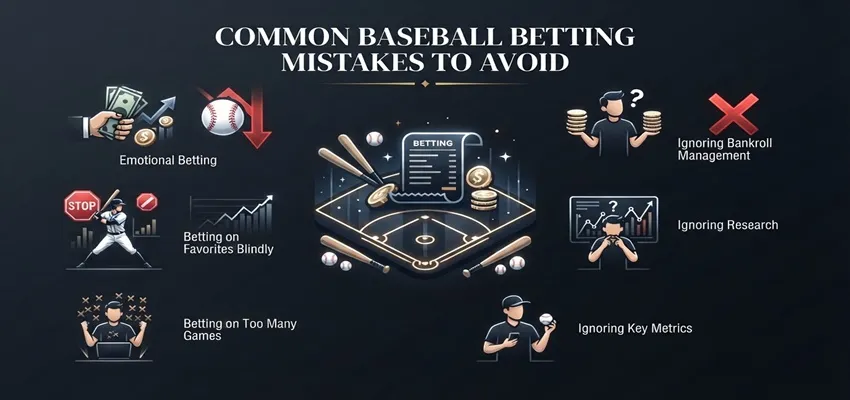
Common Baseball Betting Mistakes To Avoid
A handful of avoidable errors show up again and again in baseball betting, regardless of how long someone has followed the sport.
- Betting on a team’s reputation or market size rather than the actual pitching matchup in front of you
- Ignoring a late change to the starting pitcher or lineup that shifts the entire probability of the game
- Overreacting to a short losing or winning streak that falls well within normal statistical variance
- Chasing losses by increasing stake size on the next available game rather than sticking to a plan
- Varying bet size inconsistently from game to game instead of following a fixed staking rule
Most of these mistakes trace back to impatience rather than a lack of baseball knowledge, and avoiding them is one of the simplest baseball betting tips a bettor can apply straight away. Bettors who understand the sport well can still lose value consistently if they skip the process discipline covered throughout this guide.
How Baseball Betting Strategies Connect With Smart Betting
Everything covered in this guide, pitcher analysis, bullpen evaluation, ballpark factors, and disciplined staking, sits on top of the same foundation that applies to sports betting generally: research replacing guesswork, probability replacing gut feeling, and a long-term view replacing a bet-by-bet judgment of your own process. Baseball simply enforces that discipline more strictly than most sports, since its long season gives variance plenty of room to punish anyone treating a single result as proof their approach is right or wrong. The same principles behind smart betting strategies, research, bankroll discipline, and honest record keeping apply across every sport, not just baseball.
Recommended Betting Sites For Baseball Markets
Not every sportsbook covers baseball with the same depth. Competitive MLB odds on the moneyline, run line, and totals are the starting point, but market breadth matters just as much once you get comfortable with the fundamentals covered here; first-five-inning lines, player props, and season-long futures all add ways to apply the same research to different bet types. Live, in-play betting is worth checking too, since baseball’s pace lends itself well to reacting to a change in pitching or a shift in momentum as it happens.
Reliable payment methods and a track record of on-time payouts round out what separates a genuinely useful sportsbook for baseball from one that simply lists the sport without supporting it properly. The strongest baseball betting sites tend to stand out on exactly these points: competitive odds, deep market coverage, and a consistent track record of reliability across the leading operators.
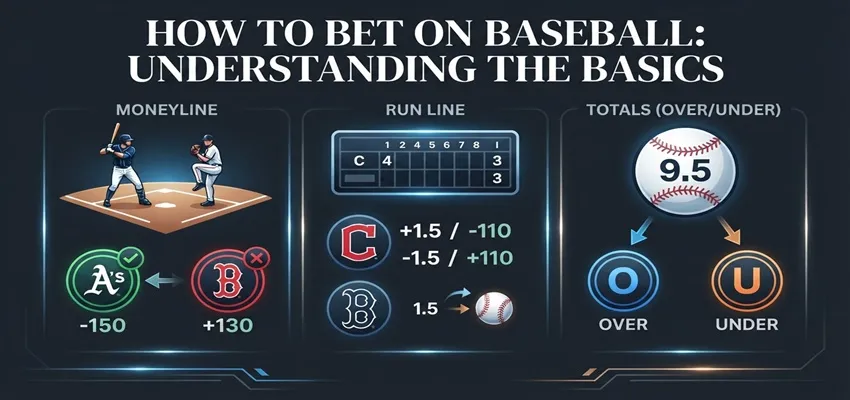
How To Bet On Baseball: Understanding The Basics
Everything in this guide assumes you are already comfortable with how a baseball bet actually gets placed, moneylines, run lines, totals, and how MLB odds are typically displayed. It also assumes you already know how to register with a licensed sportsbook, fund an account, and read a standard bet slip before confirming a wager. None of the strategy covered above works as intended if those basic mechanics still feel unfamiliar.
If any of that still feels unfamiliar, how to bet on baseball covers the practical side of baseball betting basics and market mechanics before you apply any of the strategy covered here. It walks through setting up an account, reading MLB odds in decimal, fractional, or American formats, and placing a first wager step by step. Working through it first means the strategy covered in this guide will make far more sense once you come back to it.

FAQs About Baseball Betting Strategies
What are the best baseball betting strategies?
The most reliable baseball betting strategies combine starting pitcher analysis, bullpen evaluation, and disciplined bankroll management rather than relying on team reputation. Comparing odds across sportsbooks and tracking metrics like FIP and wOBA over a full season beats chasing a single big win. No strategy guarantees profit, but research paired with unit-based staking comes closest.
How do experienced bettors analyse MLB games?
Experienced baseball bettors start with the starting pitching matchup, checking recent form, strikeout and walk rates, and history against the opposing lineup. They layer in bullpen reliability, weather, and ballpark factors before comparing the resulting probability against the odds on offer, rather than picking a favourite on reputation alone.
Which baseball statistics are most important for betting?
ERA, WHIP, and strikeout-to-walk ratio are useful starting points, but FIP and xFIP often predict future performance more reliably since they strip out defensive and luck-based variance. wOBA and OPS+ give a clearer offensive picture than batting average, and bullpen ERA matters just as much in late-inning situations.
How important are starting pitchers in baseball betting?
Starting pitchers carry more individual influence over a game’s outcome than almost any player in another major sport, since they control a large share of the innings played and shape run-scoring opportunities directly. Checking the pitching matchup before anything else separates informed baseball bettors from casual ones.
Can baseball betting strategies be profitable long term?
Baseball betting strategies can support long-term profitability, but no approach guarantees it. Profitability tends to come from consistently finding value, comparing odds across sportsbooks, and applying disciplined bankroll rules across hundreds of bets, not judging results after a single week or series.
What is the safest baseball betting market?
The moneyline is generally the most straightforward baseball market, since it only requires picking the outright winner without a run line or total attached. That said, “safest” does not mean guaranteed, and heavy favourites can still be poor value if the price does not reward the risk.
How do you find value bets in baseball?
Finding value means comparing the odds on offer against your own honest estimate of a team’s true winning probability, built from pitching matchups and bullpen form rather than reputation. Public bias toward big-market franchises often creates mispriced lines on less-followed teams, particularly in mid-week games.
Should you bet MLB games every day?
Betting every MLB game simply because the schedule allows it is a common mistake. Disciplined bettors are selective, passing on matchups where the pitching or lineup information is unclear, and treat each night’s slate as a chance to find a small number of well-researched bets rather than an obligation.
What mistakes should baseball bettors avoid?
The most common mistakes include betting on reputation rather than the pitching matchup, ignoring late lineup changes, and reacting to a short losing streak by abandoning a sound process. Chasing losses with bigger stakes and varying bet sizes inconsistently also erodes results over a full season.
Are baseball betting systems reliable?
Baseball betting systems can add useful structure around staking and bet selection, but no system removes the need for genuine research or guarantees a profit. Systems built purely around streaks or reputations tend to break down over a large sample, once baseball’s variance exposes any approach without real analytical grounding.
Final Thoughts on Baseball Betting Strategies
Baseball rewards patience more than almost any other sport you can bet on. The strategies covered throughout this guide, starting pitcher analysis, bullpen evaluation, ballpark and weather factors, and disciplined bankroll management, all point toward the same underlying idea: informed, research-driven baseball betting strategies consistently outperform decisions based on reputation or a hunch.
None of this removes variance from a 162-game season, and no strategy can responsibly promise guaranteed profit. What a genuine baseball betting strategy offers instead is a sturdier process, one built to hold up across hundreds of decisions rather than to explain away a single bad week or celebrate one lucky result as proof of skill. Discipline, research, and a willingness to judge yourself over a full season rather than a single series separate bettors who sustain this approach from those who abandon it after a rough month.
If betting ever stops feeling like entertainment and starts feeling difficult to manage, free and confidential support is available through GamCare. This independent UK charity runs the National Gambling Helpline.