A bonus that looks generous on the promo banner can still be worth very little once you read the fine print attached to it. That fine print is almost always built around wagering requirements, the single factor that decides whether bonus funds ever turn into real, withdrawable cash or simply expire untouched in your account. Understanding wagering requirements properly is the difference between claiming a bonus that genuinely adds value and signing up for one that was never realistically clearable in the first place.

This guide breaks down exactly how wagering requirements work, how to calculate what a specific offer will actually cost you in turnover, and which wording in a bonus policy should make you pause before you deposit. None of this requires a finance degree. It requires knowing which numbers to look at and which ones operators hope you skip past.

What Are Wagering Requirements?
Wagering requirements, also called rollover requirements or playthrough requirements depending on the operator, are the number of times you must bet through a bonus amount before you can withdraw any resulting winnings. A bonus is not free money the moment it lands in your account. It is conditional credit that only converts into real balance once you have wagered through it the number of times stated in the terms.
If a sportsbook credits you with a £50 bonus and attaches a 5x wagering requirement, you need to place a total of £250 in qualifying bets before you can withdraw anything derived from that bonus. This applies whether you are up, down, or breaking even when you hit that £250 turnover figure.
Wagering requirements exist for one straightforward business reason. Without them, a bettor could claim a bonus, place a single low-risk bet, and withdraw the winnings immediately, turning every promotion into a guaranteed loss for the operator. The requirement forces genuine engagement with the platform before bonus funds convert into cash a player can actually take out.
Bettors who are unsure about terms like rollover or playthrough can check the betting glossary for a full rundown of the vocabulary used across bonus and market terms.
Wagering requirements are not a penalty. They are the mechanism that makes bonus offers financially possible for operators to run in the first place. The number attached to a specific offer is what tells you whether it is a genuinely useful bonus or a headline figure dressed up to look better than it is.
Wagering Requirements vs Turnover Requirements
These terms get used interchangeably across the industry, and different operators simply favour different wording in their promotional terms without meaning anything different by it. A wagering requirement usually refers to the multiplier itself, the 5x or 10x figure attached to a bonus, while turnover, sometimes called rollover, describes the actual total amount that must be staked to satisfy that multiplier. In practice, clearing a wagering requirement and completing a turnover requirement are the same task described from two different angles: one names the rule, the other names the total you are working toward.
How Do Wagering Requirements Work?
Every wagering requirement is expressed as a multiplier, most commonly written as 3x, 5x, 10x, or higher, next to a base amount. The multiplier tells you how many times that base amount needs to be wagered before withdrawal becomes possible. What differs between operators, and what matters enormously to how achievable an offer actually is, is what that base amount includes.
There are two structurally different models in use across the industry, and mixing them up is one of the most common ways bettors misjudge how good an offer really is.
Bonus-Only Wagering Requirements
Under a bonus-only model, the wagering requirement applies strictly to the bonus amount itself, not to the deposit that triggered it. If you deposit £100 and receive a £100 bonus with a 5x wagering requirement, you need to wager £500 in total, calculated purely against the bonus, before the bonus-related winnings unlock.
This is the more player-friendly version of the two, since your original deposit is typically available to withdraw at any point, separate from the wagering requirement attached to the bonus portion.
Bonus Plus Deposit Wagering Requirements
A bonus plus deposit model calculates the wagering requirement against the combined total of your deposit and the bonus. Using the same £100 deposit and £100 bonus example, a 5x wagering requirement here applies to £200, not £100, meaning you would need to wager £1,000 in total rather than £500.
This version looks identical on the promo banner, since both might advertise “5x wagering requirement,” but the actual turnover required is double. This is exactly why the headline multiplier alone tells you very little without knowing which base amount it is calculated against.
| Wagering Model | Base Amount | 5x Wagering Requirement | Total Turnover Needed |
|---|---|---|---|
| Bonus-only | £100 bonus | 5 × £100 | £500 |
| Bonus plus deposit | £100 deposit + £100 bonus | 5 × £200 | £1,000 |
| Deposit-only | £100 deposit | 5 × £100 | £500 |
| Deposit plus percentage bonus | £100 deposit + £50 bonus | 5 × £150 | £750 |
Never compare two wagering requirements by their multiplier alone. A 3x bonus-plus-deposit offer can require more total turnover than a 5x bonus-only offer on the same deposit size. Always check which base amount the multiplier is applied to before deciding which offer is genuinely better.
How to Calculate Wagering Requirements
Working out the real cost of clearing a wagering requirement is simple arithmetic once you know the formula, but it is a step most bettors skip entirely, usually right up until they try to withdraw and find their balance is still locked.
Wagering Requirement Formula = Total Turnover Needed = Wagering Multiplier × Base Amount
The base amount depends on whether the offer is bonus-only or bonus-plus-deposit, as covered above. Once you know the total turnover figure, you can compare it against how much you would realistically bet over the period the bonus stays active, which is usually somewhere between seven and thirty days.
| Bonus Amount | Wagering Requirement | Base | Total Turnover Needed | Average Stake Needed Over 14 Days |
|---|---|---|---|---|
| £25 | 3x | Bonus only | £75 | £5.36 per day |
| £50 | 5x | Bonus only | £250 | £17.86 per day |
| £75 | 6x | Bonus only | £450 | £32.14 per day |
| £100 | 8x | Bonus plus deposit (£200) | £1,600 | £114.29 per day |
| £150 | 8x | Bonus plus deposit (£300) | £2,400 | £171.43 per day |
| £200 | 10x | Bonus plus deposit (£400) | £4,000 | £285.71 per day |
The final column is the number that matters most in practice. A £200 bonus with a 10x bonus-plus-deposit wagering requirement sounds attractive as a headline figure, but it demands nearly £286 in daily turnover to clear inside a typical two-week window, a level most casual bettors will never realistically reach without changing their normal staking habits. Skipping this calculation entirely and judging an offer by its headline size alone is one of the common betting mistakes that quietly costs bettors real value.
The size of the bonus tells you nothing on its own. Divide the total turnover figure by the number of days you have to clear it, and compare that daily number against how much you actually bet in a normal week. If the daily figure is unrealistic for your usual staking pattern, the bonus is unrealistic too, regardless of how large the headline number looks.
Minimum Odds Requirements Explained
Wagering requirements rarely apply to every bet you place. Most bonus terms also carry a minimum odds requirement, meaning only bets placed at or above a specified price count toward clearing the wagering requirement. This figure is typically set somewhere between 1.50 and 2.00 in decimal odds.
Betting below that threshold, even if the bet wins, usually means the stake still counts toward your account activity but does not progress your wagering requirement at all. This detail catches out bettors who prefer backing short-priced favourites, since a 1.20 shot winning repeatedly can leave a wagering requirement almost untouched despite a healthy amount of turnover on the account.
Converting between decimal, fractional, American, and Hong Kong prices is covered in full in the betting odds guide, along with how to work out the implied probability behind any qualifying bet.
| Odds Format | Example Price | Meets a Typical 1.50 Minimum? |
|---|---|---|
| Decimal | 1.30 | No |
| Decimal | 1.80 | Yes |
| Fractional | 1/3 (equivalent to 1.33) | No |
| Fractional | 4/5 (equivalent to 1.80) | Yes |
| American | -300 (equivalent to 1.33) | No |
| American | +150 (equivalent to 2.50) | Yes |
| Hong Kong | 0.30 (equivalent to 1.30) | No |
| Hong Kong | 0.80 (equivalent to 1.80) | Yes |
Qualifying Bets and Excluded Markets
Beyond the odds threshold, wagering requirements often restrict which markets, sports, or bet types actually count. A promotion might state that only pre-match sports bets qualify, excluding live betting entirely, or that only a single sport counts toward the requirement while every other market on the platform is excluded.
| Bet Type | Commonly Qualifies? | Notes |
|---|---|---|
| Pre-match single bets | Usually yes | The most common qualifying bet type |
| Accumulators/parlays | Sometimes | Often requires a minimum number of legs |
| Live / in-play bets | Frequently excluded | Check terms specifically before assuming it counts |
| Casino games | Rarely | Usually excluded unless it is a casino-specific bonus; contribution percentages may also be reduced |
| Cash-out bets | Frequently excluded | Cashing out early can void the qualifying status of a bet |
| Same-event multiples | Often excluded | Correlated selections are commonly blocked |
| Each-way bets | Sometimes | Some offers count only the qualifying portion of the stake |
| System bets | Sometimes | May be excluded or subject to specific minimum stake and odds conditions |
| Free bets | Usually no | Free bets generally do not count toward wagering requirements unless the promotion explicitly says otherwise |
Reading which specific bet types qualify before you start betting is worth the two minutes it takes, since placing £200 in stakes on excluded markets does nothing to move a wagering requirement forward, no matter how much action you have generated on the account.

Wagering Requirements by Bonus Type
Different categories of betting bonus carry meaningfully different wagering requirement structures, and lumping them all together is a common mistake when comparing offers.
Welcome Bonus Wagering Requirements
Depending on the operator and promotion type, welcome bonus wagering requirements can range from relatively low multipliers up to 40x or higher on the more aggressive offers. A 3x to 8x wagering requirement paired with fair minimum odds and a realistic expiry window is generally what separates reasonable welcome bonuses from offers that only look generous on the surface, and anything above 20x should be treated with real caution regardless of the headline bonus size.
No Deposit Bonus Wagering Requirements
No deposit bonuses, which credit a small amount simply for registering, tend to carry higher wagering requirements than deposit-based offers. Depending on the operator, these can range from around 30x up to 50x or higher, usually alongside a low maximum withdrawal cap. Operators use steeper wagering requirements here specifically because no deposit was ever placed, so the offer carries no financial commitment from the player to offset against.
Free Bet Wagering Requirements
Free bets work slightly differently from cash bonuses. Rather than requiring turnover on the free bet itself, most operators only pay out the net winnings from a free bet, excluding the original stake, and this portion may or may not carry an additional wagering requirement before it becomes withdrawable. Always check whether winnings from a free bet are paid as cash or as further bonus funds, since the latter usually reintroduces a fresh wagering requirement.
Cashback Wagering Requirements
Cashback offers, which return a percentage of net losses over a set period, are typically credited as bonus funds rather than cash. Depending on the operator, a wagering requirement in the region of 1x to 5x usually still applies before that returned amount can be withdrawn. A cashback offer with no wagering requirement attached is genuinely rare and worth prioritising over a larger one with strings attached.
| Bonus Type | Typical Wagering Requirement | Key Consideration |
|---|---|---|
| Welcome bonus | 3x to 40x | Check whether the requirement applies to the bonus, deposit, or both, as well as any minimum odds |
| No deposit bonus | 30x to 50x+ | Usually comes with a capped withdrawal amount and stricter qualifying conditions |
| Free bet | Stake excluded from winnings | Check whether the winnings are paid as cash or subject to further bonus conditions |
| Cashback | 1x to 5x | Often one of the more achievable wagering requirements, but check how losses and cashback are calculated |
| Reload bonus | 3x to 10x | Usually mirrors welcome bonus terms at a smaller scale |
What Counts As a Low Wagering Requirement?
There is no universal cutoff, but industry patterns give a reasonable working scale for judging whether a wagering requirement is genuinely achievable or effectively a marketing figure that few players will ever clear. As a general rule, the lower the multiplier and the total turnover figure it produces, the easier a wagering requirement is to assess and potentially complete within normal betting activity.
| Wagering Requirement | General Classification | Realistic for Most Bettors? |
|---|---|---|
| 1x to 3x | Low | Yes, clearable within normal betting activity |
| 4x to 8x | Moderate | Yes, achievable with consistent staking |
| 9x to 15x | High | Only for regular, higher-volume bettors |
| 16x to 30x | Very high | Difficult without significantly increasing normal stake size |
| 30x+ | Extreme | Rarely cleared by casual bettors regardless of bonus size |
A low wagering requirement paired with a modest bonus amount is almost always a better practical offer than a large bonus buried under a 30x or higher requirement. The smaller number you can actually clear beats the larger number you almost certainly cannot.
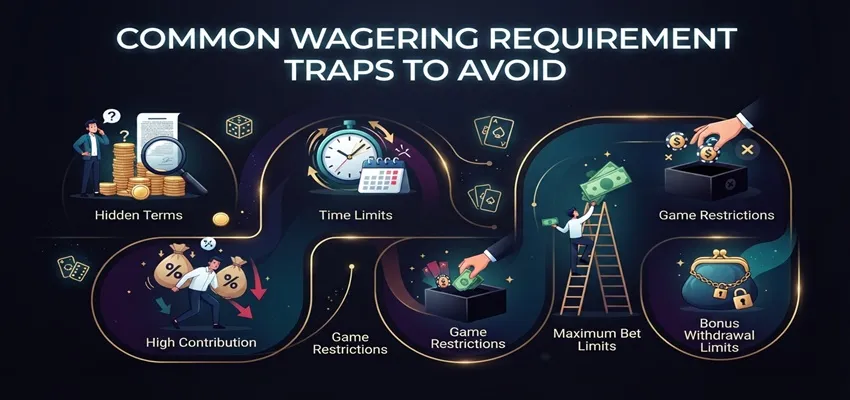
Common Wagering Requirement Traps to Avoid
Most disappointment around bonus offers traces back to a handful of recurring patterns rather than genuinely deceptive operators. Knowing what to look for takes the guesswork out of reading a bonus policy.
| Trap | Why It Costs You | How to Avoid It |
|---|---|---|
| Confusing bonus-only with bonus-plus-deposit | Doubles or triples the real turnover needed | Check exactly which base amount the multiplier applies to |
| Ignoring the minimum odds requirement | Bets on short-priced favourites do not progress the requirement | Confirm the minimum price threshold before betting |
| Missing the expiry window | Unused bonus funds are forfeited once the deadline passes | Note the exact expiry date the moment a bonus is credited |
| Betting on excluded markets | Turnover on those bets does not count at all | Check the list of qualifying sports and bet types first |
| Assuming free bet winnings are pure cash | Winnings may be paid as further bonus funds with a new requirement attached | Read whether payouts are cash or bonus credit |
| Withdrawing before the requirement is cleared | Can void the remaining bonus and any related winnings | Wait until the requirement is fully met before requesting withdrawal |
Some operators reserve the right to void winnings entirely if they detect patterns associated with bonus abuse, such as betting on both outcomes of the same match purely to clear a wagering requirement risk-free. Reading the full terms is also one of the easiest ways to avoid unreliable operators and scam betting sites, since a policy that keeps shifting after you have opted in is a warning sign worth taking seriously on its own.
How to Approach Wagering Requirements Safely
Approaching a wagering requirement sensibly comes down to matching your normal betting pace against the total turnover figure, not changing your entire staking approach overnight just to chase a deadline. Before claiming any bonus, make sure the operator clearly explains its promotion terms, withdrawal conditions, and wagering rules, since this is exactly the kind of detail covered in the wider checklist for trusted betting platforms worth working through before you deposit.
- Calculate the daily target first. Divide total turnover needed by the number of days remaining before the bonus expires, so you know exactly what pace is required.
- Stick to markets you already understand. Betting on unfamiliar sports purely to hit a wagering requirement faster tends to produce worse results than betting normally on markets you already follow.
- Confirm the minimum odds threshold before every bet. A bet placed below the minimum price does nothing for your wagering requirement, however much you stake on it.
- Spread stakes rather than committing everything in one go. A single large bet that loses can derail a bankroll faster than the same total spread across several smaller, considered wagers.
- Track your progress against the requirement. Most platforms show a live wagering requirement counter in the account section, and checking it regularly avoids surprises close to the expiry date.
- Avoid excluded bet types entirely. Live betting, cash-out bets, and certain accumulators are the most commonly excluded categories, and betting on them wastes both stake and time.
If a wagering requirement looks genuinely unreachable within the time given, it is often better to skip the offer entirely rather than force unnatural staking patterns just to chase it. A bonus is only valuable if clearing its wagering requirement fits comfortably inside how you already bet.
Wagering Requirements Calculator: Do the Math Before You Deposit
Working through the formula manually is straightforward for a single offer, but comparing several bonuses side by side gets tedious fast once minimum odds, expiry windows, and base amounts all differ between operators. A wagering requirement calculator built specifically for this sits inside the betting calculators section, letting you enter the bonus amount, the multiplier, and the base type to get an instant total turnover figure rather than working it out by hand every time.
Running two or three shortlisted offers through a calculator before depositing takes a couple of minutes and consistently prevents the more common mistake of judging a bonus purely by its headline size.

How to Compare Bonus Terms Before Claiming an Offer
Wagering requirement structures vary meaningfully between operators, even on offers that look similar at first glance. The table below illustrates how differently the same style of welcome offer can be structured once every term is laid out side by side.
| Factor | Example Offer 1 | Example Offer 2 | Example Offer 3 |
|---|---|---|---|
| Welcome Bonus | e.g. 100% up to £100 | e.g. 100% up to £150 | e.g. 150% up to £200 |
| Wagering Requirement | e.g. 5x bonus only | e.g. 8x bonus plus deposit | e.g. 10x bonus only |
| Minimum Odds | e.g. 1.50 | e.g. 1.80 | e.g. 1.40 |
| Expiry Window | e.g. 14 days | e.g. 30 days | e.g. 7 days |
| Excluded Markets | e.g. Live betting | e.g. Live betting, cash-out | e.g. None specified |
| Eligible Bet Types | e.g. Singles and accumulators | e.g. Singles only | e.g. Singles and selected multiples |
| Maximum Withdrawal | e.g. No stated cap | e.g. 10× bonus amount | e.g. £500 maximum |
| Bonus Cap | e.g. £100 | e.g. £150 | e.g. £200 |
Example Offer 3 advertises the largest bonus of the three, but a 7-day expiry window against a 10x wagering requirement demands considerably faster turnover than Example Offer 2’s more generous 30-day window on a smaller bonus. This is exactly why comparing headline bonus size alone, without checking the full wagering requirement structure behind it, regularly leads bettors to the wrong conclusion about which offer is actually best. A wagering requirement is also only half the picture, since a generous bonus attached to an unreliable operator is rarely worth the trade-off, which is exactly what the wider checklist in how to choose a betting site is built to catch before you commit to any single offer.
Responsible Use of Bonus Offers
Wagering requirements exist within a betting activity that should always be treated as entertainment rather than a source of income. Chasing a wagering requirement by increasing stakes beyond your normal comfort level, purely to unlock bonus funds before an expiry date, is one of the more common ways a bonus offer ends up causing more harm than value.
Set a budget before claiming any bonus, treat the wagering requirement as a target to meet through your normal betting activity rather than a reason to bet more than planned, and use deposit or loss limits if a platform offers them. Organisations such as BeGambleAware provide free, confidential support if betting activity, bonus-driven or otherwise, starts to feel less like entertainment and more like something difficult to step back from.

Final Verdict on Wagering Requirements
A bonus is only as good as the wagering requirement attached to it. The headline percentage or dollar figure on a promotional banner tells you almost nothing on its own, while the multiplier, the base amount it applies to, the minimum odds threshold, and the expiry window together tell you the entire real story.
Before claiming any offer, run the numbers: calculate total turnover needed, divide it by the days available, and compare that daily figure honestly against how you actually bet. A modest bonus with a fair, low wagering requirement will almost always outperform a larger one buried under aggressive terms, and knowing the difference between the two is what separates bettors who get genuine value from promotions and those who never see a single pound of bonus funds convert into real, withdrawable cash. Comparing the full range of trusted betting sites side by side is a sensible next step before deciding where to claim one.
FAQs About Wagering Requirements
What are wagering requirements?
Wagering requirements are the number of times a bettor must wager through a bonus amount, or a bonus plus deposit combined, before any resulting winnings become eligible for withdrawal. They are expressed as a multiplier such as 5x or 10x next to the relevant base amount.
How do wagering requirements work in practice?
A wagering requirement works by multiplying a base amount, either the bonus alone or the bonus plus the triggering deposit, by the stated multiplier to produce a total turnover figure. Only qualifying bets placed at or above the minimum odds requirement count toward reaching that figure.
What is considered a good wagering requirement?
A wagering requirement between 1x and 8x is generally considered achievable for most bettors within a typical expiry window. Anything above 20x is difficult to clear without significantly changing normal staking habits, regardless of how large the bonus itself is.
How do you calculate a wagering requirement?
Multiply the wagering requirement multiplier by the correct base amount, either the bonus alone for a bonus-only offer or the combined bonus and deposit for a bonus-plus-deposit offer, to get the total turnover figure required before withdrawal becomes possible.
Do losing bets count toward wagering requirements?
In most cases, qualifying losing bets still count toward a wagering requirement because progress is based on the total amount staked rather than whether a bet wins or loses. However, the exact contribution rules depend on the promotion terms.
Do all bets count toward a wagering requirement?
No. Most operators exclude live bets, cash-out bets, and bets placed below a minimum odds threshold from counting toward a wagering requirement, even if those bets are otherwise placed using bonus funds.
What happens if a wagering requirement is not cleared in time?
Unused bonus funds and any related winnings are typically forfeited once the expiry window passes, regardless of how close the account was to meeting the wagering requirement at that point.
Can you withdraw money before a wagering requirement is cleared?
Usually not the bonus portion. Requesting a withdrawal before a wagering requirement is fully met can void the remaining bonus funds and any winnings generated from them, depending on the operator’s specific terms.
What is a reasonable time limit for clearing a wagering requirement?
Windows of fourteen to thirty days are common and generally considered fair. A short window, such as seven days, paired with a high wagering requirement is a combination worth checking closely before claiming the offer.
Are low wagering requirement bonuses always the better choice?
Usually, yes, provided the bonus amount is not reduced so significantly that it offsets the benefit. A modest bonus with a low, clearable wagering requirement typically delivers more real value than a larger bonus with a wagering requirement few bettors will ever finish.