Picking the team you expect to win an NFL game is the easy part. Turning that opinion into a wager worth making is where many bettors can lose money without understanding why. American football betting strategies exist to close that gap. They push a bettor past gut instinct and into a process built on matchup analysis, statistical evidence, and an honest read of the price on offer.

That distinction matters more in American football than in most sports. A single game carries dozens of moving parts, offensive personnel, defensive scheme, weather, rest, and injury status, that shift from week to week. A team that looked dominant in September can look ordinary by November once its schedule, health, and matchups change. This piece assumes you’re already comfortable with the basics of placing a wager. If you need a refresher on account setup and bet types first, our guide on how to bet on American football covers that ground separately.
What follows is how experienced bettors actually approach an NFL matchup: practical NFL betting tips, what to research beforehand, how to read each major market, how to judge whether a price offers real value, and how to manage a bankroll so one bad week doesn’t undo months of disciplined betting.
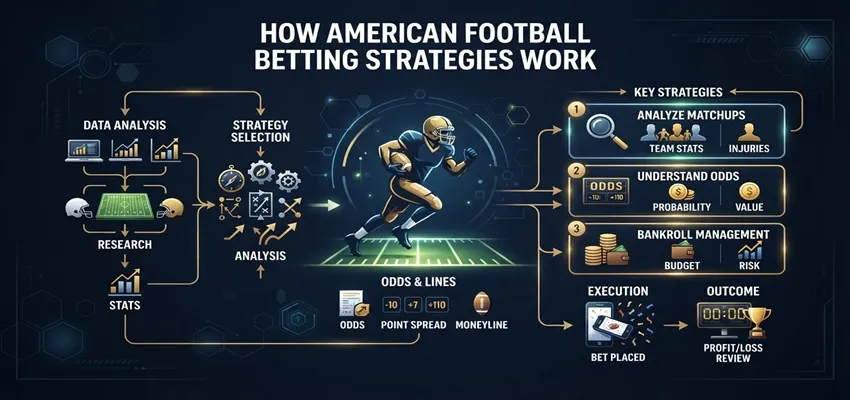
How American Football Betting Strategies Work
There’s a real difference between predicting an outcome and identifying a bet worth making, and confusing the two is probably the biggest reason casual bettors struggle to turn a profit. Predicting an outcome asks one question: who wins? Betting strategically asks a second, more useful one: at this price, does backing that outcome make sense?
A heavily favored team can still be a poor bet if the odds have been priced too aggressively around public expectation. A struggling team coming off two bad losses can still be a value if the market has overreacted to a small sample of games. American football betting strategies are built around comparing your own read of a game’s true probability against the odds a sportsbook is offering, and betting only when a gap exists between the two. This same value-first logic underpins sports betting strategies across every major sport, but American football’s mix of weekly matchups and deep statistical profiles makes NFL betting strategies especially worth applying with consistency.
A bettor who picks winners on reputation or recent headlines will win some weeks and lose others with no real explanation for either. A bettor who compares probability against price, week after week, at least has a framework to review afterward: was the process sound, even if a particular game didn’t break the right way?
Research the Teams Before Betting
Recent Form and Performance
A win-loss record can mislead on its own. Two teams can enter a game with identical records built through very different paths, one through close wins over strong opponents, the other through blowouts against weak ones. Looking past the record into margin of victory, opponent quality, and whether performance has trended up or down over the last three or four games gives a clearer picture than the season total.
Home and Away Performance
Home and away splits can reveal differences that season-long averages may hide. Some teams rely on crowd noise and a familiar environment to disrupt opposing offenses, and their road form can look noticeably weaker as a result. Others run schemes that travel well regardless of venue. Comparing offensive and defensive numbers home versus away often reveals patterns a season-long average hides.
Strength of Schedule
A team averaging 27 points a game against struggling defenses is not the same proposition as one averaging 24 against elite competition. Strength of schedule adjusts raw numbers for the quality of opposition faced, and ignoring it is one of the fastest ways to overrate a team purely because its stats look impressive in isolation.
Injuries and Player Availability
Few factors move a line as fast as a confirmed injury to a starting quarterback or a key pass rusher. Checking the latest official injury report and practice participation before finalizing a wager matters, since a backup quarterback or a depleted offensive line can change a matchup’s entire complexion regardless of how both teams have performed all season.
Analyze Offensive and Defensive Matchups
Team-level stats only tell part of the story. How one team’s strengths interact with the other’s weaknesses is often where the real edge in American football betting sits.
Passing Matchups
An efficient passing offense facing a defense that struggles against the pass creates a different expectation than the same offense facing a strong secondary. Comparing passing efficiency, yards per attempt, and red-zone passing success against the opponent’s pass defense rankings in those same categories highlights where a game is likely to be decided.
Rushing Matchups
Rushing matchups tend to matter most in games expected to be low-scoring or played in poor weather, where establishing the run controls tempo and limits the opposing offense’s number of possessions. A strong rushing attack against a defense that consistently allows a high yards-per-carry average is worth weighing heavily, particularly for totals markets.
Offensive Line and Defensive Pressure
Sack rate and pressure rate are underused in pre-game analysis. An offensive line that struggles to protect the quarterback against a defense generating above-average pressure creates real risk of turnovers and stalled drives, both of which affect spread and totals markets more than casual bettors tend to account for.
Turnovers and Field Position
Turnover margin is volatile week to week, but the tendencies behind it, a defense that forces fumbles at an unusually high rate, or a quarterback prone to costly interceptions under pressure, are worth tracking. Field position compounds the effect: a team that regularly starts drives deep in its own territory faces a structurally harder path to scoring than one starting near midfield.
Study American Football Betting Markets
Each major NFL market rewards a slightly different type of analysis, and treating them all the same way is a common mistake.
Each major NFL market rewards a slightly different type of analysis, and treating them all the same way is a common mistake. Understanding how each market works is one of the most useful American football betting tips for bettors comparing different ways to approach an NFL game.
| Market | What You Bet On | What to Check |
|---|---|---|
| Moneyline | Which team wins outright? | Compare the available odds for each team |
| Point Spread | Will a team win or lose by more than the posted spread? | Check the spread and the odds attached to each side |
| Over/Under | Will the combined score be above or below the total? | Check the posted total and the odds for over or under |
| Player Props | How will a specific player perform? | Check the player’s statistical line and available odds |
| Parlays | Will multiple selections all win? | Check every leg before confirming the combined wager |
Moneyline Strategy
Moneyline betting asks a simple question: which team wins outright, but the strategic value comes from finding underdogs the market has priced too pessimistically. For bettors making American football bets, the key is to judge the price rather than simply backing the team they expect to win. A team facing a short week, a tough travel schedule, or a run of unfavorable matchups can see its moneyline price inflate beyond what its actual chances justify.
Point Spread Strategy
The spread is designed to narrow the perceived gap between the two teams, making the margin of victory central to the wager. A three-point spread implies a far closer game than a fourteen-point spread. Comparing how a matchup’s underlying stats line up against that number, rather than simply picking the team you like, is the core of spread strategy. Key numbers, particularly three and seven points given how many NFL games are decided by a field goal or a touchdown, deserve extra attention when a spread sits close to them.
Spreads sitting near three or seven points deserve extra scrutiny, since more NFL games are decided by exactly those margins than any other final score difference.
Over/Under Strategy
Totals betting rewards thinking in terms of pace and efficiency rather than which team is stronger. A game between two fast-tempo, defensively shaky teams points toward the over, while two ball-control offenses facing strong defenses points toward the under, regardless of who’s favored to win outright. NFL totals also respond heavily to weather, with wind in particular having an outsized effect on passing efficiency in outdoor stadiums.
Player Prop Strategy
NFL player props allow for more targeted analysis than team-level markets, since a specific player’s role, usage, and matchup can be judged independently of the final score. A running back facing a defense that struggles specifically against the run, even if that defense performs well overall, can be a stronger prop opportunity than a team-level bet on the same game. Player prop markets can also react quickly to relatively small changes in betting activity or player news.
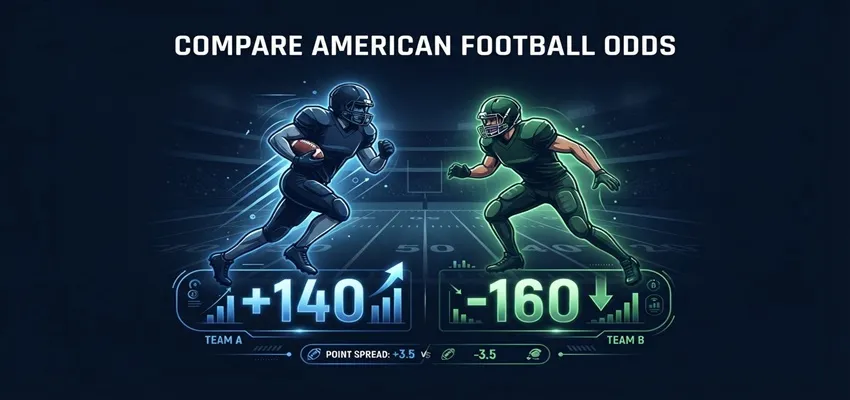
Compare American Football Odds
None of the analysis above matters if it isn’t weighed against the offer price. A prediction, on its own, is just an opinion. Odds convert that opinion into an implied probability, and only by comparing your own assessment of a team’s chances against the NFL odds can you judge whether a bet actually makes sense.
This is where a strong team can still be a poor bet. If a team’s odds imply an 80 percent chance of winning but careful analysis suggests something closer to 65 percent, backing that team at that price is a losing proposition over time, regardless of how the specific game in front of you turns out. Comparing odds across multiple sportsbooks matters too, since even small differences on the same outcome add up meaningfully across a full season, and independent betting site reviews can help identify which operators consistently price closer to true value.
American football odds move constantly in response to injury news, weather forecasts, and betting volume, so the price available on Monday for a Sunday game is rarely the one still standing by kickoff. Checking a line at more than one point before betting, rather than locking in the first number you see, is a simple habit that improves long-term value without any extra analysis required.
Get in the habit of checking the same game’s price across two or three sportsbooks before betting. A half-point of extra value here and there adds up significantly over a full season.
Find Value in American Football Betting
Value betting is the practical output of everything covered so far: research, matchup analysis, and price comparison all exist to help identify situations where the odds underestimate a team’s real chances. This is one of the central ideas behind effective NFL betting strategies, particularly when the available price does not fully reflect the underlying matchup.
Consider a hypothetical example. Suppose a road underdog is priced at odds implying a 30 percent chance of winning, but a bettor’s analysis, based on matchup strength, recent form, and injury reports, suggests the team’s actual chances sit closer to 40 percent. That ten-point gap between market price and estimated probability is where value betting lives. It doesn’t guarantee this specific underdog wins its game. It means that, across many similar situations, backing that kind of price discrepancy should produce an edge over time.
This distinction matters because value betting is often mistaken for a guaranteed winning system. It isn’t. A well-identified value bet can still lose, and a poorly reasoned favorite can still win. What it offers instead is a better long-term process, one grounded in an actual gap between price and probability rather than a preference for a particular team.
A value bet losing doesn’t mean the process was wrong, and a bet without value winning doesn’t mean it was right. Judge the reasoning behind a bet, not just its result.
Use Statistics for American Football Betting Analysis
For effective American football betting analysis, statistics should provide context rather than simply repeat past results. Comparing efficiency, turnovers, scoring, and strength of schedule can reveal whether recent performance is likely to continue or has been inflated by weaker opponents.
| Statistic | Why It Matters |
|---|---|
| Scoring Efficiency | Shows whether an offense converts opportunities into points or leaves production on the field. |
| Points Allowed per Drive | Adjusts for pace and gives a cleaner read on defensive quality than points allowed per game. |
| Passing and Rushing Efficiency | Reveals whether production comes from genuinely effective execution or a handful of explosive plays that may not repeat. |
| Turnover Differential | Directly affects field position and scoring opportunities, since possessions in a game are finite. |
| Red-Zone and Third-Down Rate | Measures a team’s ability to sustain and finish drives, skills that don’t always show up in yardage totals. |
| Sack Rate | Reflects both offensive line protection and pass rush quality, shaping how comfortably a quarterback can operate. |
| Explosive Play Rate | Separates offenses that can change a game’s complexion quickly from those relying purely on sustained drives. |
| Strength of Schedule | Should be applied to every stat above, since a number against weak opposition means something different from the same number against elite competition. |
Understand Line Movement
A betting line rarely stays fixed from the moment it opens until kickoff. Understanding why it moves, and when that movement should or shouldn’t influence a decision, is part of reading American football betting markets well.
Opening lines are set by sportsbooks based on their own models, then adjusted as money comes in on either side. Some movement reflects genuine new information, a confirmed injury, a shifting weather forecast, a coaching change, and reacting to that kind of movement is often reasonable. Other movement is driven purely by betting volume, sometimes concentrated on a popular team regardless of the underlying matchup, and following that kind of movement without independent analysis can leave a bettor with a worse price than the one available earlier in the week.
The safer approach treats line movement as one input among several rather than a signal to follow automatically. If a line moves in the direction your own analysis already supported, that’s reasonable confirmation. If it moves against your view with no new information explaining it, that’s worth investigating rather than immediately abandoning your original read.
Before reacting to any line movement, check whether an injury report or weather update has come out in the last few hours. If nothing has actually changed, the shift is more likely about betting volume than new information worth following.
American Football Live Betting Strategies
For American football live betting strategies, the first few possessions can reveal useful information that may not have been obvious before kickoff. Watching how each offense handles pressure, how quickly teams are moving the ball, and where drives are starting can provide a better sense of the game’s actual flow than the score alone.

Reading Game Flow
Possession, tempo, and field position tell a more current story than any pre-game statistic once a game is underway. A team dominating time of possession and controlling field position, even without a commanding scoreboard lead, often represents better in-game value than the score alone suggests.
Evaluating New Information
An early injury to a key player, an unexpected defensive adjustment, or a shift in weather mid-game can change the calculus set before kickoff. Live markets typically adjust fast, but there’s often a short window where a bettor who processes new information quicker than the broader market finds value that disappears minutes later.
Avoiding Emotional Live Bets
The speed of in-play markets makes emotional decisions far more likely than in pre-match betting. Chasing a bad beat with an impulsive live wager, or overreacting to a single big play, tends to produce worse outcomes than the same analytical process applied more slowly before kickoff. Approaching live betting strategies with the same discipline as pre-game analysis, rather than as a faster-paced activity with looser standards, guards against some of the most common in-play mistakes.
Build a Consistent Betting Process
Turning everything above into a repeatable habit is what actually separates a disciplined bettor from someone making one-off decisions each week. The following NFL betting tips can help turn that approach into a consistent pre-bet routine:
- Research the matchup, including recent form and scheme tendencies
- Check the latest team news and injury reports
- Evaluate the relevant statistics for both teams
- Identify which market, moneyline, spread, total, or player prop, best fits the matchup
- Form an independent expectation of the likely outcome
- Compare that expectation against the current price
- Assess whether a genuine value gap exists
- Determine an appropriate stake based on bankroll rules
- Record the bet and the reasoning behind it
- Review the decision afterward, regardless of the result
This process won’t turn every week into a winning one. What it creates is a consistent standard to judge every bet against, making it possible to spot genuine mistakes in reasoning rather than simply blaming bad luck after a loss.
Bankroll Management and Risk Control
Even the sharpest matchup analysis gets undermined by poor bankroll management, which is why risk control belongs inside any serious discussion of American football betting strategies rather than treated as a separate topic.
A defined betting budget, money set aside specifically for wagering and kept apart from regular finances, should be established before the season starts. Staking a consistent percentage of that budget per wager, rather than varying stake size with confidence or recent results, keeps a single bad week from having an outsized effect on the overall bankroll. Increasing stakes after a loss to chase back money already gone is one of the fastest ways to turn a manageable downswing into a serious problem, and it’s worth avoiding regardless of how confident the next pick feels.
Variance is unavoidable in a sport where a single fumble bounce or missed field goal can decide a game. Even a well-reasoned process built around genuine value will produce losing stretches. Bankroll management exists specifically to make those stretches survivable rather than season-ending.
The exact staking percentage matters less than staying consistent with it. A disciplined 1% stake beats an emotional 5% stake every time variance turns against you.
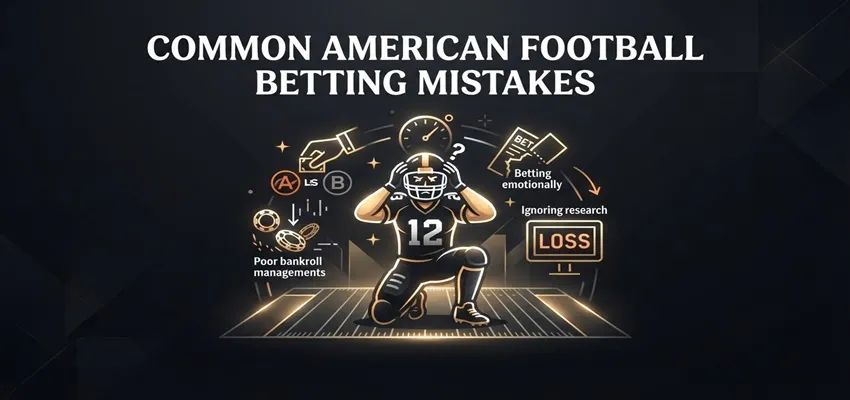
Common American Football Betting Mistakes
Some mistakes show up often enough to be worth naming directly. Understanding these common American football betting mistakes can help bettors avoid decisions based on emotion, incomplete information, or a poor reading of the market. Recognizing them before placing a wager is often easier than trying to correct them afterward.
| Mistake | Why It’s a Problem |
|---|---|
| Backing a favorite automatically because of reputation | Ignores whether the price still reflects real value. |
| Overreacting to a single game | Builds decisions on a small and often misleading sample. |
| Checking injury reports only casually | Misses exactly the kind of information sharp bettors weigh most heavily. |
| Chasing losses by raising stakes or betting extra games | Tends to compound problems rather than solve them. |
| Following public betting percentages without independent analysis | Ignores that popular opinion and sharp money frequently disagree. |
| Overreacting to every piece of line movement | Leads to constantly shifting positions without a clear rationale. |
| Spreading bets across too many markets in one week | Dilutes the quality of research applied to each individual decision. |
Choosing Betting Sites for American Football
Not every sportsbook covers American football with the same depth, and the differences matter more once a bettor moves beyond simple moneyline and spread wagers.
| Factor | What to Check |
|---|---|
| Market Coverage | Full range of spreads, totals, and player props across every game, not just marquee matchups. |
| Odds Quality | Consistently competitive pricing compared with other sportsbooks. |
| Market Variety | Useful alternative lines, player props, team totals, and specialty markets beyond the standard moneyline and spread. |
| Live Betting Performance | Fast-updating in-play odds and stable mobile functionality during games. |
| Line Movement | Clear and regularly updated prices so you can compare the current line with earlier market prices. |
| Payment and Security | Reliable payment options, solid account protection, and appropriate licensing. |
| Customer Support | Accessible support channels and reasonably fast responses when account or betting issues arise. |
| Responsible Gambling Tools | Easy access to deposit limits, time-outs, self-exclusion, and other responsible gambling controls. |
Market coverage is the first consideration when comparing the best betting sites for American football: does the operator offer a full range of spreads, totals, and player props across every game each week, or only the marquee matchups? Odds themselves are worth comparing directly, since even small price differences on the same game add up over a full season. For anyone using in-play markets regularly, mobile functionality and how quickly live odds update during a game can matter as much as the pre-match price. Payment options, account security, and access to responsible gambling tools such as deposit limits and self-exclusion round out what’s worth checking before settling on where to bet regularly.
Comparing how different operators actually perform across these categories, rather than relying on marketing claims alone, offers a reasonable starting point for narrowing down the options.
Don’t judge a sportsbook’s American football coverage purely on marquee Sunday games. Check whether it also fully prices Thursday night and international games, since that’s where coverage gaps usually show up first.
Responsible Betting
Betting on American football, like any form of sports betting, carries real financial risk, and nothing in this article changes that. A sound process built around research, matchups, and value can improve the quality of decisions over time. Still, it can’t guarantee that any individual bet, or any given week, turns a profit.
Setting firm limits on both time and money spent betting, treating losses as an accepted part of the activity rather than something to chase, and stepping back if betting starts to feel less like entertainment and more like a source of stress all matter more than any single strategic insight covered in this piece.

FAQs About American Football Betting Strategies
What is the best strategy for betting on American football?
There isn’t a single best strategy. An effective approach combines matchup research, choosing the market that fits the game (moneyline, spread, total, or props), and comparing your own probability estimate against the price on offer rather than just picking who you think will win.
Which statistics matter most for American football betting analysis?
Turnover differential, red-zone and third-down conversion rates, sack rate, and efficiency metrics adjusted for strength of schedule tend to carry more predictive value than raw yardage or scoring totals on their own.
How does moneyline betting differ from point spread betting?
Moneyline focuses purely on picking the outright winner and rewards finding underdogs priced too pessimistically, while spread betting requires judging whether a matchup’s statistical gap is larger or smaller than the number the sportsbook has set.
What’s the best approach to NFL totals betting?
Totals reward thinking about pace and matchup style rather than which team is favored, weighing offensive tempo and defensive efficiency, along with weather conditions such as wind, against the posted number.
What does value betting mean in American football?
It means identifying situations where your own estimate of a team’s winning probability is meaningfully higher than what the current odds imply, rather than betting simply because you like a team.
How is live betting different from pre-match strategy?
Live betting relies on interpreting real-time factors like possession, tempo, and in-game injuries rather than pre-game research, and rewards fast, disciplined decisions over emotional reactions to recent plays.
How much of a bankroll should be risked on a single NFL bet?
Most disciplined bettors risk a small, consistent percentage of their overall bankroll per wager, commonly in the low single digits, rather than varying the stake based on how confident a particular pick feels.
What is the most common mistake bettors make with American football strategies?
Overreacting to a single recent result, whether a surprising win or a bad loss, and adjusting an entire view of a team based on that one data point rather than a broader sample.
Can American football betting strategies guarantee profit?
No. No strategy guarantees profit on individual bets or across a season. A sound process improves decision quality and long-term consistency, but variance and unpredictable in-game events remain part of the sport.
How important is line movement when analyzing an NFL game?
It’s useful context, particularly when tied to injury news or weather, but following it blindly without independent analysis can leave a bettor with a worse price than the one available earlier in the week.
Final Thoughts
American football betting strategies work best treated as an ongoing discipline rather than a one-time system to master and forget. Matchup research, informed by real statistics rather than reputation, only pays off when it’s consistently weighed against the price a sportsbook is actually offering. Probability and price, not a gut feeling about which team looks better on paper, are what separate a genuinely useful process from guesswork dressed up as analysis.
None of this removes variance from the sport. Fumbles bounce unpredictably, officiating calls swing games, and even a well-supported bet loses often enough to test anyone’s patience. What a consistent, value-focused approach offers instead is a way to judge decisions on their own merits across a full season, rather than by whether the scoreboard cooperated on any single Sunday. That distinction, between a good process and a good outcome, is what separates disciplined bettors from everyone else chasing the same games.
If betting starts to feel difficult to control, Gambling Therapy provides free, confidential support and practical advice for people affected by gambling harm.