Placing a bet on an NFL game looks intimidating the first time you open a sportsbook and see a screen full of numbers, but the actual process is simpler than it looks once you understand what each number means. This American football betting guide covers how to bet on American football in 2026, from what you need to get started, to reading the odds, to placing your first wager with confidence.

Nothing here assumes prior betting experience. This is NFL betting for beginners, and by the time you finish reading, you should be comfortable telling the difference between a moneyline, a point spread and a total, understand how a bet slip works, and know what to check before confirming any wager.
What You Need to Bet on American Football
Before placing a single wager, a few NFL betting basics need to be in place. None of this is complicated, but skipping a step usually confuses later.
You’ll need a betting account with a licensed sportsbook, funds available in that account through an accepted payment method, and an actual NFL or American football event that the sportsbook is offering markets on. You’ll also need the sportsbook to list the specific type of bet you want to place, since not every operator offers the same range of player props or specialty markets. Most importantly, you need a basic understanding of what you’re actually betting on before you commit any money, which is exactly what the rest of this guide covers.
If you haven’t opened a betting account before, our broader guide on how to bet on sports covers account setup and the registration process in more detail. This NFL betting guide picks up from there and focuses specifically on American football.
How American Football Betting Works
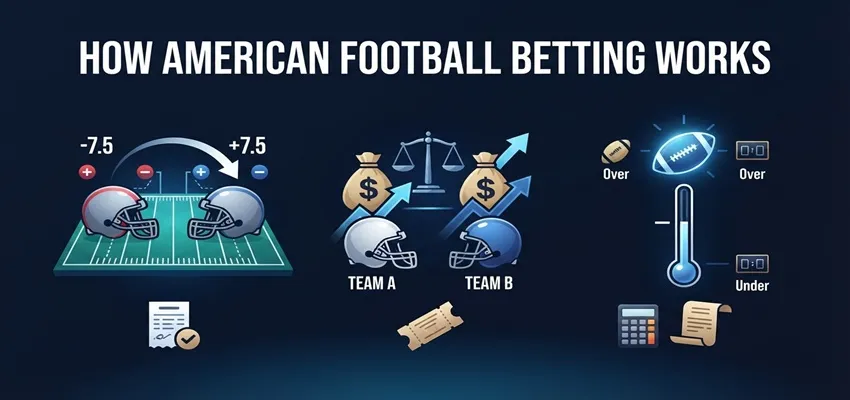
At a basic level, betting on American football means picking an outcome connected to a real NFL game and staking money on it. Once a bet settles as a winner, the sportsbook pays back your stake plus a profit based on the odds. If it settles as a loss, you lose the amount you staked.
NFL betting follows a consistent pattern regardless of which sportsbook you use. You choose a game, look at the markets available for that game, pick the specific bet you want (such as which team wins, or whether the total points will go over or under a set number), see the odds attached to that selection, decide how much to stake, and confirm the wager. The sportsbook then settles the bet once the game finishes, based on the actual result.
Getting comfortable with that sequence is really what learning how to bet on American football comes down to. This American football betting guide breaks down each step so beginners can understand how the different bet types work.
How to Read American Football Betting Odds
NFL betting odds are one of the first things beginners need to get comfortable with, since they show both the price of a selection and the potential return from a winning bet. Most sportsbooks let you switch between a few different odds formats, and it helps to recognize all three even if you only use one regularly. Whichever format a sportsbook uses, American football betting odds are built around the same three systems: American, decimal, and fractional.
American odds are the default format on most US-facing sportsbooks. A minus sign, such as -150, means risking 150 units to make 100 units in profit. A plus sign, such as +130, means a 100-unit stake produces 130 units in profit. So a $150 bet at -150 returns $100 in profit, while a $100 bet at +130 returns $130 in profit.
Decimal odds, common outside the US, show your total return per unit staked, including your original stake. Odds of 2.50 mean a $10 bet returns $25 in total, which is $15 in profit plus your original $10 back.
Fractional odds, most common in the UK, show profit relative to stake as a fraction. Odds of 5/2 mean a $10 bet profits $25, calculated by dividing 10 by 2 and multiplying by 5. Odds can also be converted into an implied probability, giving a rough indication of how likely the sportsbook’s price suggests an outcome is to occur. Decimal odds of 2.00, for example, imply a 50% chance of that outcome happening, before accounting for the sportsbook’s built-in margin.
| Format | Example | What It Means |
|---|---|---|
| American | -150 / +130 | Minus odds show the amount needed to win 100 units; plus odds show the profit from a 100-unit stake. |
| Decimal | 2.50 | Shows the total return per unit staked, including your original stake. |
| Fractional | 5/2 | Shows the potential profit relative to the stake as a fraction. |
| Implied Probability | 50% at 2.00 | Shows the approximate probability represented by the odds before accounting for the sportsbook’s margin. |
None of these formats change what’s actually being predicted. They’re just different ways of displaying the same underlying price, and getting comfortable reading them is one of the first real steps in learning how to bet on American football. Trusted betting reviews can also help you compare how different sportsbooks display odds, markets, and betting features before choosing where to place a wager.
The format you use doesn’t change what you’re actually betting on. Pick whichever one you find easiest to read and stick with it, since consistency matters more than the specific format.
The Main American Football Bet Types
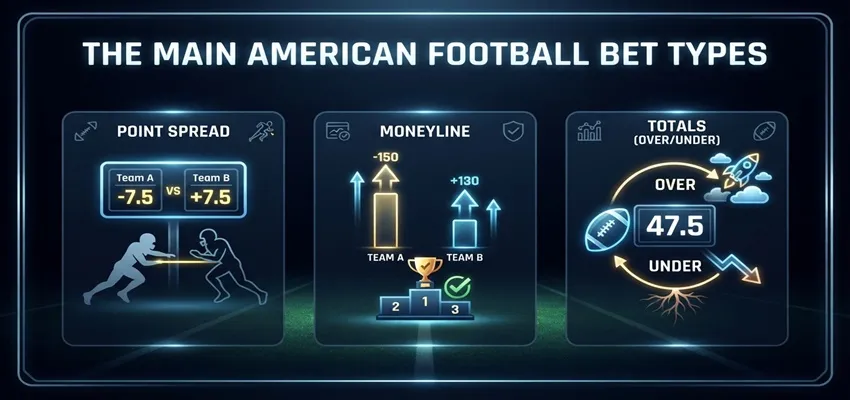
The main NFL bet types are the moneyline, the point spread, totals, player props, and parlays. Almost everything else you’ll see on a sportsbook builds on these five, so getting comfortable with them is the real starting point for NFL betting for beginners and for anyone learning how to bet on American football.
| Bet Type | What You’re Predicting | Simple Example |
|---|---|---|
| Moneyline | Which team wins outright | Team A to win the game |
| Point Spread | Whether a team covers the margin | Team A -6.5 to win by 7 or more |
| Over/Under | The combined final score | Over 45.5 total points |
| Player Props | An individual player’s statistical performance | A quarterback’s passing yards |
| Parlays | Multiple selections combined into one bet | Moneyline and total in a single wager |
| Team Props | A specific team’s performance or statistic | Team A to score over 24.5 points |
| Game Props | A specific event or outcome within the game | Which team scores first |
| First Touchdown | Which player scores the first touchdown | Team A’s running back to score first |
| Alternate Lines | A different spread, total, or player prop line | Team A -3.5 instead of -6.5 |
Moneyline Bets
A moneyline bet is the simplest wager available: you’re picking which team wins the game outright, with no point spread involved. Favorites carry minus odds, and underdogs carry plus odds, reflecting how likely each side is to win. Betting the favorite means risking more to win less, while betting the underdog means risking less for a bigger payout if it wins.
Point Spread Bets
The point spread evens out a mismatched game by adding or subtracting points from the final score. If Team A is a 6.5-point favorite, they need to win by 7 or more points for a spread bet on them to pay out. Betting Team B, the underdog, means they can lose by up to 6 points, or win outright, and the bet would still succeed. Spread bets are often priced around -110 on both sides, though the exact number can vary by sportsbook and matchup.
Over/Under or Total Points Bets
Also called totals, this market ignores which team wins entirely and focuses only on the combined score. If the total is set at 45.5 points, betting the over means you’re predicting both teams will combine for 46 points or more, while betting the under means you expect 45 points or fewer.
Player Prop Bets
Player props let you bet on an individual’s statistical performance rather than the game’s outcome. Common examples include a quarterback’s total passing yards, a running back’s rushing yards, or whether a specific player scores a touchdown. These are usually presented as an over/under line on that player’s expected output, similar in structure to a team total but applied to one player instead.
Parlays
A parlay combines multiple individual bets into a single wager, and every selection in it has to win for the parlay to pay out. The appeal is a larger potential payout from a smaller stake, since the odds of each leg multiply together. The trade-off is real: losing any single leg loses the entire parlay, which makes them considerably riskier than betting each selection separately. Parlays aren’t a shortcut to bigger profits, just a different risk-and-reward structure worth understanding before using them.
A parlay only needs one leg to fail for the entire bet to lose. Treat the bigger payout as compensation for that added risk, not as a shortcut to easier profits.
How to Choose an American Football Bet
With the main bet types covered, choosing which one to actually bet on comes down to a straightforward sequence:
- Choose the game you want to bet on
- Review which markets the sportsbook offers for that game
- Decide what type of outcome you want to bet on (moneyline, spread, total, or a prop)
- Check the current odds for that selection
- Compare prices across sportsbooks if you have more than one account
- Decide how much you want to stake
- Review the bet slip before confirming
- Place the wager
This process doesn’t require deep analysis to get started. As you get more comfortable with how each market behaves, moving into more detailed research, the kind covered in our American football betting strategies guide, becomes a natural next step once the basics feel familiar.
How to Place an NFL Bet Step by Step
Every sportsbook’s interface looks slightly different, but once you know how to bet on NFL games at one operator, the actual steps for placing a bet follow a near-identical pattern across the industry.
- Select American football or NFL from the sports menu
- Choose the specific game you want to bet on
- Select the market (moneyline, spread, total, or props)
- Click the odds for your chosen selection, which adds it to your bet slip
- Enter your stake amount
- Review the potential return shown next to your stake
- Double-check that the selection matches what you intended to bet
- Confirm the bet
Once confirmed, the bet slip typically shows a confirmation screen, and the wager appears in your account’s open bets or bet history section until the game finishes and the result is settled.
Read your bet slip twice before confirming. Most sportsbooks won’t let you edit or cancel a bet once it’s placed, so catching a mistake beforehand is the only real safety net you have.

How to Understand an NFL Bet Slip
The bet slip is where everything comes together before you commit money, so it’s worth knowing exactly what each part of it means.
The selection shows exactly what you’re betting on, such as a specific team to cover the spread or a total to go over a set number. The odds show the price attached to that selection at the moment you added it. Your stake is the amount of money you’re risking, and the potential return shows your stake plus profit if the bet wins, calculated automatically based on the odds.
| Bet Slip Element | What It Shows |
|---|---|
| Selection | The exact outcome you’re betting on |
| Odds | The price attached to that selection when it was added |
| Stake | The amount of money you’re risking |
| Potential Return | Your stake plus profit if the bet wins |
| Single Bet | One selection standing on its own |
| Parlay/Multiple | Two or more selections combined, with combined odds |
| Bet Type | The type of wager selected, such as moneyline, spread, total, or player prop |
| Odds Change | A notification when the odds have changed before the bet is confirmed |
| Cash Out | The amount available if you choose to settle an eligible bet before the event ends |
| Confirmation | The final status showing that your bet has been successfully placed |
A single bet involves one selection on its own. A multiple or parlay bet combines two or more selections into one wager, with the combined odds shown separately from each leg. Before confirming any bet, the slip usually asks for a final review, and once confirmed, most sportsbooks lock in the odds you saw at that moment even if the market moves afterward.
Some sportsbooks also offer a cash out option on eligible bets, letting you settle a wager before the event finishes rather than waiting for the final result. The amount offered changes as the market moves, and cash out isn’t available on every bet or every market.
Pre-Match vs Live American Football Betting
Pre-match betting means placing your wager before kickoff, using odds set in advance based on how the sportsbook expects the game to unfold. This is the most common starting point for beginners since there’s no time pressure and you can take as long as you need to review the market.
Live betting, sometimes called in-play betting, lets you place wagers after the game has started, with odds that update continuously based on what’s happening on the field. A team trailing at halftime might see its moneyline odds lengthen, while a strong start can shorten a spread in real time. Live markets move quickly and require faster decisions, which makes them better suited to bettors who are already comfortable with how pre-match markets work.
What to Check Before Placing an American Football Bet
A short pause before confirming any bet catches most of the mistakes beginners make. Run through these points every time:
- The current odds, since prices can shift between when you first see a game and when you’re ready to bet
- The market you’ve actually selected, confirming it matches the bet you intended to place
- Team or player availability, particularly for prop bets tied to a specific player
- The game’s status, especially for anything close to kickoff or already in progress
- Weather conditions, when relevant, since wind and rain can affect passing and total-points markets
- Your stake, making sure it matches what you planned to risk
- That the selection on your bet slip is exactly the outcome you meant to back
None of these checks take more than a few seconds once they become habit, but skipping them is one of the easiest ways to get the basics of how to bet on American football wrong.
If the odds change while you’re reviewing your bet slip, most sportsbooks will flag the new price and ask you to accept it before the bet goes through. Take that extra second to actually read it rather than confirming out of habit.

Common Beginner Mistakes When Betting on American Football
A few mistakes show up repeatedly among newer bettors still learning how to bet on American football, and most are easy to avoid once you know what to watch for.
Misunderstanding the spread is common, particularly confusing which side needs to cover versus which side simply needs to avoid losing by too much. Confusing moneyline with spread betting leads some beginners to expect a spread payout from a straight moneyline wager, or vice versa. Ignoring the total line entirely, focusing only on which team wins while skipping the over/under market, means missing out on a bet type that doesn’t depend on picking a winner at all.
Entering the wrong selection on a bet slip happens more often than you’d expect, especially when odds are changing and a bettor rushes the final confirmation. Staking more than intended, often through a slip of the finger on a mobile app, is another avoidable error worth double-checking for. Betting without actually looking at the odds first, based purely on which team feels right, skips the one piece of information the entire wager depends on.
Chasing losses by increasing a stake to make up for a previous loss tends to create bigger problems than it solves. Placing too many bets at once, across markets you haven’t fully thought through, makes it harder to track what you’re actually risking. Misunderstanding how parlays work, particularly underestimating how much harder they are to win than a single bet, leads some beginners toward parlays for the wrong reasons. And betting on a market you don’t fully understand, simply because it was suggested somewhere, is worth avoiding until you’ve read up on how that specific bet type works.
How to Manage Your Betting Stake Responsibly
Managing your stake doesn’t require anything complicated, just a few consistent habits.
Set a betting budget before you start, using only money you’re fully prepared to lose. Decide your stake before placing the bet rather than adjusting it in the moment based on how confident you feel. Avoid chasing losses by increasing your stake to try to win back money from an earlier bet, since this tends to compound problems rather than solve them. Never use money set aside for essential expenses like rent, bills, or savings to fund a wager. And where a sportsbook offers responsible gambling tools such as deposit limits or time-outs, using them from the start is a reasonable habit rather than something to set up only after a problem develops.
These habits aren’t specific to American football either. The same discipline shows up across sports betting strategies more broadly, which is worth a look once you’re betting regularly across more than one sport.
Decide your stake before you see the odds, not after. A stake chosen in advance is a decision; a stake chosen in the moment is usually just a reaction.
Choosing a Betting Site for American Football
Not every sportsbook covers American football the same way, and a few basics are worth checking before settling on where to bet.
| Factor | What to Check |
|---|---|
| Market Coverage | Full range of NFL markets, including player props and alternate lines |
| Odds | Competitive, consistent pricing compared with other sportsbooks |
| Payment Methods | Reliable deposit and withdrawal options |
| Mobile Experience | Stable performance, especially during live betting |
| Licensing | A valid license from a recognized regulator |
| Customer Support | Responsive and easy to reach |
| Responsible Gambling Tools | Visible deposit limits and self-exclusion options |
| Betting Limits | Reasonable minimum and maximum stakes for the markets you use |
| Bet Settlement | Clear rules for how NFL bets are settled, including postponed or abandoned games |
| Withdrawal Process | Clear processing times, fees, and verification requirements |
Look at how many NFL markets a site actually covers, including player props and alternate lines, rather than just the headline moneyline and spread. Compare odds where you can, since even small pricing differences add up over a season of betting. Check the available payment methods, how the mobile experience holds up during live betting, and whether the account verification process is straightforward. Licensing matters more than almost anything else on this list, since a properly licensed sportsbook is required to follow rules around fund security and fair treatment of customers. Responsive customer support and visible responsible gambling tools round out what’s worth confirming before you deposit.
For a broader comparison of options, our page on American football betting sites covers what to look for across operators in more depth.
Check a sportsbook’s license before anything else. A great welcome offer means nothing if the operator isn’t properly regulated in your market.
Simple American Football Betting Example
Here’s a fully hypothetical example to tie everything together. Imagine Team A is hosting Team B, and the sportsbook lists three markets: a moneyline, a point spread, and a total.
Team A is priced at -150 on the moneyline, with Team B at +130. The point spread has Team A favored by -3.5, meaning they’d need to win by 4 points or more for a spread bet to pay out, while Team B covers by either winning outright or losing by 3 points or fewer. The total is set at 44.5 points.
Suppose you decide the point spread looks like the most straightforward bet based on how you expect the game to play out. You’d select Team A -3.5 on the bet slip, enter a stake you’re comfortable with, say $20, and the slip would show your potential return based on the standard spread odds, typically somewhere close to -110. Reviewing the slip once more to confirm the selection, stake, and odds all match what you intended, you’d then confirm the wager.
None of the numbers here are real current odds or a specific matchup. They’re intended purely to show how the pieces, the market, the odds, the stake, and the bet slip, fit together in practice.

FAQs About How to Bet on American Football
How do I start betting on American football?
Open an account with a licensed sportsbook, add funds using an accepted payment method, and pick an NFL game with markets you understand. From there, choosing a bet type, checking the odds, and confirming your stake completes the process.
What is the difference between American football betting and NFL betting?
Not much in practice. The two terms are used interchangeably in most contexts, since the NFL is the dominant American football competition that sportsbooks build the majority of their markets around. The distinction only really matters if you’re talking about college football, which uses the same bet types but runs as a separate competition with its own markets and odds.
What are the easiest American football bets for beginners?
Moneyline bets are usually the simplest starting point since they only require picking which team wins outright. Totals, or over/under bets, are also straightforward since they don’t require picking a winner at all.
What is an NFL moneyline bet?
A moneyline bet is a wager on which team wins the game outright, with no point spread involved. Favorites carry minus odds and underdogs carry plus odds, reflecting each side’s likelihood of winning.
What is an NFL point spread?
A point spread adds or subtracts points from the final score to even out a mismatched game. The favorite must win by more than the spread for a bet on them to pay out, while the underdog can lose by less than the spread, or win outright, and still cover.
What does over/under mean in American football betting?
Over/under, or totals, is a bet on the combined score of both teams rather than which team wins. Betting the over means expecting the combined score to exceed the posted number, while the under means expecting it to fall short.
How do NFL betting odds work?
Odds show both the implied likelihood of an outcome and how much a winning bet pays out. American odds use plus and minus signs, decimal odds show total return per unit staked, and fractional odds show profit as a ratio to your stake.
What is a player prop in NFL betting?
A player prop is a bet on an individual player’s statistical performance, such as passing yards, rushing yards, or whether they score a touchdown, rather than on the outcome of the game itself.
Can I bet on American football live?
Yes. Live, or in-play, betting lets you place wagers after kickoff, with odds that update continuously based on what’s happening in the game. It moves faster than pre-match betting and suits bettors already comfortable with the basics.
How much should I stake on an NFL bet?
There’s no fixed amount that works for everyone, but the stake should always come from a budget you’ve set in advance and are fully prepared to lose, rather than being decided in the moment based on confidence in a particular pick.
Is American football betting risky?
Yes. All sports betting carries financial risk, and no bet type or strategy guarantees a profit. Treating it as entertainment, setting a budget, and never chasing losses are the most practical ways to manage that risk.
How NFL Betting Odds Work?
NFL betting odds show both the implied likelihood of an outcome and how much a winning bet pays out. American odds use plus and minus signs, decimal odds show total return per unit staked, and fractional odds show profit as a ratio to your stake.
Responsible American Football Betting
Betting on American football, like any form of sports wagering, involves genuine financial risk, and no bet type or approach in this guide changes that. Outcomes aren’t guaranteed, and even a well-reasoned wager can lose.
Keeping stakes within a budget you’ve set in advance, avoiding the temptation to chase losses, and stepping back if betting starts to feel less like entertainment and more like pressure all matter more than which specific bet you choose. Our responsible gambling page covers the tools and support available if you’d like to look into this further.
Final Checklist Before You Place an NFL Bet
Before confirming any American football wager, a quick run through this list helps catch most avoidable errors:
- Am I betting on the correct game and the correct market?
- Do I actually understand how this bet type works?
- Have I checked the current odds?
- Have I selected the correct side or outcome?
- Is my stake within the budget I set for myself?
- Have I reviewed the potential return shown on the bet slip?
- Am I placing this bet because I understand it, rather than trying to make up for a previous loss?
If you can answer all of these honestly before hitting confirm, you’re betting with intention rather than guesswork.
It can also help to take a quick look at an NFL betting resource before placing a bet, particularly when you want to double-check the rules or terminology behind a market. A clear explanation can save you from making a decision based on a misunderstanding, especially when you’re still getting familiar with American football betting.