Cricket betting has become one of the most popular forms of sports wagering globally, driven by packed international calendars, T20 leagues, and a huge range of betting markets available for almost every match. For newcomers, though, the sheer number of markets and odds formats can feel overwhelming before a single bet is even placed.
That is exactly what this guide is for. This complete cricket betting for beginners guide walks through how to bet on cricket from the very first step: understanding what a market actually is, how odds work, and how to place a bet with confidence rather than guesswork. By the end, you will know how cricket betting works in practice, not just in theory.

This cricket betting guide for beginners sticks to the basics: markets, odds, and the fundamentals of placing a bet with confidence. If you are looking for deeper analysis, staking plans, or live in-play tactics, those topics are covered separately once the basics below feel familiar.
How Does Cricket Betting Work?
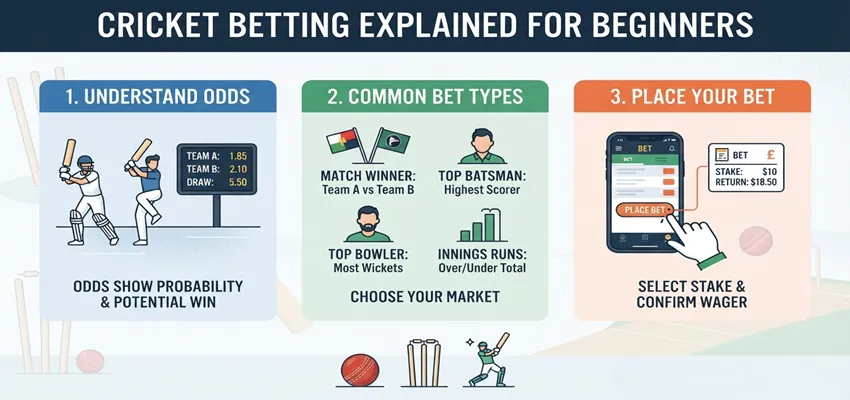
At its core, cricket betting works the same way as betting on any other sport. You choose a match, pick a market you want to bet on, review the odds attached to that market, decide how much you want to stake, place the bet, and then wait for the result to settle. That sequence is essentially how to bet on cricket, whatever the format or market involved.
Breaking that down a little further, the process usually looks like this:
Choose a cricket match. This could be an international Test, a One Day International, or a T20 league fixture.
Select a betting market. This is the specific outcome you are betting on, such as which team wins or how many runs will be scored.
Check the odds. The odds tell you how likely the bookmaker thinks that outcome is, and how much you could win.
Decide your stake. This is simply the amount of money you choose to risk on that bet.
Place the bet. Confirm the selection and stake through your sportsbook of choice.
Check the result. Once the match or the specific market has concluded, your bet is settled as a win or a loss.
What You Need Before You Place Your First Bet
Before placing a cricket bet, you need a verified account with a licensed sportsbook, funds in that account, and a basic understanding of the match and market you are betting on. Most platforms also require proof of age and identity during sign-up, which is a normal part of legal, regulated betting rather than an extra hurdle.
Not every platform offers the same range of cricket markets or the same odds, so it is worth comparing a few of the best betting sites before settling on one, rather than signing up with the first one you come across.
Underneath all of this sits a simple relationship between probability and odds. Odds are really just a bookmaker’s way of expressing how likely they think something is to happen, converted into a number that also tells you your potential payout. The more likely an outcome is judged to be, the lower the odds, and the less likely it is, the higher the odds. Understanding that relationship is the single most useful thing a beginner can learn before placing a first bet.
Cricket Betting Explained for Beginners
A cricket bet, in the simplest terms, is a prediction about something that will happen in a match, backed by money. That prediction might be as broad as “Team A will win” or as specific as “Player X will be the top run-scorer in the match.”
Bookmakers create these markets by assessing the probability of each outcome and then setting odds that include a built-in margin for themselves. This is why the odds across different outcomes in the same market never quite add up to a perfectly fair representation of probability. That margin is simply how bookmakers generate revenue, and it is present across every sport, not just cricket.
There are two broad categories of cricket betting to understand as a beginner. Pre-match betting means placing your bet before the match starts, based on team news, recent form, and the information available in advance. Live cricket betting, on the other hand, allows you to place bets while the match is actually in progress, with odds updating continuously as the game unfolds.
Cricket’s different formats also shape what betting options are available. A five-day Test match naturally supports session-based and multi-day markets that would make no sense in a three-hour T20 game, while T20 cricket tends to focus more heavily on totals, boundary counts, and powerplay-specific markets because of its shorter, faster-paced structure. Recognizing this early on is a genuinely useful part of learning how to bet on cricket, since it will help a lot of the market names in the next sections make more sense.
| Format | Match Length | Common Betting Markets | Beginner Difficulty |
|---|---|---|---|
| Test Cricket | Up to 5 days | Match winner, session markets, draw/no result, innings totals | Medium |
| One Day International (ODI) | 50 overs per team | Match winner, total runs, top batter, top bowler | Easy |
| T20 Cricket | 20 overs per team | Match winner, powerplay markets, boundaries, total runs | Easy |
| The Hundred | 100 balls per team | Match winner, player markets, innings totals | Medium |
Understanding Cricket Betting Markets
A betting market is simply a specific question a bookmaker offers odds on, and getting these cricket betting markets explained clearly is one of the most useful things a beginner can read early on. Cricket has one of the widest ranges of markets in sports betting, partly because the sport itself has so many phases, and partly because a single match creates opportunities for many different questions to be asked and answered.
Here are the markets beginners are most likely to encounter:
- Match Winner: A bet on which team will win the match outright. This is the most straightforward market, and usually the first one new bettors try.
- Top Batter: A bet on which player will score the most runs in the match or in a specific innings.
- Top Bowler: A bet on which bowler will take the most wickets.
- Total Runs: A bet on whether the combined or team total runs will finish over or under a number set by the bookmaker.
- Highest Opening Partnership: A bet on which team’s opening pair will put on the highest partnership before the first wicket falls.
- Player Performance Markets: Bets built around an individual player reaching a specific run total, taking a certain number of wickets, or hitting a set number of boundaries.
- Toss Winner: A simple bet on which captain will win the pre-match coin toss.
- First Innings Markets: Bets focused specifically on the first innings, such as the first innings total or which team scores more in that innings.
- Live Betting Markets: Markets that update throughout the match itself, such as runs in the next over or the outcome of the current session.
For a quick overview, here is how these markets compare in terms of what they predict and how approachable they are for beginners:
| Market | What You Predict | Difficulty Level |
| Match Winner | Which team wins the match | Easy |
| Toss Winner | Which captain wins the coin toss | Easy |
| Total Runs | Whether runs finish over or under a set number | Easy |
| Highest Opening Partnership | Which team’s openers post the higher partnership | Medium |
| First Innings Markets | Outcomes tied to the first innings only | Medium |
| Top Batter | Which player scores the most runs | Medium |
| Top Bowler | Which bowler takes the most wickets | Medium |
| Player Performance Markets | Whether a specific player hits a run, wicket, or boundary target | Advanced |
| Live Betting Markets | In-play outcomes that update as the match unfolds | Advanced |
Each of these markets predicts something slightly different, so understanding exactly what you are betting on matters more than it might first seem. A “Total Runs” bet, for example, has nothing to do with which team wins; a team can lose the match while the total runs bet still settles as a winner if the number lands on the right side of the line.
Live markets in particular have become far more accessible thanks to modern platforms. Many bettors now prefer using dedicated betting apps for live cricket betting, since they tend to update odds faster and load more smoothly during fast-moving passages of play than switching between browser tabs on a desktop.
Cricket Betting Markets Explained: Which Bets Can Beginners Place?
Not all cricket betting markets are equally beginner-friendly. Some require very little background knowledge, while others benefit from a closer understanding of team news, conditions, or player tendencies.
Simple markets, such as match winner and toss winner, ask a single, clear question with two or three possible outcomes. They are easy to understand, easy to track, and a sensible place to start for anyone new to cricket betting.
More complex markets, such as top bowler, player performance markets, or session-based Test cricket markets, involve more moving parts. A top bowler market, for instance, depends on team selection, the conditions on the day, and how overs are likely to be shared among the bowling attack, all of which a complete beginner may not yet feel confident judging.
This does not mean beginners should avoid these markets altogether. It simply means it is worth understanding what a market is actually asking before placing money on it, rather than picking a bet purely because the odds look appealing. A market you fully understand, even a simple one, is generally a better starting point than a complex one you are only partially familiar with.
How Do Cricket Betting Odds Work?
Understanding cricket betting odds means knowing what a price is really telling you about probability and potential payout. Odds exist to do two jobs at once: they show how likely a bookmaker thinks an outcome is, and they tell you how much you stand to win if that outcome happens. Odds are usually presented in one of three formats, depending on the platform and region.
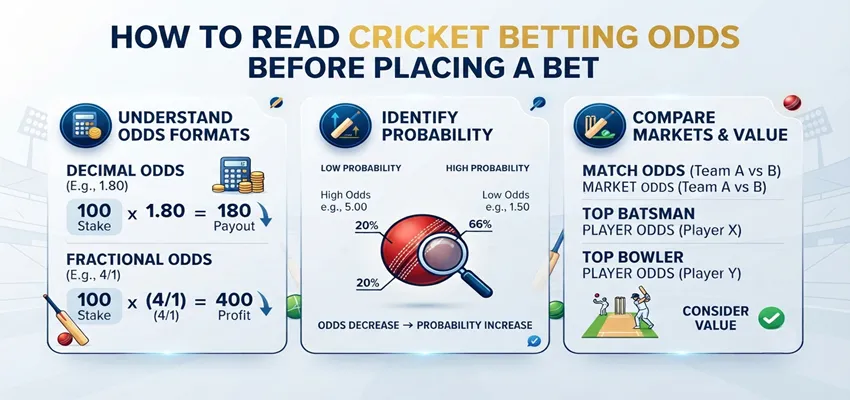
Decimal odds are the most common format used internationally and are also the easiest for beginners to work with. A decimal price of 2.00 means a winning $10 bet returns $20 in total, which includes your original stake. To calculate a potential return, you simply multiply your stake by the decimal figure.
Fractional odds, more commonly used in the UK, show the potential profit relative to your stake. Odds of 5/1 mean that for every $1 staked, you would win $5 in profit if the bet comes in, on top of getting your original stake back. Odds of 1/2 mean you would need to stake $2 to win $1 in profit.
American odds use positive and negative numbers. A figure like +200 shows how much profit a $100 bet would return, while a figure like -150 shows how much you would need to stake to win $100 in profit. This format is common on platforms aimed at bettors in the United States.
Here is a quick reference for comparing the three formats side by side:
| Odds Format | Example | How It Works |
| Decimal | 2.00 | Multiply your stake by the number for total return (stake included) |
| Fractional | 5/1 | Shows profit relative to stake; $1 staked wins $5 profit |
| American | +200 / -150 | Positive shows profit on a $100 bet; negative shows stake needed to win $100 |
| Hong Kong | 1.00 | Shows the potential profit returned for each unit staked, similar to decimal odds but excluding the original stake |
| Malay | 0.50 / -0.50 | Uses positive and negative values to show potential profit or loss, commonly used in Asian betting markets |
| Indonesian | +0.75 / -1.25 | Expresses odds using decimal-style values where positive odds show potential profit and negative odds show the stake required for a target profit |
Regardless of format, the underlying rule stays the same: higher odds mean the bookmaker considers the outcome less likely, and a winning bet at higher odds returns more money. Lower odds mean the outcome is considered more likely, and the potential return is smaller. Getting comfortable with this is a core part of how to bet on cricket successfully, since misreading a price can lead to real confusion at the moment you confirm a bet.
This connects directly to implied probability, which is simply the odds converted back into a percentage chance. Decimal odds of 2.00, for example, imply roughly a 50 percent chance of that outcome happening, once you account for the bookmaker’s margin. You do not need to master this calculation to bet on cricket, but understanding roughly what odds are telling you is genuinely useful. Our full guide on cricket betting odds explained goes through this conversion in more detail, with worked examples for each format.
How to Read Cricket Betting Odds Before Placing a Bet
Once you understand the different odds formats, the next skill is simply reading them properly before you commit to a bet. Reading cricket betting odds correctly, rather than skimming past the numbers, is often what separates a confident beginner from someone betting on a lucky guess. This is a habit worth building early, since it is very easy to glance at a price and misjudge what it actually means.
Start by checking the available odds for every realistic outcome in the market you are considering, not just the one you already have in mind. Seeing the full picture, including the odds on the outcomes you are not backing, helps you judge how confident the market itself appears to be.
Next, compare the odds for your intended selection against the alternatives in the same market. If a heavy favorite is priced only slightly shorter than the underdog, that can be a useful signal that the match is closer than the team names alone might suggest.
Before confirming anything, work out the actual return your stake would produce, not just the headline odds figure. A $20 bet at odds of 1.80 returns $36 in total, for example, which is a very different number from what some beginners assume just by glancing at “1.80” on a screen.
A few common odds mistakes are worth avoiding here. Confusing decimal odds with a multiplier on profit alone, rather than total return, is one of the most frequent errors. Betting on a market without checking if a better price for the same outcome is available on another platform is another. Simply taking a moment to read the odds properly, rather than betting on instinct, removes a lot of unnecessary confusion early on.
Best Cricket Bets to Place for Beginners
There is no single “best” cricket bet, since the right choice depends on how confident you feel and how much you already understand about the teams involved. That said, some markets are more forgiving starting points than others.
Match winner bets are the simplest entry point. You are betting on one straightforward outcome, and the logic behind the bet is easy to explain to yourself afterward, win or lose. Choosing beginner-friendly bets like this one gives you room to learn without feeling overwhelmed by every market at once.
Total runs bets can also suit beginners well, particularly in limited-overs cricket where scoring patterns are more predictable than in Test matches. The main risk is that totals can swing quickly with weather delays or a collapse in batting, so it is worth checking recent scoring at the specific ground first.
Top batter and top bowler markets offer bigger potential returns than match winner, since there are more possible outcomes to choose from, but they also carry more risk. A slightly weaker player having a good day, or a strong player getting out early, can decide these markets regardless of overall team form.
None of these markets guarantee a positive outcome, and no amount of preparation removes risk entirely from sports betting. As you get more comfortable with how markets and odds behave, some bettors begin exploring value betting, which focuses on identifying odds that may undervalue the real chance of an outcome. That is a more advanced concept worth exploring once the basics covered in this guide feel familiar.
Pre-Match Cricket Betting Checklist
Before placing a pre-match bet, a short checklist can help you avoid the most common beginner oversights. None of this requires advanced analysis, just a few minutes of basic research.
- Check team lineups. Confirm the announced playing eleven, since a late change to a key player can shift a market significantly.
- Review recent results. Look at how each team has performed in their last few matches, ideally in the same format.
- Understand the match format. A Test, an ODI, and a T20 fixture all behave differently, and markets should be judged with that in mind.
- Check pitch information. Basic details, such as whether the surface is known for helping batters or bowlers, are usually available in pre-match previews.
- Check weather conditions. Rain and overcast conditions can affect both play and certain limited-overs markets tied to overs bowled.
- Review available markets. Look at what is on offer before deciding, rather than defaulting to the first market you see listed.
Working through a short list like this takes only a few minutes but noticeably reduces the number of avoidable mistakes when you are still learning how to bet on cricket.
How to Bet on Cricket Step by Step
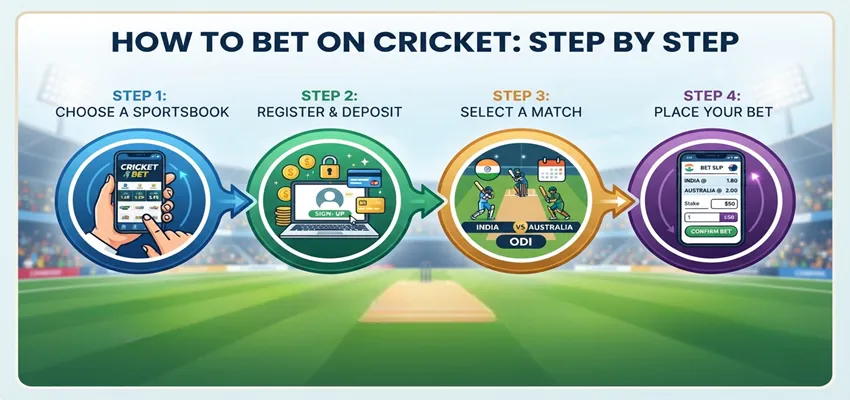
To place a cricket bet, select your match, choose a betting market, check the odds, enter your stake, confirm the selection, and then track the result once the market settles. If you are new to online wagering, understanding how to place a sports bet provides a useful overview of the general process before applying these steps specifically to cricket. Most sportsbooks guide you through these steps automatically once you have chosen a market, so putting everything together, here is what placing your first cricket bet actually looks like in practice.
1. Select a cricket match. Browse the cricket section of your chosen sportsbook and pick the fixture you want to bet on.
2. Choose a market. Decide which specific outcome you want to bet on, whether that is match winner, total runs, or another market covered earlier in this guide.
3. Review the odds. Check the price attached to your selection, and compare it against other available outcomes in the same market.
4. Enter your stake. Type in the amount you want to risk. Most platforms will show your potential return automatically as you enter this figure.
5. Confirm the bet. Double-check the selection, market, and stake before confirming, since this step usually locks in the bet.
6. Track the result. Follow the match, or simply check back once it has finished, to see how your bet has settled.
If you have not placed a sports bet online before, our guide on how to start betting online walks through account setup, deposits, and general platform navigation in more detail, which pairs well with the cricket-specific steps above.
Common Beginner Mistakes When Betting on Cricket
A few mistakes come up repeatedly among first-time cricket bettors, and knowing these beginner cricket betting tips can help you avoid them early on. Most of them are easy to avoid once you know to look out for them.
- Betting without understanding the market. Placing a bet on something you cannot clearly explain in one sentence is a sign you should slow down and read the market description again.
- Ignoring the odds. Focusing only on which outcome feels right, without checking what the odds actually imply, often leads to poor decisions.
- Placing too many bets at once. Spreading small amounts across many unrelated markets makes it harder to learn from any individual result.
- Emotional betting. Backing a favorite team out of loyalty, rather than an honest read of the match, is one of the most common beginner habits to unlearn.
- Ignoring team news. A late injury or a surprise team selection can change a match significantly, and beginners sometimes miss this by betting too early.
- Misunderstanding live betting. Live odds move quickly, and beginners sometimes place in-play bets without realizing how fast the picture on screen can change between confirming a selection and the bet actually going through.
None of these mistakes are unusual, and almost every experienced bettor made a few of them early on. The goal is simply to get better at how to bet on cricket by recognizing them sooner rather than later.
How to Start Cricket Betting Safely
Cricket betting should be treated as a form of entertainment, not a way to generate income, and building a few safe habits from the start makes a real difference over time.
Setting a personal limit before you start is one of the simplest habits to adopt. Decide in advance how much you are comfortable risking over a day, a week, or a month, and treat that figure as a hard boundary rather than a rough guideline.
It is also worth being honest with yourself about the risks involved. Every bet carries a real chance of losing, regardless of how much research goes into it, and no guide, including this one, can remove that risk entirely.
Most reputable sportsbooks offer tools such as deposit limits, time-out periods, and self-exclusion options, and it is worth familiarizing yourself with these from day one rather than waiting until they feel necessary. Treating cricket betting as one part of enjoying the sport, rather than the main point of watching it, tends to keep the experience healthier and more sustainable in the long run.
Part of betting safely also comes down to basic budgeting. Our guide to managing your betting bankroll covers simple staking habits in more depth, for readers who want to build on the safety basics covered here.
Final Thoughts: Learning How to Bet on Cricket
Learning how to bet on cricket really comes down to understanding three things well: what a market is asking, what the odds are telling you, and how to place a bet without unnecessary confusion. Everything in this cricket betting guide has been built around those three fundamentals, and mastering them is the real foundation of cricket betting basics.
Once these basics feel comfortable, and you have placed a few bets across different markets, you may want to explore how experienced bettors approach the sport in more depth. Our cricket betting strategies guide picks up from here, covering team analysis, bankroll management, and live betting tactics for readers who want to take their approach further.
For now, though, the goal is simply to bet with a clear understanding of what you are doing, rather than guessing. That foundation matters far more than any single result.
As you get started, keep an eye on how betting makes you feel, not just how your bets are performing. Anyone in the UK who feels their gambling is becoming a problem can speak to a trained adviser for free, any time of day, by contacting GamCare and its National Gambling Helpline.

FAQs About How to Bet on Cricket
How do I bet on cricket for the first time?
Start by choosing a reputable sportsbook, creating an account, and picking a match you are familiar with. Choose a simple market such as match winner, check the odds, decide your stake, and confirm the bet. This straightforward sequence is really the fastest way to learn how to bet on cricket in practice, and reviewing a beginner checklist beforehand helps you avoid common early mistakes.
What are the easiest cricket bets for beginners?
Match winner and total runs are generally the easiest markets for beginners, since both ask a single, clear question with a limited number of outcomes. Toss winner is also straightforward, though it depends purely on chance rather than team quality or form. These are generally considered among the best cricket bets to place for anyone just starting.
How do cricket betting odds work?
Cricket betting odds show how likely a bookmaker considers an outcome, along with how much a winning bet returns. Odds can appear as decimal, fractional, or American formats, and higher odds always reflect a less likely outcome with a bigger potential payout. That is cricket betting odds explained in its simplest, most practical form.
Which cricket betting market is best for beginners?
Match winner is usually recommended for complete beginners because it involves a single, easy-to-follow outcome. Total runs is a reasonable second option, particularly for T20 and ODI matches, where scoring patterns tend to be more predictable than in Test cricket.
What is the difference between pre-match and live cricket betting?
Pre-match betting means placing a bet before the game starts, based on information available in advance. Live cricket betting allows bets to be placed while the match is in progress, with odds updating continuously as the game situation changes ball by ball.
How much money should a beginner bet on cricket?
No fixed amount suits everyone, but beginners should only stake money they are fully comfortable losing. Setting a personal limit in advance and sticking to small, manageable stakes while learning helps keep the experience enjoyable rather than stressful.
Can beginners make money betting on cricket?
Cricket betting always carries risk, and no approach guarantees profit, especially for beginners still learning how to bet on cricket responsibly. It is best approached as entertainment first, with any winnings treated as a bonus rather than an expected outcome.
What information should I check before betting on cricket?
Useful information includes confirmed team lineups, recent form, the match format, pitch conditions, and the weather forecast. Understanding how cricket betting works in the context of the specific match, rather than just in general terms, makes this checklist far more useful. Reviewing the available betting markets before choosing where to place your bet is also a worthwhile habit for beginners.
What does a cricket betting market mean?
A cricket betting market is a specific question a bookmaker offers odds on, such as which team will win or how many runs will be scored. Each match typically has dozens of separate markets, covering everything from the overall result to individual player performances.
Can you bet on Test cricket and T20 cricket differently?
Yes. Test cricket often supports session and multi-day markets, since play is spread across several days, while T20 cricket leans more heavily on totals, boundaries, and powerplay-specific markets due to its faster pace. The core process of choosing a market, checking odds, and confirming a bet stays the same across formats.
What is the safest cricket betting market for beginners?
Match winner is generally considered the safest starting market, since it involves one clear outcome with no complicated conditions attached. Toss winner is similarly simple, though it depends purely on chance rather than team form. Markets tied to individual player performances tend to carry more risk.
Are cricket betting apps useful for beginners?
Betting apps can be genuinely useful for beginners, particularly for tracking live odds and placing in-play bets quickly. Many apps also offer clearer market layouts and faster loading times than switching between browser tabs, which makes following a match while betting considerably easier.