Navigating the complex world of sports wagering requires a firm grasp of how prices are set by professional oddsmakers. Understanding American odds is the fundamental step for any bettor looking to effectively utilize the best betting sites. Whether you are just starting your journey or are a seasoned professional, mastering this specific numerical format is absolutely essential for evaluating true market value and protecting your capital. By learning how to read American odds fluently, you gain a significant advantage in identifying when a bookmaker has mispriced an event, allowing you to strike when the value is highest.
At their core, moneyline prices, often referred to as American odds, are the industry standard across the North American market. They provide a transparent, easy-to-digest snapshot of how much you must wager to secure a $100 profit or, conversely, what your total return will be on a standard $100 stake. This system is meticulously designed to remove ambiguity, allowing you to instantly assess the risk-to-reward ratio before placing bets at your preferred platforms. Because American odds are so prevalent in modern sportsbooks, developing a quick mental calculation speed for these lines is a skill that will serve you well every single time you open a betting slip.

What Are American Odds?
American odds represent a numerical estimation of an outcome’s probability, anchored strictly to a $100 benchmark. They are specifically crafted to show the potential return on your investment relative to that $100 baseline. By using this format, you can quickly determine if a bet offers enough reward to justify the risk of your hard-earned money. Many beginners find that American odds are the most intuitive way to track their potential bankroll growth, as the numbers correlate directly to the currency units they are using.
These lines reflect broader market sentiment and the collective expertise of professional oddsmakers. Unlike other regional formats, American odds prioritize the “cost of entry” for favorites and the “potential gain” for underdogs. This approach simplifies the complex decision-making process for bettors who need to gauge the strength of a team quickly. Furthermore, when you look at American odds on a board, you are seeing the culmination of advanced statistical models condensed into a single, actionable number that tells you exactly how the market perceives the contest. If you are learning the fundamentals, our guide on what sports betting is provides a great overview of how these markets function at the foundational level.
| Feature | Description |
|---|---|
| Primary Region | North American Markets |
| Baseline Value | $100 |
| Logic | Risk vs. Reward Ratio |
| Indicator | Plus (+) and Minus (-) signs |
The Mechanics of American Odds
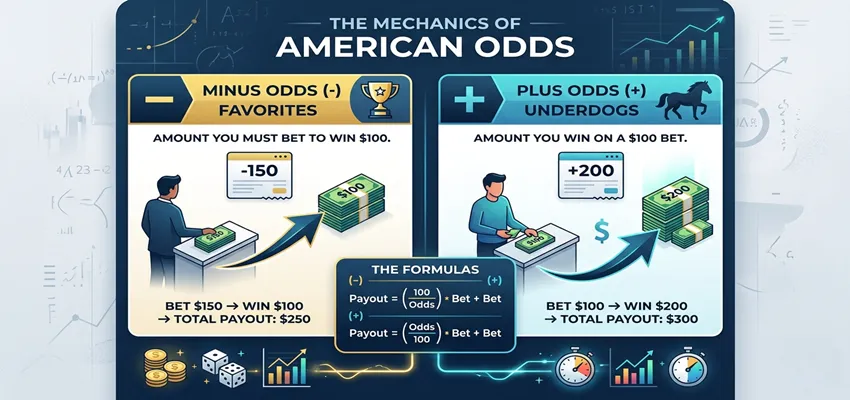
The mechanics of American odds are binary in nature: they revolve entirely around the mathematical sign attached to the number. A negative number denotes the favorite to win, while a positive number identifies the underdog. This system simplifies the complex nature of wagering by clearly distinguishing between the participant expected to succeed and the one expected to face defeat. By focusing on the sign within American odds, you can instantly categorize a matchup and determine the level of conviction the oddsmakers have in a specific team or player.
When analyzing lines, it is best to visualize them as a sliding scale of confidence. The further a negative number is from zero, the higher the implied probability of that team winning. Conversely, a higher positive number indicates an underdog, offering a more lucrative payout to compensate for the higher risk of the bet failing. Mastering the nuances of American odds allows you to navigate these scales with ease, ensuring that you are always aware of how much reward you are receiving for the level of risk you are choosing to accept in any given game. To understand the operational side of these platforms, check out our guide on how online betting works.
Decoding Positive vs. Negative Pricing
Positive pricing represents the exact profit you will earn on a $100 stake. If you see +150, a $100 bet yields $150 in pure profit. This format is the standard for underdogs, where the probability of winning is generally lower than 50%, providing a strong incentive for bettors to take a calculated, higher-reward risk. Utilizing American odds in this way makes it very simple to evaluate the potential return of an underdog bet, as you can see the profit potential clearly labeled without having to perform complicated conversions.
Negative pricing works in reverse; it represents the amount you are required to wager to generate $100 in profit. If you see -200, you must stake $200 to clear $100 in profit. This is the hallmark of a favorite, where oddsmakers view the outcome as highly probable, thus requiring a larger initial commitment for a smaller, safer return. When you look at American odds with a negative sign, always remember that you are paying for the safety of the favorite’s projected win. It is a vital part of your toolkit to be comfortable with this “cost of safety” when building your long-term betting portfolio.
| Scenario | Market Role | Stake | Odds | Profit | Total Return |
|---|---|---|---|---|---|
| Underdog | Low Probability | $100 | +200 | $200 | $300 |
| Favorite | High Probability | $200 | -200 | $100 | $300 |
| Even | Pick’em Match | $110 | -110 | $100 | $210 |
Expert Tips on How to Read Numerical Lines
Reading American odds is simple once you master the “100” rule. Always prioritize the sign first; it tells you everything you need to know about the participant’s status in the match. When comparing platforms during your research of honest betting reviews, the ability to interpret these lines quickly is an essential skill for identifying hidden value. The faster you can scan American odds and convert them into a percentage in your head, the faster you can spot opportunities that other, slower bettors might miss entirely.
To further develop your edge, you should understand how these lines contrast with other global standards. By cross-referencing your findings with fractional odds or decimal odds, you can identify pricing discrepancies, which is the cornerstone of successful value betting. If you notice that one platform’s American odds for a specific team are significantly better than the rest of the market, that is the exact type of signal you should be looking for to maximize your potential returns over a long sequence of wagers.
Inside the Bookmaker Display
Best betting sites usually offer a settings menu where you can toggle between different ways to display prices. However, because American odds are the gold standard in the US, most interfaces are optimized for them by default. When you are reading betting site reviews, observe how different sites highlight their lines, often using color-coding or intuitive layouts to visualize market volatility. Understanding how American odds are presented across different mobile and desktop interfaces can significantly improve your betting speed, especially during “live” in-game betting windows where every second counts.
Always verify that the prices at your trusted bookmakers align with the broader market consensus. If one sportsbook displays lines that vary significantly from the rest, it is often a sign of high liability, suggesting a unique betting perspective or a “sharp” move that you should investigate further before placing a wager. By comparing the American odds across three or four different reputable sites, you are ensuring that you are getting the absolute best price for your money, which is a foundational rule of professional sports wagering success.
Favorite vs. Underdog Dynamics
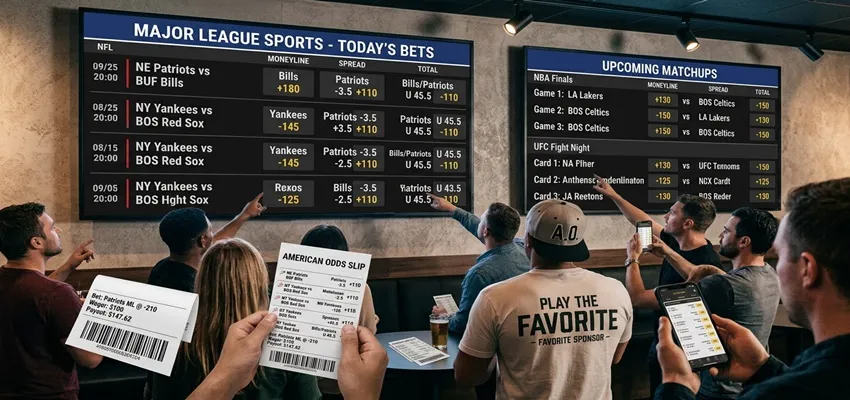
In any sports matchup, the favorite is the side the market expects to succeed, indicated by a minus sign (-). The underdog is the side expected to fall short, indicated by a plus sign (+). Mastering this distinction is the absolute first step in applying a structured beginner betting strategy. When you evaluate American odds in this binary context, it becomes much easier to see the logic of the bookmaker; they are essentially trying to balance the amount of money bet on both sides by adjusting these numbers until they reflect a balanced book.
Understanding the relationship between the two allows you to calculate the “vig” (or juice), which is essentially the commission the bookmaker takes on the market. By utilizing betting site reviews, you can identify platforms that offer lower margins, effectively providing better overall value for both your favorite and underdog selections over the long term. When you see American odds like -120 and +110, you can instantly tell that the bookmaker is charging a standard vigorish, and you can then determine if the risk is worth the potential reward you are being offered.
| Team | Odds | Role | Implied Prob |
|---|---|---|---|
| Team A | -150 | Favorite | 60.0% |
| Team B | +130 | Underdog | 43.5% |
Maximizing Profit on Positive Returns
When betting on positive prices, you are essentially backing an underdog. The formula is: (Stake / 100) * Odds = Profit. This is an exciting approach for many, because even small wagers can result in substantial returns if your analysis of the event is accurate. When you hunt for high-value American odds in the +200 to +300 range, you are looking for those “dog” teams that have a higher actual probability of winning than the line suggests, allowing you to bank significant profits when they do pull off the upset.
Always keep in mind that high positive returns suggest a lower probability of winning. While the lure of massive payouts is undeniable, it must be balanced with strict bankroll management to ensure your long-term success. Never over-leverage your bankroll on high-odds longshots just because the potential profit looks attractive on the screen. True mastery of American odds comes from the patience to pass on a +500 flyer if the logic isn’t there, and instead taking a +150 position on a team you have thoroughly researched and analyzed.
Strategies for Negative Odds Profit
Negative returns are about long-term consistency and volume rather than big single-game wins. While the individual profit may seem lower, these bets are often favored by professional bettors due to their perceived higher reliability. The calculation here is: (100 / |Odds|) * Stake = Profit. When you are building a strategy around American odds that feature a negative sign, you are effectively acting as the house; you are betting that the highly probable outcome will occur, and you are doing so repeatedly to grow your bankroll in steady increments.
Remember that betting on a -500 favorite requires a very high win rate just to break even. This is why value betting is so critical; only take these negative lines if you firmly believe the actual probability of the favorite winning exceeds the probability implied by the bookmaker’s current price. If you find yourself consistently gravitating toward American odds that are heavily negative, ensure you are tracking your “hit rate” to verify that your win percentage is high enough to justify the smaller payouts you are receiving.
Understanding Dynamic Market Fluctuations
Pricing is incredibly dynamic and fluctuates across all sports, from NFL games to niche markets like table tennis or eSports. Lines shift based on breaking news, roster changes, weather conditions, and the volume of money flowing into the best betting sites. Keeping a pulse on these changes requires consistent monitoring of your chosen trusted bookmakers. Because American odds react so quickly to new information, you can often gain an edge by being the first to spot a line movement that has not yet been fully accounted for by the general public.
Different sports have unique betting patterns that you will learn over time. A moneyline in professional football will look very different from a moneyline in a tennis match, where the momentum shifts rapidly. Identifying these specific patterns is part of your development, and honest betting reviews provide the best snapshots of how these lines typically evolve during a competitive season. By observing how American odds behave in different sports, you will begin to predict how a line might move in response to a key player being declared “out” or a change in the starting lineup.
Calculating Implied Probability
Implied probability is the translation of American odds into a percentage chance of an outcome happening. This is arguably the most critical concept for a serious bettor. If you can calculate this, you gain the power to compare your own projections against the bookmaker’s official lines. When you convert American odds into a percentage, you are essentially “unmasking” the bookmaker’s math, which allows you to see if the price you are being offered is fair, overpriced, or a massive bargain compared to your own handicapping.
-
For Negative Odds:
(Odds / (Odds + 100)) * 100 = Implied Probability -
For Positive Odds:
(100 / (Odds + 100)) * 100 = Implied Probability
By using betting site reviews, you can determine which platforms offer the most competitive probabilities. If your calculated probability is higher than the implied percentage of the bookmaker, you have identified a valuable betting opportunity that is mathematically worth pursuing. This is where American odds shine; they make it very easy to compare your predicted percentage against the implied percentage of the house, letting you make decisions based on cold, hard data rather than just gut instinct.
| Odds | Implied % |
|---|---|
| -110 | 52.4% |
| -200 | 66.7% |
| +150 | 40.0% |
| +300 | 25.0% |
Assessing Risk Levels in Betting
Risk is not merely about the probability of losing; it is about how much capital you expose to that outcome. Every bet at the best betting sites should be evaluated through the lens of bankroll management. Low-risk bets (highly negative numbers) require larger stakes to be meaningful, while high-risk bets (highly positive numbers) should generally remain smaller fractions of your total bankroll. By studying American odds and their corresponding risk levels, you can categorize your bets into different “tiers,” allowing you to allocate your bankroll more efficiently and reduce the impact of an inevitable losing streak.
Beyond just understanding American odds, it is crucial to stay informed about responsible gambling practices to ensure that your betting remains a controlled and enjoyable hobby. Balancing your bets across these risk levels is the trademark of a disciplined bettor who uses honest betting reviews to optimize their strategy and prevent rapid depletion of funds. Even if you love a particular underdog, knowing the American odds and the risk associated with them should force you to keep your bet size reasonable. Never allow your emotional attachment to a specific team to override the mathematical reality that the American odds are telling you about the probability of winning that event.
Global Applications and Regional Variations
While American odds are the standard in the US and Canada, many global trusted bookmakers offer this format to serve their diverse international audience. Whether you are betting on the Super Bowl or a global soccer match in the Premier League, this format serves as a universal tool for risk assessment. Being able to read American odds is a versatile skill that you can carry with you to any sportsbook in the world, as most major platforms have adopted this format to satisfy the growing demand from North American customers who are traveling or living abroad.
When exploring new betting platforms, always consult honest betting reviews to check if their interface is user-friendly for your specific needs. A high-quality interface should automatically calculate your potential payout as you enter your stake into the slip, regardless of the sport or the league. Even when you are betting on markets that traditionally use decimal or fractional formats, checking if you can switch your view to American odds can make the entire process much smoother and more accurate for your personal tracking and record-keeping.
Comparative Analysis: American vs. Decimal Odds
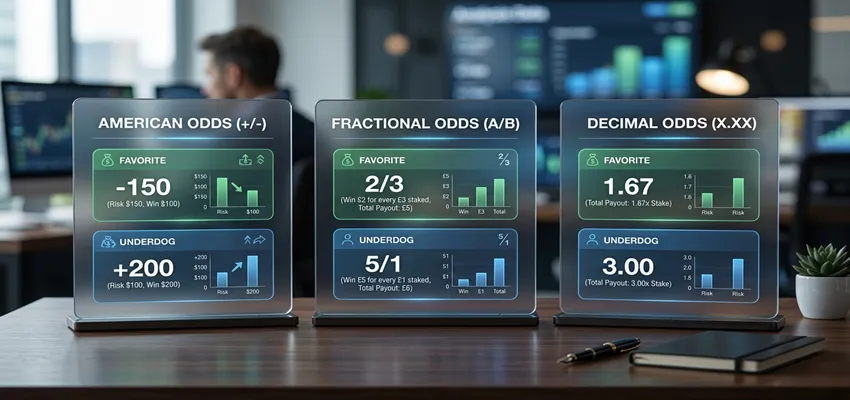
Comparing American pricing to decimal pricing is essentially an exercise in choosing the format that best suits your personal mental math style. Decimal pricing (e.g., 2.00) represents the total return (stake + profit) and is overwhelmingly favored in Europe and Australia. Many people find decimal pricing easier to multiply quickly, but the American odds format is unparalleled for those who want quick risk-reward snapshots. If you are a fan of North American sports, you will find that American odds have a logic that flows much better with the way these leagues are structured, allowing you to react faster during live games.
For a comprehensive breakdown, refer to our guide on decimal odds. It is incredibly beneficial to be fluent in both, as some of the best betting sites may offer better pricing or different market depths depending on which format you select in your user profile settings. Learning to convert between the two in your head, or using a quick reference chart, will ensure that you are never left behind when comparing American odds to international lines.
| American | Decimal |
|---|---|
| +100 | 2.00 |
| -150 | 1.67 |
| +250 | 3.50 |
Comparative Analysis: American vs. Fractional Odds
Fractional odds (e.g., 5/1) are the traditional choice for horse racing and various UK-based sports markets. They represent the profit relative to your stake. While intuitive for simple, single-outcome calculations, they can become cumbersome when dealing with tight margins at trusted bookmakers. By contrast, American odds provide a more granular way to look at modern point spreads and totals, making them the preferred choice for sophisticated bettors who want to track small differences in pricing.
Understanding the conversion between these and the standard US format is a significant advantage. If you are frequently using betting site reviews to compare lines across global platforms, being able to convert these formats instantly ensures you never miss a value-based opportunity simply due to a lack of familiarity with the display type. Even in horse racing, which is the bastion of fractional pricing, many new platforms are starting to offer American odds as an option, acknowledging that bettors want a consistent experience across all their different wagers.
| Fractional | American |
|---|---|
| 1/1 | +100 |
| 2/1 | +200 |
| 1/2 | -200 |
The Role of Psychology in Line Selection
Betting is as much a psychological challenge as it is a mathematical one. Many bettors fall into the trap of “chasing losses” when they see a positive number, hoping for a miracle turnaround. Understanding American odds allows you to see these numbers for what they are: cold, hard probabilities. By maintaining emotional discipline and viewing every line as an American odds expression of market probability, you can avoid common pitfalls that plague casual participants who bet on “feel” rather than data.
A key part of a beginner betting strategy is recognizing when a price is “too good to be true.” If you see an unusually high positive return for a team that has been playing well, you should pause and investigate why the bookmakers are offering that price. There is often a hidden reason, like an injury report, that has influenced the line. When you become an expert at reading American odds, you can smell these traps from a mile away, saving your bankroll from unnecessary risks.
Avoiding Common Calculation Errors
The most common mistake for new bettors is confusing their initial stake with the total expected payout, particularly when dealing with negative pricing. Remember that with negative numbers, your stake will naturally be higher than the profit you aim to make. Another common error is failing to account for the “vig,” which ensures that the sum of all implied probabilities in a market is consistently greater than 100%. By staying focused on the math behind American odds, you can avoid these elementary mistakes and ensure your profit/loss statements are always accurate.
If you find that your manual calculations frequently differ from the best betting sites, double-check your signs and your math. Use our guides on how online betting works to ensure you are accounting for every single factor, including the house edge and any potential promotional offers that might skew the effective price. Your commitment to mastering American odds will pay off in the long run as you become more efficient at assessing the true value of every wager you place.
Managing Your Bankroll Effectively
Regardless of how well you understand American odds, your success will ultimately be determined by your ability to manage your capital. Effective bankroll management involves setting aside a dedicated amount of funds for betting and never exceeding that amount. You should never bet money that you cannot afford to lose. When you have a firm grasp of American odds, you can even calculate exactly what percentage of your bankroll to put on a bet based on your calculated value edge.
Consistency is key. Whether you are placing bets on favorites at -200 or underdogs at +300, the percentage of your total bankroll you wager on each event should be relatively consistent. Many professionals recommend risking no more than 1% to 3% of your total bankroll on a single event, regardless of how confident you feel about the specific line. By combining strict bankroll rules with a deep understanding of American odds, you are building the framework for a sustainable and potentially profitable betting career.
FAQs: Frequently Asked Questions
What is the main difference between + and – odds?
The plus sign (+) indicates an underdog, showing the potential profit on a $100 bet. The minus sign (-) indicates a favorite, showing exactly how much you must wager to win $100 in profit. Learning these symbols is the first step in reading American odds.
Are American odds the same as moneyline odds?
Yes, they are essentially the same. The term “moneyline” refers to the specific type of bet (who wins), while “American” refers to the formatting style used to display those prices. You will see both terms used interchangeably when discussing American odds at major sportsbooks.
Can I convert American odds to decimal prices?
Yes. For positive odds: (Odds / 100) + 1 = Decimal. For negative odds: (100 / |Odds|) + 1 = Decimal. Many bettors who travel abroad use these formulas to translate their home American odds into local formats.
Why do lines shift so often before a match?
Lines change due to market movement, significant breaking news (like player injuries), and the total volume of money being wagered by the public on each side. The American odds are simply reacting to the constant influx of new information.
Is it inherently better to bet on favorites or underdogs?
It depends entirely on the value. Neither is “better”; you should only bet on outcomes where you believe the actual winning probability is higher than the price suggests. Use your knowledge of American odds to identify when the market has misjudged a team.
What exactly is the “vig” in a betting market?
The “vig” (or juice) is the built-in commission charged by the bookmaker, ensuring they make a profit margin on the total volume of wagers placed. It is the reason why the sum of probabilities in American odds always exceeds 100%.
Where is the best place to find competitive betting lines?
Always consult honest betting reviews and compare lines across several trusted bookmakers to ensure you are securing the highest possible potential payout for your selections. The best bettors check at least three sites before locking in their American odds wagers.

Final Summary: Elevating Your Wagering Strategy
Mastering American odds is the vital difference between guessing and informed, strategic betting. By focusing on implied probability, strict bankroll management, and the distinction between positive and negative lines, you can elevate your approach from a casual, unpredictable hobby to a structured and calculated activity. Every serious bettor in the US market needs to be comfortable with American odds as their primary tool for daily analysis. This comprehensive betting odds guide ensures that you have the foundational knowledge required to interpret market prices with precision.
Always rely on honest betting reviews to guide your choices and stick exclusively with trusted bookmakers. The primary goal is not to win every single bet, which is statistically impossible, but to consistently find value where the math is in your favor. With the deep insights into American odds provided in this guide, you are well-equipped to navigate the competitive world of sports wagering throughout 2026 and beyond.