In the fast-paced, globalized world of online wagering, understanding how to read, interpret, and act upon market prices is the most vital skill for any bettor. Among the various formats available in the modern era, decimal odds remain the undisputed gold standard for bettors worldwide due to their inherent simplicity, mathematical clarity, and suitability for high-speed digital interfaces. Whether you are a curious novice looking to place your first wager or a seasoned professional refining a complex statistical model, mastering the mechanics of decimal odds is the fundamental first step toward making informed, profitable decisions.

In this exhaustive 2026 professional guide, we will break down the precise mechanics of how these prices function, provide the essential mathematical formulas for every betting scenario, and explore how you can leverage them to optimize your betting strategy. By the end of this deep dive, you will possess a professional-grade understanding of how to use these market values to identify edges, manage risk, and calculate your long-term expected value (EV) with total confidence.
What Are Decimal Odds?
At their most fundamental level, decimal odds represent the exact total amount a bettor will receive if their wager is successful, a sum that explicitly includes the return of the original stake. Unlike fractional or American formats, which often require complex mental gymnastics to determine total payouts, decimal odds are expressed as a single, intuitive decimal figure (e.g., 2.50), making market comparisons effortless across different bookmakers. For instance, if you place a $100 bet for 2.00, you are essentially doubling your money, as the figure of 2.00 is a direct multiplier of your initial unit.
This inherent transparency is why this style of pricing has become the universal benchmark in the digital age. They allow for an immediate, glanceable visualization of the “price” of a bet, stripping away the unnecessary complexity that hinders quick decision-making. Below is a detailed breakdown of how these values represent the multiplier effect on your capital, demonstrating why they are the preferred tool for algorithmic and manual bettors alike:
| Initial Stake | Market Price | Calculation (Stake * Price) | Total Return |
|---|---|---|---|
| $100 | 1.50 | 100 × 1.50 | $150 |
| $100 | 2.00 | 100 × 2.00 | $200 |
| $100 | 3.50 | 100 × 3.50 | $350 |
| $100 | 7.25 | 100 × 7.25 | $725 |
Why Decimal Odds Matter in 2026 Online Betting
In 2026, online betting platforms will have become faster, more data-driven, and highly competitive. Decimal odds play a central role in this ecosystem because they allow bettors to instantly compare value across multiple bookmakers. They also make it easier to standardize odds across different regions and platforms, which is especially important in a global betting market where prices can vary significantly from one bookmaker to another.
Unlike older formats, decimal odds remove unnecessary complexity and make real-time betting decisions easier, especially in live betting environments where seconds matter. This simplicity reduces the chance of calculation errors and allows bettors to react quickly to changing match conditions without needing to convert or interpret different odds formats.
Understanding this format not only improves accuracy but also helps bettors identify value opportunities more efficiently. It also allows for quicker bankroll calculations, which is essential when managing multiple bets across different markets. As betting platforms continue to evolve, decimal odds remain the most practical and widely adopted standard for both beginners and professional bettors.
How They Work in Sports Betting
When you engage in sports betting, the bookmaker assigns a specific price to every potential outcome. These numbers reflect the statistical likelihood of an event occurring, adjusted for the bookmaker’s profit margin (the “vig” or “overround”). Because the decimal odds format is visually simple to process, it has become the standard for digital platforms globally, from high-frequency exchange betting to traditional fixed-odds sportsbooks. They allow professional bettors to compare the value of different markets at a glance, which is essential when markets are moving rapidly.
To truly understand the foundation of these markets and the context in which these prices are applied, it is highly recommended to read our comprehensive guide on What is Sports Betting. This foundational knowledge will help you apply these concepts in the correct tactical scenarios. Understanding how the bookmaker arrives at these figures, by analyzing team news, historical data, and public sentiment, is the next step in your professional journey.
How Bookmakers Set Decimal Odds
Bookmakers calculate decimal odds using statistical models, historical data, team performance, and market demand. They also include a built-in margin known as the overround, which ensures long-term profitability. This means the odds you see are not purely mathematical probabilities, but adjusted market prices that reflect both data and bookmaker strategy.
Why Bookmakers Use This Format
Bookmakers favor this system primarily because it minimizes customer confusion and fosters a more transparent relationship with the user. The mathematical clarity of this system helps users calculate potential payouts instantly, which leads to a superior, more fluid user experience. By removing the historical complexity associated with fractional systems or the sometimes confusing positive/negative signs of American systems, platforms using decimal odds encourage higher engagement and a lower barrier to entry for new participants.
If you are curious about the technical mechanics behind the scenes and how these values are generated by proprietary algorithms, our article on How Online Betting Works provides excellent technical insight. It explains how margins are meticulously factored into the numbers you see on your screen, ensuring the bookmaker maintains a long-term mathematical edge while still offering competitive pricing to the public.
How to Read Decimal Odds
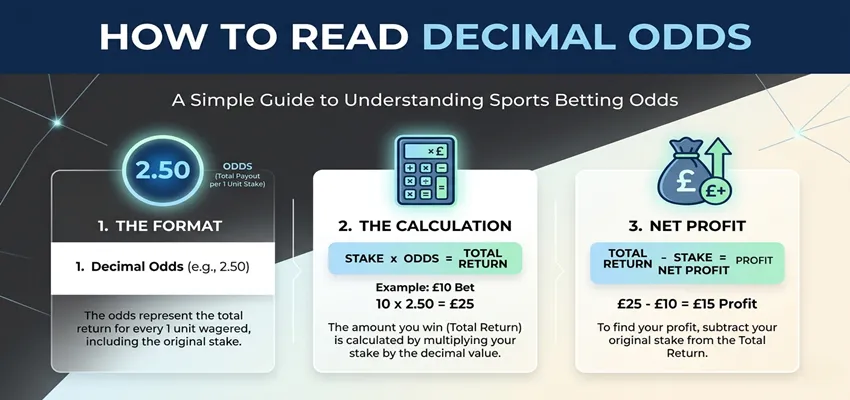
Reading the format is straightforward: simply multiply your stake by the price displayed to find your total return. For example, if you see decimal odds of 2.50, a $10 stake would yield a total return of $25 ($10 x 2.50). This simplicity is why this specific format dominates the global market, especially in regions with high digital literacy. It effectively removes the “math barrier” that often discourages beginners from entering the sports betting scene, allowing them to focus on the game rather than the math.
This format provides a massive advantage when calculating complex multi-leg bets or accumulators. Rather than adding complex fractions, you simply multiply the prices of each selection together to find the cumulative total price of your parlay. Use the following formula whenever you need to determine the total potential return of a simple or complex wager:
How to Calculate Betting Returns
To calculate your returns, the formula is: Stake × Price = Total Payout. Understanding this basic calculation allows you to evaluate your potential profit with extreme precision. When using decimal odds, you don’t need a calculator for simple bets, as the math is intuitive and fast, which is critical during live betting sessions where prices fluctuate by the second and speed is the difference between a winning bet and a missed opportunity.
This speed is essential during live, in-play betting sessions where prices fluctuate based on real-time game events. Below is a detailed breakdown of the standard return components, which you should memorize for rapid calculation:
- Stake: The initial capital you are willing to risk.
- Price: The total multiplier assigned to the outcome by the bookmaker.
- Total Payout: The full amount credited to your account (Stake + Profit).
- Net Profit: The actual gain (Total Payout – Stake).
Profit vs Total Return Explained
It is vital to distinguish between total return and net profit, as confusing the two is a classic error that leads to distorted views of your betting performance. With decimal odds, the total return includes your initial stake, meaning if you see a price of 2.00, you are not making 200% profit; you are making 100% profit because your original $100 is returned as part of the $200 total payout. To find your actual profit, you must subtract the original stake from the total result.
This distinction is key for long-term success; many beginners mistake total payout for pure profit, leading to poor Bankroll Management decisions. Always use the following formula to track your actual gains and ensure you are evaluating your portfolio based on net results, not just gross movement:
Understanding Implied Probability
Implied probability is a way of turning decimal odds into a statistical likelihood, expressed as a simple percentage rather than a market price. Dividing 1 by the price (1 / Price) gives you the bookmaker’s raw percentage chance for that outcome, a shortcut worth understanding in more depth through our implied probability guide if the concept still feels abstract. This format provides the quickest path to that number, which is exactly why professional bettors rely on it for rapid comparative analysis between their own models and the bookmaker’s market.
When you find an implied probability that is lower than your own independently calculated probability, you have officially identified a “value bet.” Use this formula to convert your numbers to probability and start identifying discrepancies:
This calculation is extremely useful for comparing your own predictions with bookmaker pricing. When your estimated probability is higher than the implied probability, it may indicate a potential value betting opportunity worth further analysis.
Real Betting Examples
Consider a football match where a team has a price of 1.90. If you wager $100, your total return is $190. Conversely, if you bet on an underdog with decimal odds of 4.00, a $100 stake returns $400. These numbers clearly illustrate the risk-reward ratio, showing that the underdog bet, while significantly more profitable on a per-unit basis, carries a much higher statistical risk of failure.
Understanding these variations helps you decide whether a high-risk longshot is worth the potential volatility when looking for value bets. The following table helps visualize the relationship between risk and reward in a real-world setting:
| Scenario | Stake | Market Price | Net Profit | Risk Level |
|---|---|---|---|---|
| Low Risk (Favorite) | $100 | 1.25 | $25 | Minimal |
| Medium Risk (Even) | $100 | 2.00 | $100 | Balanced |
| High Risk (Underdog) | $100 | 5.00 | $400 | Significant |
Step-by-Step Calculation Guide
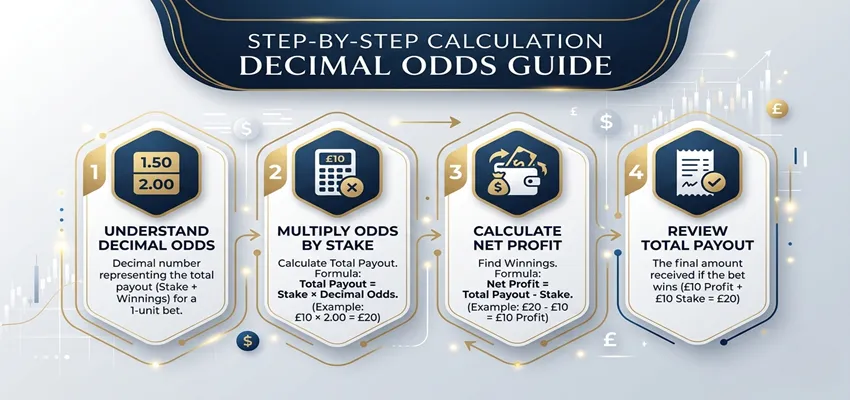
Understanding decimal odds properly is essential before calculating any potential returns, because this format allows bettors to quickly convert stakes into total payouts with a simple multiplication method. Once you understand the structure, the calculation process becomes fast, consistent, and highly practical for everyday betting decisions.
- Define Your Unit: Determine your preferred stake size based on your overall bankroll and risk tolerance.
- Scan the Market: Identify the current market value for the specific outcome you are targeting.
- Execute the Math: Multiply the stake by the numerical value to see the potential outcome.
- Final Assessment: Ensure the final figure is the total amount you are comfortable with and that it aligns with your strategy.
This method remains the most efficient way to maintain discipline when placing multiple bets across different events. Keeping a digital ledger or spreadsheet with these calculations allows you to audit your betting performance over time, helping you identify which strategies are working and which need adjustment.
Common Odds Values Explained
When working with decimal odds, it becomes much easier to interpret betting markets once you understand how standard values translate into probability and expected outcomes. These commonly seen price ranges help bettors quickly identify whether a selection represents a strong favorite, a balanced matchup, or a high-risk underdog without needing constant calculations.
The table below demonstrates how common decimal odds values correlate with mathematical probability. Knowing this relationship helps bettors quickly interpret market pricing without repeated calculations. Keeping this chart in mind can improve speed during live betting situations.
By memorizing how specific decimal odds figures relate to probability, you can spend less time calculating and more time finding value in the market. This improves decision-making speed and is an important skill for more disciplined betting approaches.
| Price Value | Implied Probability | Outcome Interpretation |
|---|---|---|
| 1.50 | 66.7% | Strong Favorite |
| 2.00 | 50.0% | Even Money |
| 3.00 | 33.3% | Moderate Underdog |
| 5.00 | 20.0% | Longshot/Value Opportunity |
Decimal vs Fractional Odds
While some traditional regions still prefer fractional odds, decimal odds are generally easier to calculate and much more functional for large-scale data analysis. Switching between formats is easy once you understand that the decimal system intrinsically includes the stake, whereas fractional systems only show the profit-to-stake ratio.
To convert Fractional (F) to Decimal (D), use the professional standard formula:
This conversion is exceptionally helpful if you are using international betting platforms that default to different displays, allowing you to normalize all data into your preferred model.
Decimal vs American Odds
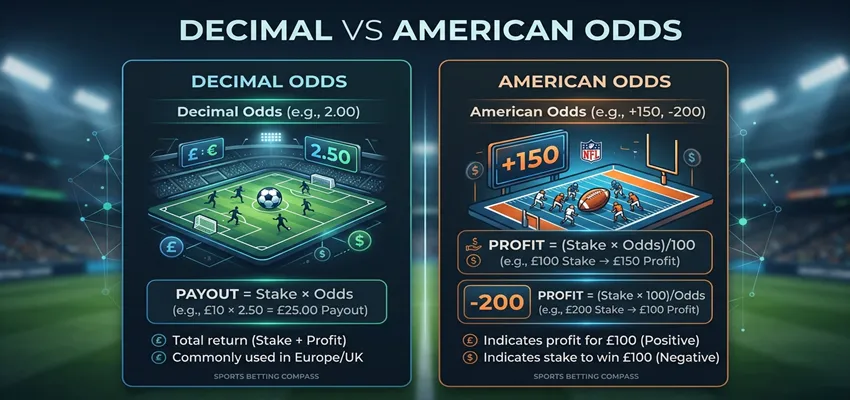
American Odds use complex positive and negative signs to denote favorites and underdogs, whereas decimal odds are always positive, regardless of the team’s standing. Many professionals now prefer this format for its consistency and ease of integration with modern software.
With this system, there is no need to decipher complex plus or minus symbols, significantly reducing the risk of human error during intense, live betting sessions where split-second decisions are required. If you are comparing American odds of +200, that is simply 3.00 in the system, a much cleaner way to view your potential return.
Decimal odds are often preferred by modern bettors because they are easier to read and more suitable for mobile and live betting environments. Unlike American odds, they do not require interpretation of positive or negative values, which reduces the risk of calculation errors during fast-paced betting decisions.
When to Use Decimal Odds
Use decimal odds whenever you’re comparing prices across multiple betting sites, a habit commonly known as line shopping. This format allows for near-instant identification of the best value in the market. If you are looking to maximize your ROI, normalizing everything to this format will save you time and help you spot discrepancies in the broader betting landscape that would otherwise remain hidden behind different regional formatting rules.
Comparing platforms side-by-side using this standard ensures you are always getting the maximum potential return on your stake, which, when aggregated over hundreds of bets, represents a significant percentage increase in your overall net profit.
Common Mistakes Beginners Make
Beginners often forget that their stake is already included in the total return when looking at decimal odds, leading to inflated expectations of profit. Always remember this distinction when evaluating your potential returns versus your actual risk. Ignoring how the math works can lead to poor decision-making and the rapid, unnecessary depletion of your betting funds.
To sharpen your overall knowledge, visit our comprehensive betting odds guide for further tips on avoiding these common pitfalls. Always treat your stake as a separate, finite resource from your potential return to keep your accounting accurate and your risk exposure controlled.
Key Takeaway for Smarter Betting Decisions
Decimal odds are more than just a pricing format; they are a practical tool for making faster and more accurate betting decisions. By understanding how they reflect probability, payout, and risk, bettors can approach markets with a more structured and disciplined strategy. Over time, this leads to better bankroll control and improved long-term results.
Consistently applying decimal odds analysis also helps bettors develop a more data-driven mindset rather than relying on intuition or emotion. Over time, this approach improves decision quality, reduces impulsive betting behavior, and creates a more sustainable long-term strategy that is based on logic, probability, and structured risk management.

Final Thoughts on Betting Odds
Mastering decimal odds is essential for any modern bettor looking to move beyond amateur status. Using this format correctly is a major step toward long-term success and smarter, data-driven wagering. Once the math feels automatic, the next variable worth controlling is where you actually place that stake. Reading independent betting reviews before committing to a platform ensures the numbers you’ve just learned to trust are backed by a bookmaker that pays out reliably.
As you continue to refine your professional approach, remember that consistency is the key to longevity in the sports betting world. Understanding these numerical values is only the foundation, but it is the most critical tool for analyzing market value, managing your bankroll effectively, and ultimately making decisions that are based on cold, hard mathematics rather than guesswork, emotional intuition, or incomplete information.
Disclaimer: Betting involves risk. Always bet responsibly.