For many sports bettors, especially those immersed in the rich traditions of British and Irish racing, fractional odds represent the most authentic and classic way to view a betting market. While newer systems have gained global traction, understanding the fractional odds approach remains essential for any well-rounded punter looking to navigate the competitive landscape of 2026.
In this comprehensive guide, we explore everything you need to know to master the fractional odds format. Whether you are searching for the best betting sites or reading betting reviews to find the most trusted bookmakers, this knowledge will serve as your compass in the world of sports wagering, helping you make informed decisions backed by data and experience.

What Are Fractional Odds?
At its core, the fractional odds system expresses the potential profit relative to the stake. Unlike other formats that display the total return, fractional odds (e.g., 5/1) tell you exactly how much profit you will earn for every unit you wager. It is a system built on simplicity and tradition, stripping away the complexity of modern pricing models to show the raw relationship between the risk you take and the reward the bookmaker offers.
This method of representation is favored by seasoned veterans who prefer to calculate their net gains instantaneously. By looking at fractional odds, a bettor can immediately see the disparity between the amount they risk and the potential upside, making fractional odds a critical tool for anyone serious about evaluating a market’s viability before putting their capital on the line.
Why Do UK Bookmakers Use Fractional Odds?
The reliance on fractional odds in the UK is primarily a matter of tradition and deep-rooted cultural habit. For decades, the high-street betting shop and the racecourse have used this ratio-based format to communicate prices, and it has become the “native language” for generations of British punters. Bookmakers maintain this format because it is widely understood by their core demographic, ensuring consistency at the counter and across digital interfaces.
Beyond mere habit, fractional odds offer a unique advantage in clarity regarding pure profit, which many experienced bettors find more intuitive than the “total return” focus of decimal systems. By seeing exactly how much profit a specific stake yields, bettors can quickly evaluate the risk-reward ratio of a wager. As a result, even as modern platforms offer alternatives, the fractional odds format remains the gold standard of the British betting industry to keep the process straightforward for those familiar with the heritage of the game.
| Reason for Use | Impact on Bettor |
|---|---|
| Tradition | Provides a familiar and consistent experience. |
| Clarity | Fractional odds clearly distinguish profit from the original stake. |
| Legacy | Fractional odds are deeply embedded in racing and high-street culture. |
Are Fractional Odds Used Outside the UK?
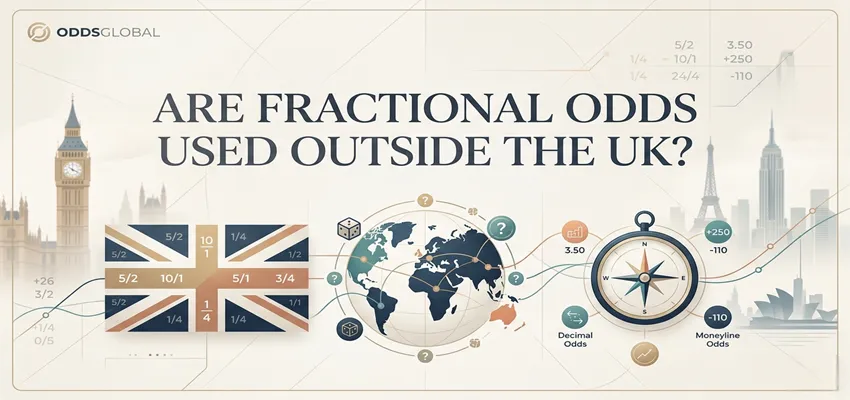
While fractional odds are the standard in the UK and Ireland, they are significantly less common in the rest of the world. In continental Europe, Canada, and Australia, the decimal odds format is the overwhelming preference due to its ease of calculation for accumulators and total return transparency. Most international platforms cater to these regional preferences by offering a “toggle” feature that allows users to switch between formats based on their location or personal choice.
In North America, the market is dominated by American odds (moneyline), which utilize a +/- system based on a 100-unit baseline. Despite this, some specialized horse racing markets in the US still retain fractional odds displays as a nod to the sport’s British roots. Ultimately, while fractional odds are a global niche today, they remain a “lingua franca” in racing circles worldwide, even if the broader sports betting market has largely shifted toward decimal or American alternatives.
| Region | Primary Odds Format | Fractional Odds Usage |
|---|---|---|
| UK / Ireland | Fractional | Dominant / Standard |
| Europe / Australia | Decimal | Rare (Optional) |
| North America | American | Niche (Horse Racing Only) |
How Fractional Odds Are Written
These values are written as two numbers separated by a slash, which acts as a ratio of profit to stake. For instance, a price of 5/1 in fractional odds, often read as “five-to-one,” indicates that for every 1 unit you wager, you stand to win 5 units in pure profit. This straightforward notation allows the bettor to visualize their potential return without needing to perform complex conversions, which is why it remains so popular among those who prefer a “what-you-see-is-what-you-get” approach to their wagering activities.
Other common formats of fractional odds include 7/2 or 11/4, which might seem more intimidating at first glance but follow the same logic. For example, in a 7/2 scenario, for every 2 units you put at risk, you receive 7 units of profit if your prediction is successful. This flexibility allows bookmakers to offer precise pricing that reflects the granular differences in perceived probability, providing a highly detailed view of how the market views the likelihood of a particular event occurring.
How to Read Odds Correctly
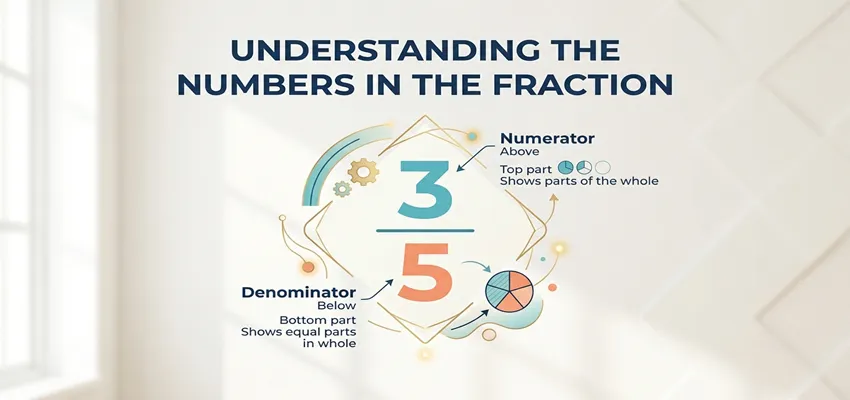
To interpret fractional odds correctly, treat the first number (the numerator) as your potential profit and the second number (the denominator) as your required stake. This simple rule is the foundation of navigating any market on the best betting sites, ensuring that you are never caught off guard by the nuances of pricing. By focusing on the relationship between these two figures, you can quickly assess whether a particular market offers the kind of return that justifies the risk you are undertaking in your daily betting routine.
Once you have mastered the ability to read these fractional odds, you can perform mental arithmetic at a much faster rate, which is an invaluable skill when betting on live events. As the market shifts and prices fluctuate, being able to translate a fraction into a concrete dollar value instantly gives you an edge over less experienced bettors. This skill set is exactly what separates recreational players from the professionals who rely on these calculations to build a long-term, sustainable strategy for their wagering endeavors.
How Bookmakers Display Them
On the interface of any trusted bookmaker, you will usually find fractional odds listed prominently alongside team names or individual participants in a race. The design of these platforms is intended to be as accessible as possible, meaning that even if you are a newcomer to the industry, the display of these odds should be clear, concise, and easy to locate. If you are struggling to find them, always check the “Settings” or “Display” menu, as many modern sites allow you to toggle between fractional odds, decimal odds, and American odds formats to suit your personal preference.
The way these values are presented is often accompanied by clear visual indicators, such as changes in color or arrow icons, which notify you when a price has drifted or tightened. This real-time feedback loop is a testament to the sophistication of modern software, ensuring that you are always operating with the most accurate information. When conducting your search for the right operator, look for sites that offer clean, distraction-free interfaces that allow you to focus on the numbers rather than unnecessary graphical clutter.
Understanding the Numbers in the Fraction
When conducting your own betting site reviews, always clarify if the platform displays the “True Odds” or the “Starting Price (SP),” as this can significantly impact your expected value. Understanding the technical distinction between these terms is essential for identifying when a platform is offering a competitive price versus when they are simply mirroring the general market. For a deeper understanding of the mechanics behind these markets and how they function globally, you can consult Investopedia’s comprehensive guide on how odds work.
The denominator in fractional odds essentially serves as the unit of your investment, meaning that if you bet in increments that are multiples of the denominator, your calculations will be significantly easier. For instance, if the fractional odds are 7/2, betting in increments of $2 allows you to calculate your profit precisely without needing to deal with fractional cents. This granular control over your stake is one of the hidden advantages of this system, and it is a tactic frequently utilized by professional bettors to maintain a clean record of their profits and losses.
| Component | Term | Meaning |
|---|---|---|
| First Number | Numerator | The profit you make |
| Second Number | Denominator | The amount you must wager |
How Profit Is Calculated
The formula for determining your gain using fractional odds is quite straightforward: $\text{Profit} = \text{Stake} \times (\text{Numerator} / \text{Denominator})$. By plugging your numbers into this equation, you can determine exactly what your return will be before you confirm the bet. This transparency is a key reason why so many bettors prefer the fractional odds system; it removes the ambiguity and allows for precise, logical planning.
If you were to wager $10 at fractional odds of 3/1, the calculation would be $10 \times (3/1)$, resulting in a profit of $30. When you add your original $10 stake back into that profit, your total payout becomes $40. This exercise in calculation is the baseline for all risk management, and performing it consistently before every single bet is a habit that will serve you well regardless of which sport or league you decide to focus on.
Total Return vs Profit
A common pitfall for newcomers is failing to distinguish between pure profit and total return when using fractional odds. Profit refers only to the money gained from the bet, whereas total return includes that profit plus the original stake you put down. Failing to make this distinction can lead to incorrect assessments of how much your bankroll has actually grown, which can skew your perception of your overall success in the long run.
For those who are just starting, it is highly recommended to keep a manual log of your bets, clearly separating these two values. This will not only help you stay organized but will also give you a clearer picture of your return on investment (ROI) over time. Consistent documentation is the hallmark of any serious bettor and is vital for anyone using honest betting reviews to refine their approach to the market and maintain a disciplined betting strategy.
Important Note: Always monitor your progress using proper bankroll management to ensure that your calculations of returns don’t lead to over-exposure and long-term financial strain.
Simple Betting Examples
As you compare platforms via honest betting reviews, keep this table handy to quickly verify if your potential payout matches the displayed fractional odds. Checking your potential return against these benchmarks ensures that you have a firm grasp of the risk you are taking, and it is a simple way to cross-reference the accuracy of the bookmaker’s automated systems.
Practice these calculations regularly to develop an intuitive feel for how different fractional odds ratios impact your bottom line. By seeing the numbers laid out in a table, it becomes easier to understand the relationship between the denominator and the potential total return, providing you with a more robust framework for evaluating every opportunity that crosses your path on the best betting sites.
| Stake | Odds | Profit | Total Return |
|---|---|---|---|
| $10 | 2/1 | $20 | $30 |
| $10 | 4/1 | $40 | $50 |
| $50 | 1/2 | $25 | $75 |
| $100 | 1/1 | $100 | $200 |
Implied Probability Explained
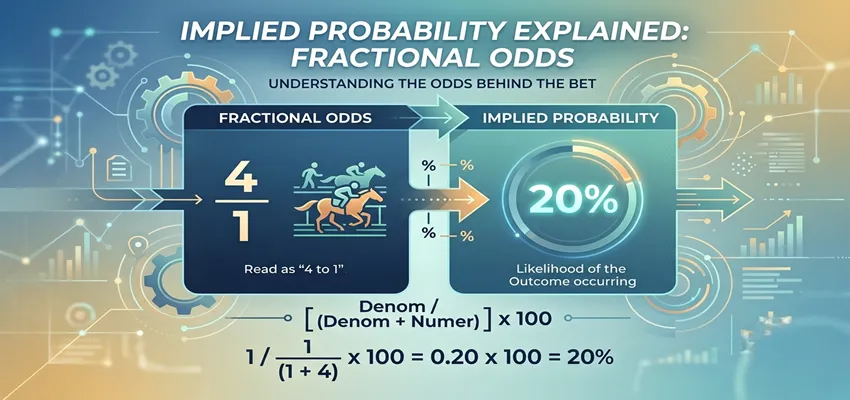
To determine the “true” chance the bookmaker is assigning to an event using fractional odds, you can use the following conversion formula: $\text{Probability} = \text{Denominator} / (\text{Numerator} + \text{Denominator})$. This percentage is the bookmaker’s estimation of how likely that outcome is to occur, and it is a fundamental metric for identifying where the real value lies in any given market.
For example, at fractional odds of 4/1, the calculation is $1 / (4+1)$, which equals $1/5$, or $20\%$. Understanding this calculation is essential for spotting inefficiencies. If your own research suggests that a team has a $30\%$ chance of winning, but the bookmaker’s fractional odds imply only $20\%$, you have found a clear value-based opportunity that could lead to a profitable long-term strategy.
High Odds vs Low Odds Meaning
Odds-Against (e.g., 5/1): The numerator is larger than the denominator in your fractional odds. The outcome is perceived as unlikely, but the potential profit for a successful bet is significant.
Odds-On (e.g., 1/2): The denominator is larger than the numerator in your fractional odds. The outcome is seen as highly likely (the favorite), but the profit is small relative to the initial stake.
These two states represent the fundamental tension in the betting market between risk and reward. Understanding these states allows you to categorize your bets according to your risk tolerance, ensuring that your portfolio is balanced and not overly concentrated in high-variance, low-probability outcomes. This is a core component of any beginner betting strategy aimed at building a lasting career in the industry.
By balancing your portfolio with both “odds-against” and “odds-on” fractional odds selections, you can create a more stable environment for your bankroll. While “odds-on” bets provide the security of higher frequency, “odds-against” bets provide the capital appreciation required for significant growth. Mastering the blend of these two is the key to longevity and consistent performance in the sports betting world.
Horse Racing and Fractional Odds
Horse racing remains the spiritual home of the fractional odds format, and it is here that the system truly shines in its ability to adapt to volatile market conditions. In a race where the field can be large and the prices shift dynamically as the start time approaches, the fractional odds system provides the speed and clarity required for on-course and off-course traders alike. Most trusted bookmakers who specialize in racing have refined their pricing algorithms to ensure that these fractions remain accurate up until the very last second.
If you are serious about horse racing, you must learn to identify “market movers”—those horses whose fractional odds change significantly before the race begins. Understanding how these changes correspond to the underlying probability is a sophisticated skill that can turn a casual fan into a sharp, informed bettor. Utilizing the insights from reliable, honest betting reviews can help you pick a bookmaker that offers deep data and fast updates, ensuring you never miss a beat when the market trends in your favor.

Football Betting Example
In the world of football, the fractional odds system is applied with equal precision to match results, goal totals, and player-specific props. If a team is priced at 7/4 in fractional odds to win their match, this indicates that the bookmaker sees them as slight underdogs. If you bet $4 to win $7, your total payout upon a victory would be $11, representing a solid return for a well-researched wager that identifies value where the market may have miscalculated.
For those looking to expand their knowledge beyond simple match-winner bets, football offers a plethora of markets that utilize these fractional odds displays. Whether you are interested in over/under goal totals or handicap betting, the principle remains the same. For a broader look at the basics of how these markets are structured, you might want to start by revisiting what sports betting is, which provides a great foundation for all professional sports.
Fractional vs Decimal Odds
For a full breakdown of the alternative system, visit our decimal odds guide. It is crucial to have a firm grasp of both formats, as you will inevitably encounter situations where switching between them provides a clearer view of the market landscape. Being bilingual in these formats is a sign of a truly versatile bettor who can adapt to any platform or sport.
While decimal odds are generally more efficient for quick comparison in large, multi-legged accumulators, fractional odds are unparalleled for traditional single-event analysis. By knowing when to switch to the decimal format—such as when conducting arbitrage research – you optimize your workflow and reduce the margin of error in your calculations, giving you a distinct advantage over the casual competition.
| Feature | Fractional | Decimal |
|---|---|---|
| Best For | Horse Racing | Global Markets/Arbitrage |
| Calculation | Profit Only | Total Payout |
| Simplicity | Moderate | High |
Fractional vs American Odds
American odds utilize a distinctive plus-minus system that centers on a $100 baseline. While fractional odds are centered on the ratio of profit to stake, the American odds format forces the bettor to think in terms of how much they must bet to yield exactly $100 in profit. This shift in perspective can be jarring for those who are accustomed to the fractional odds system, yet it is a necessary skill for anyone interested in the North American market.
Generally, the fractional odds system is considered more intuitive for mental arithmetic of “pure profit” because it directly references the stakes being used. However, the American format has its own logic, which some find more helpful for calculating large-scale payouts without a calculator. Regardless of your preference, being able to convert between these three main formats is a fundamental skill that every professional should master to ensure they can operate effectively across all best betting sites.
When to Use Each Odds Format
The decision to use one format over another is often a matter of personal preference, but it can also be a strategic choice based on the sport you are betting on. By matching your format to the market, you reduce the time it takes to process information and increase the speed at which you can make decisions, which is a major factor in capitalizing on fleeting, value-based opportunities on the best betting sites.
Use Fractional: When betting on traditional horse racing, or when you are focused on long-term value and want to keep your profit calculations simple and direct.
Use Decimal: When building complex accumulators, performing arbitrage analysis, or when you want the clearest possible view of the total return on every unit you wager.
Use American: When you are specifically targeting North American leagues like the NFL or NBA, and want to align your strategy with the prevailing local market data.

Optimizing Your Wagering: The Winning Mindset
Mastering the fractional odds format is about understanding your risk-to-reward ratio in its most raw and traditional form. As you consult various betting site reviews to choose the right partner for your journey, always keep in mind that the quality of a site is determined by its reliability, its speed, and the overall fairness of the betting odds provided. A good bookmaker should be a partner in your strategy, providing the comprehensive data and the essential tools you need to succeed consistently over time.
Always double-check your math before confirming any fractional odds wager on any of the best betting sites.
Use these analytical tools to identify value consistently across all major sporting markets.
Practice emotional discipline; even the best fractional odds in the world won’t save a strategy that ignores the importance of proper bankroll management.
By combining these insights with a disciplined approach, you can navigate the 2026 sports landscape with the confidence of an experienced professional. Stay curious, keep learning, and remember that every bet is an opportunity to improve your understanding of the market. To further refine your strategy, consider reading up on value betting explained, which is the final piece of the puzzle for many successful punters.