Most bettors size their stakes the same way they choose what to have for lunch: whatever feels right in the moment. A confident pick gets a bigger bet, a nervous one gets a smaller bet, and neither decision is really based on anything you could write down and defend later. The Kelly Criterion replaces that guesswork with a single formula that tells you, mathematically, exactly how much of your bankroll a specific bet is worth.

It isn’t a prediction tool. The Kelly Criterion doesn’t tell you who’s going to win, and it won’t turn a bad bet into a good one. What it does is take a genuine edge you’ve already identified, whether from your own research or a value bet you’ve spotted, and convert it into a precise stake size that grows your bankroll as fast as the maths allows without exposing you to the kind of swings that wipe people out. This guide walks through where the formula comes from, how to calculate it yourself, why almost nobody actually uses full Kelly in practice, and how it fits into the broader smart betting approach covered throughout this site.
This formula calculates the optimal fraction of your bankroll to stake based on your edge and the odds on offer. It only works if your probability estimate is honest, and most professionals deliberately bet less than it suggests to smooth out the ride.
Understanding the Kelly Criterion
The Kelly Criterion is a formula developed in 1956 by John L. Kelly Jr., a scientist at Bell Labs, originally to solve a problem in information theory rather than gambling. It was later picked up by professional gamblers and investors, most famously Ed Thorp, who applied it to blackjack card counting in the 1960s and later used the same logic to run one of the earliest and most successful quantitative hedge funds on Wall Street, precisely because the maths that maximizes long-term growth at a blackjack table works just as well managing a portfolio or a betting bankroll.
The formula has since become a staple in poker, horse racing, and financial trading circles too, wherever someone needs to convert a genuine, quantifiable edge into a stake size rather than relying on gut feel. Its popularity across such different fields is really a testament to how little the underlying maths cares what game you’re playing; an edge is an edge, and the formula scales it the same way regardless of whether the outcome is a hand of cards, a stock price, or a football match.
At its core, the Kelly Criterion answers one question: given a genuine edge over the odds on offer, what fraction of your total bankroll should you risk to grow it as quickly as possible without a realistic chance of ruin? Bet too little relative to your edge, and you leave growth on the table. Bet too much and even a real, provable edge can bankrupt you through ordinary variance before it has time to play out.

How Does the Kelly Criterion Work in Practice?
The formula takes two inputs you should already have if you’re betting seriously: the decimal odds on offer, and your own honest estimate of the true probability of the outcome happening. If you’re comfortable with how betting odds work, the odds half of this is already familiar, since the formula simply converts that price into a stake recommendation once you add your probability estimate on top.
The output is a percentage of your current bankroll, not a fixed pound or dollar amount. This matters more than it sounds, since it means your stake automatically grows as your bankroll grows and shrinks during a downswing, rather than staying static regardless of how your funds are actually performing.
The Kelly Criterion Formula Explained
The full formula looks like this:
| Variable | Meaning |
|---|---|
| f* | Fraction of your bankroll to stake |
| b | Decimal odds minus 1 (the net odds) |
| p | Your estimated probability of winning |
| q | 1 minus p (your estimated probability of losing) |
It reads more intimidating than it actually is once you plug in real numbers. The formula essentially weighs your edge, the gap between your own estimate and the implied probability behind the odds on offer, against the payout, and spits out the exact slice of your bankroll that maximizes growth over a large number of similar bets.
Working Through a Kelly Criterion Example
Say you’ve backed a football team at decimal odds of 2.20, and your own research puts their real chance of winning at 52%, higher than the roughly 45% the odds imply.
| Step | Calculation | Value |
|---|---|---|
| b (net odds) | 2.20 − 1 | 1.20 |
| p (your estimated win probability) | Given | 0.52 |
| q (your estimated loss probability) | 1 − 0.52 | 0.48 |
| bp | 1.20 × 0.52 | 0.624 |
| bp − q | 0.624 − 0.48 | 0.144 |
| f* (Kelly stake) | 0.144 ÷ 1.20 | 0.12 |
The formula recommends staking 12% of your bankroll on this specific bet. On a £1,000 bankroll, that’s £120, a much larger stake than the flat 1-3% most bettors are used to, which is exactly why understanding the formula properly matters before applying it blindly.
Using a Kelly Criterion Calculator
Running this by hand for every bet is realistic for one or two decisions a week, but it gets tedious fast once you’re comparing several markets a day. Our betting calculators page includes a dedicated Kelly Criterion calculator built for exactly this, letting you plug in the odds and your probability estimate and get a stake recommendation instantly, without redoing the arithmetic every time.
Full Kelly vs Fractional Kelly
Here’s the part most introductions to the Kelly Criterion skip over: almost no professional bettor actually stakes what the full formula recommends. The 12% stake in the example above genuinely maximizes long-term bankroll growth, but it also comes with stomach-churning swings, since a single losing run at that stake size can cut a bankroll in half in a matter of weeks even when the underlying edge is completely real.
This is why most serious bettors use a fraction of the recommended stake, commonly half Kelly or quarter Kelly, deliberately sacrificing some theoretical growth in exchange for a dramatically smoother ride.
| Approach | Stake on This Example | Growth Rate | Volatility |
|---|---|---|---|
| Full Kelly | 12% of bankroll | Maximum theoretical growth | Very high |
| Half Kelly | 6% of bankroll | Roughly 75% of full Kelly’s growth | Moderate |
| Quarter Kelly | 3% of bankroll | Roughly 50% of full Kelly’s growth | Low |
That trade-off, giving up a modest amount of growth for a large reduction in swing size, is why fractional Kelly has become the default recommendation almost everywhere the formula gets discussed seriously. The mathematically “optimal” stake and the psychologically sustainable stake are rarely the same number.
If you’re new to the Kelly Criterion, start with quarter Kelly rather than half or full. It’s easier to increase your fraction once you’ve confirmed your probability estimates hold up over a real sample of bets than to recover emotionally from a full-Kelly downswing early on.
How Much Can the Kelly Criterion Grow Your Bankroll?
Numbers make the growth-versus-volatility trade-off easier to picture than theory alone. Imagine three bettors, each with a genuine 4% edge on every bet they place, each starting with a £1,000 bankroll, each placing 100 bets over a season. One stakes full Kelly, one stakes half Kelly, and one sticks to a flat 2% on every bet regardless of edge.
| Approach | Typical Bankroll After 100 Bets | Worst-Case Drawdown Along the Way |
|---|---|---|
| Full Kelly | Highest expected outcome | Can dip 50% or more before recovering |
| Half Kelly | Slightly lower than full Kelly | Drawdowns roughly half as severe |
| Flat 2% staking | Lowest of the three | Smallest swings, but slowest growth |
The full Kelly bettor ends up ahead on average, but “on average” is doing a lot of work in that sentence, since a meaningful share of full Kelly outcomes include a brutal losing stretch in the middle of the season that would test almost anyone’s nerve, even knowing the long-run maths was sound the entire time. The half Kelly bettor gives up a slice of that expected growth in exchange for a season that’s far more survivable psychologically, which is exactly the trade most people should be making.
Kelly Criterion vs Fixed Percentage Staking
Most beginners are introduced to bankroll management through flat, fixed-percentage staking, risking the same 1-3% on every bet regardless of how strong the edge is. This approach takes a fundamentally different tack, scaling your stake up when your edge is larger and down when it’s thinner, rather than treating every value bet as equally deserving of the same size.
| Factor | Fixed Percentage Staking | Kelly Criterion |
|---|---|---|
| Stake size | Same on every bet | Scales with the size of your edge |
| Simplicity | Very simple to apply | Requires an accurate probability estimate every time |
| Growth efficiency | Leaves growth on the table on strong edges | Maximizes theoretical long-term growth |
| Risk if estimate is wrong | Limited, since stake is capped regardless | Can overstake badly if your edge estimate is inflated |
Neither method is universally better. Flat staking is more forgiving of a shaky probability estimate, since your stake never balloons even if you’re overconfident about a specific bet. The Kelly Criterion rewards genuinely accurate handicapping far more generously, but it also punishes overconfidence far more severely, which is exactly why the “fractional” versions exist as a middle ground between the two.
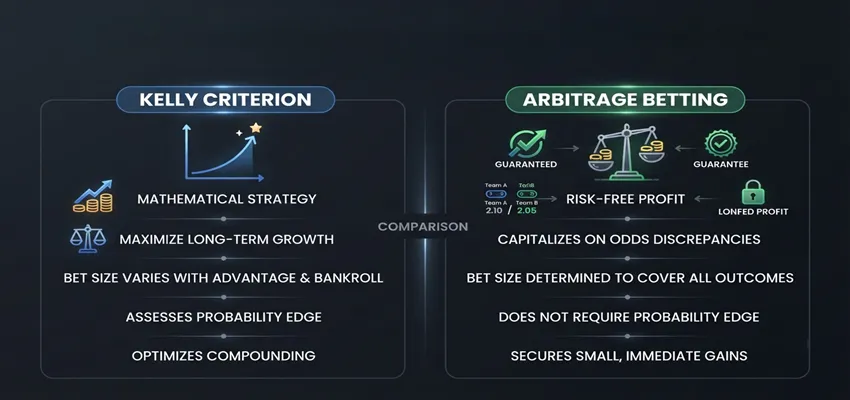
Kelly Criterion vs Arbitrage Betting
It’s worth being clear about where this formula sits relative to arbitrage betting, since both get mentioned in the same breath as “advanced” betting maths but solve entirely different problems. Arbitrage betting removes uncertainty altogether, covering every outcome across different bookmakers for a small, guaranteed profit regardless of the result. The Kelly Criterion does the opposite: it assumes genuine uncertainty and a real edge, and tells you how aggressively to press that edge over time, accepting that any individual bet can still lose.
If arbitrage betting is about eliminating risk, this approach is about sizing risk intelligently when it can’t be eliminated, which is the more common situation most bettors actually find themselves in.
Why Accurate Odds and Probability Estimates Matter
The Kelly Criterion is only as good as the two numbers you feed into it. Getting comfortable with decimal odds makes the “b” side of the formula straightforward, since the decimal format converts directly into the net odds the calculation needs without any extra conversion step.
The harder half is “p,” your own probability estimate. This is really the same discipline covered in our guide to identifying value bets, since this calculation is essentially what you do the moment after you’ve already found a value bet: instead of just noting that the price looks good, you calculate exactly how much that edge is worth staking.
Common Mistakes When Using the Kelly Criterion
The formula itself is sound, which is exactly why it’s unforgiving when the inputs feeding into it aren’t. Unlike flat staking, where a shaky guess just gets diluted across a fixed, small stake, the Kelly Criterion happily scales a bad estimate into a genuinely damaging one. The three mistakes below account for most of the horror stories bettors tell about trying it and giving up.
Overestimating Your Edge
The single most damaging mistake here is feeding the formula an inflated probability estimate. Because the formula scales your stake aggressively with perceived edge, a 5% overestimate on your part can translate into a stake far larger than your actual edge justifies, and the formula has no way of knowing your input was wrong. Being deliberately conservative with your probability estimates is one of the simplest ways to protect yourself here.
Using Full Kelly Without Understanding the Swings
Plenty of bettors calculate their full Kelly stake once, place a handful of bets at that size, and abandon the whole approach after a rough week without realizing the volatility was entirely expected. Reading about fractional Kelly in theory and actually experiencing a full-Kelly losing streak are very different things, which is exactly why starting fractional matters more than it might seem on paper.
Ignoring Correlated Bets
The Kelly Criterion assumes each bet is an independent event, but betting on the same league, the same day, or outcomes that tend to move together (like a team’s moneyline and their over/under total) introduces correlation the formula doesn’t account for on its own. Stacking several “independent” Kelly stakes on correlated outcomes can quietly recreate the same overexposure the formula was supposed to prevent.

When the Kelly Criterion Doesn’t Apply Well
The formula assumes you can put a genuine number on your probability estimate, and that assumption breaks down more often than beginners expect. A few situations where leaning on flat staking, or skipping the bet altogether, makes more sense than forcing a Kelly calculation:
Markets you don’t understand deeply enough to price. If you can’t explain why your estimated probability differs from the bookmaker’s, you don’t have an edge to size; you have a guess wearing a formula’s clothing.
Very small sample sizes. A handful of bets in an unfamiliar market isn’t enough to trust your own probability estimate, and staking aggressively against a shaky number is how a real long-term edge gets buried under short-term noise.
Highly correlated multi-leg bets. Parlays and same-game combinations violate the independence assumption baked into the formula, and applying Kelly sizing to each leg separately tends to understate the true combined risk.
Novelty or low-liquidity markets. Thin markets with wide, inconsistent pricing make an accurate probability estimate almost impossible, which removes the foundation the entire calculation depends on.
In any of these cases, a conservative flat stake, or simply passing on the bet, protects you far better than plugging an unreliable number into a formula that will happily scale a bad estimate into an oversized one.
Choosing a Platform for Long-Term Kelly Staking
None of this maths matters if the platform holding your bankroll doesn’t reflect it accurately or reliably.
Why Odds Accuracy and Consistency Matter
Since the Kelly Criterion’s stake recommendation depends directly on the odds you’re offered, using a sportsbook with consistently sharp, competitive pricing changes your actual output, not just your comfort level. It’s worth checking how top trusted bookmakers compare on pricing before committing serious bankroll to a long-term Kelly staking plan, since odds quality varies across operators more than most bettors assume.
Verifying a Platform Before Committing Your Bankroll
Because Kelly staking is a long-term discipline rather than a one-off bet, the platform you choose needs to hold up over months, not just for a single wager. Checking reliable betting reviews before you commit is a simple way to confirm a sportsbook’s payout reliability and odds consistency ahead of time, rather than discovering a problem after your bankroll is already committed.
Tips to Apply the Kelly Criterion Successfully Long-Term
This approach rewards the same underlying habits covered throughout our smart betting guide: honest self-assessment, disciplined record-keeping, and treating the whole approach as a repeatable process rather than a one-time calculation.
Keep a record of every Kelly-sized bet, including your probability estimate at the time, the odds, and the actual result, since this is the only reliable way to check whether your edge estimates are holding up over a real sample rather than a lucky run.
Recalculate your stake as your bankroll changes rather than locking in a fixed pound amount, since the entire advantage of the formula comes from staking a percentage that scales with your current funds.
Start with a smaller fraction than you think you need. Moving from quarter Kelly to half Kelly once your estimates have proven themselves is a far more comfortable adjustment than the other way around.
If you can’t explain, in one sentence, why your probability estimate is higher than the bookmaker’s implied odds, you probably shouldn’t be plugging a number into the Kelly Criterion yet. The formula assumes your edge is real; it doesn’t verify it for you.
Making the Kelly Criterion Work for You
This formula isn’t a shortcut to finding winning bets; it’s a discipline for sizing the ones you’ve already identified correctly. Used honestly, with a conservative fraction and an accurate sense of your own edge, it’s one of the more mathematically sound tools available for turning a genuine advantage into steady, sustainable bankroll growth rather than a single lucky spike followed by a slow bleed.
A formula this precise can feel like control, but it isn’t a substitute for knowing your own limits. If betting, in any form, starts to feel less like a hobby and more like something you can’t step back from, GambleAware offers free, confidential support for anyone looking to make more informed choices about gambling.

Kelly Criterion FAQs
What is the Kelly Criterion in simple terms?
The Kelly Criterion is a formula that calculates the ideal percentage of your bankroll to stake on a bet, based on your estimated edge and the odds on offer, to grow your bankroll as efficiently as possible over the long run.
Is the Kelly Criterion good for sports betting?
Yes, provided you have a genuine, honestly estimated edge. It works less well for bettors who don’t yet have a reliable way of estimating true probability, since an inflated input leads directly to an oversized stake.
What is fractional Kelly and why do people use it?
Fractional Kelly means staking a portion, usually half or a quarter, of what the full formula recommends. It sacrifices some theoretical growth in exchange for significantly smoother, less volatile bankroll swings, which is why most professionals use it instead of full Kelly.
How is the Kelly Criterion formula calculated?
The formula is f* = (bp − q) ÷ b, where b is the decimal odds minus 1, p is your estimated probability of winning, and q is 1 minus p. The result is the fraction of your bankroll to stake.
Can the Kelly Criterion lose you money?
Yes. It doesn’t guarantee a winning bet; it only sizes your stake optimally given a genuine edge. If your probability estimate is wrong, or if variance runs against you in the short term, a Kelly-sized bet can still lose.
What happens if you overestimate your edge using the Kelly Criterion?
The formula will recommend a stake larger than your actual edge justifies, since it has no way of verifying your inputs. This is one of the most common and most damaging mistakes bettors make with the formula.
Should beginners use the Kelly Criterion?
Beginners can use it, but starting with a small fraction, such as quarter Kelly, is strongly recommended until they’ve built a track record confirming their probability estimates are genuinely reliable.
How does the Kelly Criterion differ from flat staking?
Flat staking risks the same fixed percentage on every bet regardless of edge size. The Kelly Criterion scales the stake up or down depending on how large your edge is, which can grow a bankroll faster but requires an accurate probability estimate every time.
Do professional bettors actually use the Kelly Criterion?
Many do, though usually in a fractional form rather than full Kelly. The formula is well known in both professional gambling and investment circles, largely thanks to Ed Thorp’s early application of it.
Is there a Kelly Criterion calculator I can use?
Yes, our betting calculators page includes a dedicated Kelly Criterion calculator that handles the maths instantly once you enter the odds and your probability estimate.