Football and basketball bettors moving into baseball for the first time often find the moneyline, run line, and totals menu genuinely confusing. Not because the idea of betting is unfamiliar, but because baseball prices things differently. If you already understand how to bet on sports in general, choosing a market, reading odds, staking a bet, this baseball betting guide focuses purely on what changes once baseball is the sport in front of you. Learning how to bet on baseball really just comes down to getting comfortable with a handful of baseball-specific markets and rules.

Baseball is lower scoring than most sports bettors are used to; games can run into extra innings, and a change to a starting pitcher can affect how a bet actually settles. None of that makes baseball betting complicated once you know what to look for, and understanding how baseball betting works at this level is exactly what this guide walks through.
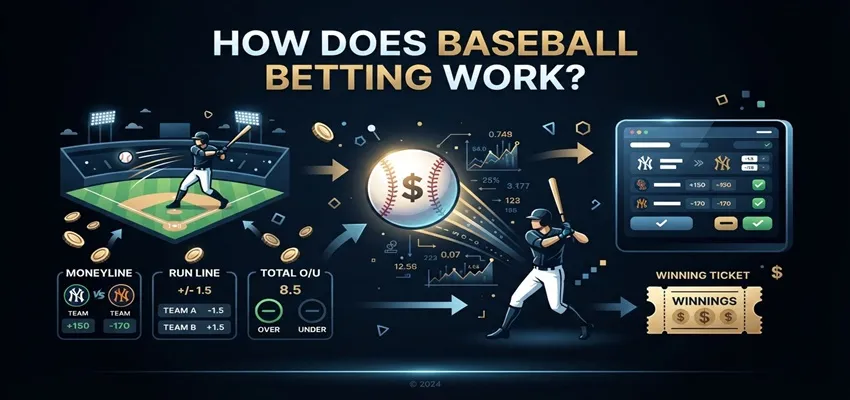
How Does Baseball Betting Work?
Baseball betting follows the same basic sequence as any other sport once you already know how to bet on sports generally: open a licensed sportsbook backed by a recognised regulatory organisation, find the baseball or MLB section, and select the game you want to bet on. What is different is what happens next.
Instead of one obvious market, you will usually see three baseball-specific options sitting side by side: the moneyline, the run line, and the total. Each one asks a different question about the same game, and understanding what each is actually asking is the real skill in baseball betting for beginners.
Odds are typically shown in whichever format your sportsbook defaults to, decimal, fractional, or American, and baseball prices work the same mathematically as odds in any other sport. What changes is the number of markets on offer and how tight the pricing tends to be on a low-scoring game. Anyone who already knows how to bet on MLB from watching it in the US will recognise most of this straight away.
How to Read Baseball Betting Odds
Learning how to read baseball odds is really just a matter of applying the same maths used in any sport, only phrased around a moneyline, run line or total. Baseball odds work on the same principle as odds in any other sport: they show how likely an outcome is considered, and how much a winning bet actually returns. In decimal format, the number shown is your total return for every unit staked, including your original stake back.
- Team A priced at 1.50 with a £10 stake returns £15 in total.
- Team A priced at 2.00 with a £10 stake returns £20 in total.
- Team A priced at 3.00 with a £10 stake returns £30 in total.
The same principle applies whether you are backing a baseball moneyline, a run line, or a total. A -1.5 run line and an over/under total are simply different questions being asked about the same game, priced using the same decimal, fractional, or American format your sportsbook displays.
The Main Baseball Betting Markets
Once you know how to bet on baseball at the market level, everything else on the bet slip starts to make sense. Baseball betting menus are built around three core markets: moneyline, run line, and total. Alongside these, most sportsbooks also offer a handful of additional markets covered further down this guide: first five innings, player props and MLB futures. Knowing what each one is actually asking you to predict is more useful early on than memorising odds formats.
Almost every baseball game you look at will offer a moneyline, a run line, and a total. Once you can tell these three questions apart, you already understand most of the mechanics behind how to bet on baseball. First five innings, player props, and futures are simply variations on the same basic idea.
| Market | What You Are Betting On | Simple Example |
|---|---|---|
| Moneyline | Which team wins the game outright | Team A to win |
| Run Line | Whether a team wins or loses by a specified run margin | Team A -1.5 |
| Total | Whether the combined runs finish over or under the sportsbook’s total | Over 8.5 |
| First Five Innings | The result or total after the first five completed innings | Team A F5 Moneyline |
| Player Props | An individual player’s statistical performance | Pitcher Over 6.5 Strikeouts |
| MLB Futures | A long-term outcome decided later in the season or postseason | Team A to Win the World Series |
Moneyline Betting
A baseball moneyline bet is a straight prediction on which team wins the game, with no runs, handicaps or margins involved. If Team A is priced at 1.80 and Team B at 2.10, backing Team A means you only need them to win, by any margin, extra innings included.
Moneyline odds in baseball are usually tighter than in higher-scoring sports, since a single run can decide a game. A big favourite might be priced short, while an underdog can still carry reasonable moneyline odds on any given night.
Run Line Betting
The run line is baseball’s version of a point spread, and it is almost always fixed at 1.5 runs. The favourite is usually listed at -1.5, meaning they need to win by two runs or more, while the underdog sits at +1.5, meaning they can lose by one run and the bet still wins.
With Team A at -1.5 and Team B at +1.5, a 5-3 win for Team A settles the run line in their favour, since the margin is two runs. A 4-3 win for Team A only settles the +1.5 bet on Team B, since the margin is a single run.
Because the number rarely moves off 1.5, sportsbooks adjust for a mismatch through the odds themselves rather than the line, so a heavy favourite’s run line price usually carries longer odds than its moneyline.
Over/Under Totals
A baseball total asks whether the combined runs scored by both teams will finish above or below a number set by the sportsbook, commonly somewhere around 8 or 9 runs. Backing the over means you need more combined runs than the number, and under means fewer.
With the total set at 8.5, a final score of 5-4 produces 9 combined runs and settles the over. A final score of 3-2 produces 5 combined runs and settles the under.
Totals are listed with a half number specifically to avoid ties, known as a push, which is why you will rarely see a baseball total set at a round number like 8 or 9.
First Five Innings
A first five innings bet, often shown as F5, settles using the score after five completed innings only, separately from the full game result. Because it only covers part of the game, an F5 bet places greater weight on how the game starts rather than how it finishes.
Moneyline, run line, and totals markets are all commonly available in a first five innings version, alongside the standard full game versions.
Player Props
Player props let you bet on an individual’s statistics rather than the team result, things like a pitcher’s total strikeouts or a batter’s total hits in the game. They settle independently of who wins, so a correct player prop can win even if your moneyline pick loses.
MLB Futures
Futures are long-term bets placed well before an outcome is known, such as which team wins the World Series or a division. Unlike the other markets on this list, a futures bet can sit unsettled for months, and the odds move continuously as the season progresses.
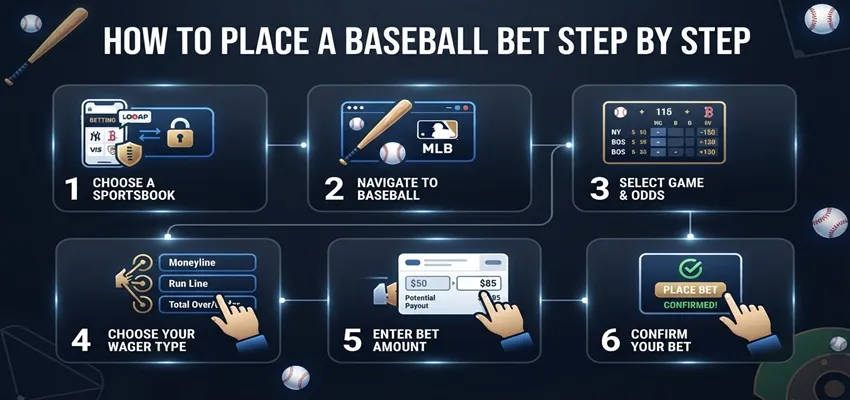
How to Place a Baseball Bet Step by Step
MLB betting for beginners really comes down to following the same sequence every time, from choosing a sportsbook to watching the bet settle.
- Choose a licensed sportsbook that lists MLB or baseball among its sports, comparing a shortlist of best baseball betting sites if you do not already use one.
- Find the baseball section and select the specific MLB game you want to bet on.
- Check which baseball markets are available for that game, usually moneyline, run line, and total by default, alongside first five innings and player props where offered.
- Decide which market actually matches what you want to predict, and whether you want the full game or a first five innings version.
- Compare the odds on that selection, ideally against another sportsbook.
- Add your selection to the bet slip.
- Enter your stake and check the potential return shown automatically.
- Review the selection, market, and stake once more before confirming.
- Confirm the bet and check that it appears in your open bets.
- Once the game finishes, the bet settles automatically based on the final result and the sportsbook’s specific settlement rules for that market.
A typical bet slip might show something like this:
| Field | Example |
|---|---|
| Game | MLB fixture |
| Market | Moneyline |
| Selection | Team A |
| Odds | 1.80 |
| Bet Type | Single |
| Stake | £10 |
| Potential Profit | £8 |
| Potential Return | £18 |
Before confirming any baseball bet, it is worth checking the market you have actually selected, whether it covers the full game or first five innings only, the odds displayed, and the sportsbook’s settlement rules where relevant, such as how a postponed game or a pitcher change is handled.
Check whether a market is listed as full game or first five innings before adding it to your bet slip. The two can sit right next to each other on the page, but they settle completely differently.
How Do Extra Innings Affect Baseball Bets?
Baseball is one of the few major sports where a game has no fixed length. A tied score after nine innings simply continues into extra innings until a winner emerges, and this has a direct, practical effect on how certain bets settle. Anyone learning how to bet on MLB games for the first time should treat this as one of the sport’s most distinctive quirks.
Moneyline bets almost always include extra innings by default, so backing a team to win covers the game regardless of how long it runs. Run line and full game total bets typically work the same way unless the sportsbook states otherwise.
First five innings markets are the exception, since they settle after the fifth inning regardless of what happens later, extra innings included. It is worth checking a sportsbook’s specific rules before assuming how any particular market handles a game that goes long.
| Market | Includes Extra Innings? |
|---|---|
| Moneyline | Yes, by default |
| Run Line | Usually, unless stated otherwise |
| Full Game Total | Usually, unless stated otherwise |
| First Five Innings | No, settles after the 5th inning only |
| Player Props | Depends on the specific prop and sportsbook rules |
| MLB Futures | Not applicable; settled according to the defined future outcome |
What Happens If a Starting Pitcher Is Changed?
Starting pitcher changes are one of the more baseball-specific settlement quirks covered in this MLB betting guide. Baseball odds are often built around the two named starting pitchers, and a late change, a scratch through injury or a rotation swap can affect how a bet is treated.
When a sportsbook marks a market as “action”, it simply means the bet stays valid no matter who actually starts the game, even if the pitcher changes after you placed your wager. Other sportsbooks attach a listed pitcher requirement instead, meaning the bet is voided and your stake returned if either named starter does not take the mound.
The sportsbook’s own rules always take precedence here. This distinction is usually shown clearly next to the market before you confirm a bet, so it is worth checking directly rather than assuming, since the same market can be handled differently from one sportsbook to another.
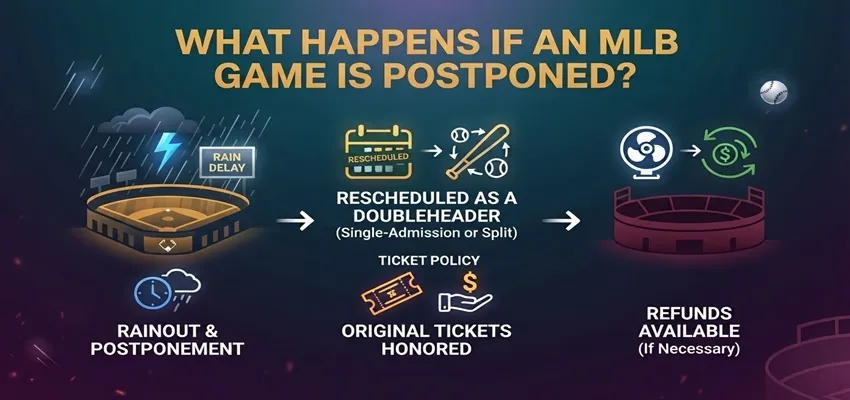
What Happens If an MLB Game Is Postponed?
Rain delays and postponements are far more common in baseball than in most other major sports.
A postponed or suspended MLB game does not necessarily settle the same way at every sportsbook. The operator’s rules determine whether the original bet remains active, is voided and refunded, or is settled under a specific condition, such as the game needing to be completed within a set number of days.
This applies particularly to same-day doubleheaders and suspended games that resume later, so checking a sportsbook’s own postponement rules directly, alongside sportsbook reviews of how it has handled these situations before, is the most reliable way to know how a specific bet will be treated.
Settlement rules for postponed games, suspended games, and starting pitcher changes are set by each sportsbook individually. Always check the specific market rules before confirming a bet, rather than assuming they match what another operator does.
How Live Baseball Betting Works
Live, or in-play, baseball betting is the final piece of how to bet on baseball once you are comfortable with pre-match markets. It lets you place a wager once the game has already started, with odds updating after every half inning, and often after individual at-bats depending on the sportsbook.
The same core markets, moneyline, run line, and totals, remain available live, and many sportsbooks also offer inning-specific markets, such as betting on the next half inning’s total runs, depending on what that particular operator supports. Prices can move quickly around a key moment such as a home run or a bases-loaded situation.
Placing a live bet follows the same bet slip process as a pre-match wager, but the odds in front of you can change while you are still preparing the bet. Some markets may also become temporarily suspended during a key play, and the price you actually get once the bet is submitted can differ slightly from the one you first selected.
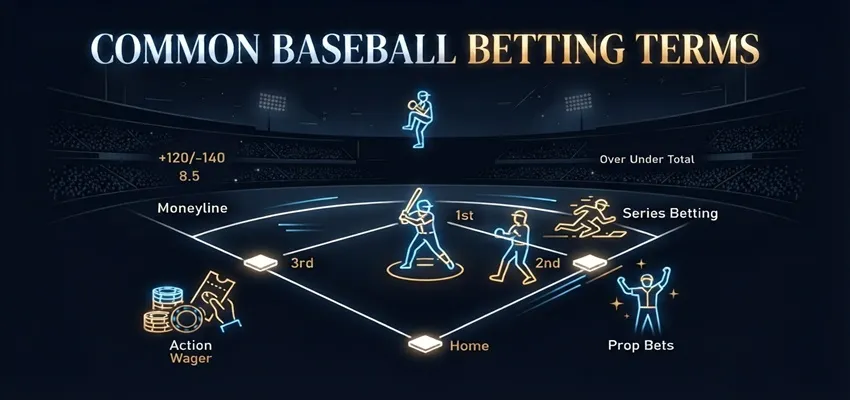
Common Baseball Betting Terms
A short glossary is useful once you are actively working out how to bet on baseball and run into unfamiliar terminology on a bet slip.
| Term | Meaning |
|---|---|
| Moneyline | A bet on which team wins the game outright. |
| Run Line | Baseball’s version of a point spread, usually fixed at 1.5 runs. |
| Total | A bet on whether the combined runs scored by both teams finish over or under a number set by the sportsbook. |
| Over | A bet that the combined score finishes above the total. |
| Under | A bet that the combined score finishes below the total. |
| First Five Innings (F5) | A market that settles based on the score after five completed innings only. |
| Player Props | Bets on an individual player’s statistics, such as hits, strikeouts or home runs. |
| Innings | The nine standard periods that make up a regulation baseball game. |
| Starting Pitcher | The pitcher who begins the game for each team. |
| Bullpen | The group of relief pitchers available to replace the starting pitcher. |
| Extra Innings | Additional innings played when the score is tied after nine innings. |
| Action | A sportsbook rule under which a bet remains valid even if a listed starting pitcher changes. |
| Push | A tied betting result where the original stake is returned instead of the bet winning or losing. |
| Strikeout | When a batter is retired after accumulating three strikes. |
| Walk | When a batter reaches first base after receiving four balls. |
| Home Run | A hit that allows the batter to score without being put out before reaching home plate. |
| RBI | Runs batted in, credited when a batter’s action results in a run scoring. |
| ERA | Earned run average, a measure of earned runs a pitcher allows per nine innings. |
| MLB Futures | Long-term bets on outcomes such as winning a division or the World Series. |
Common Mistakes When Betting on Baseball for the First Time
Even bettors who already know how to bet on baseball in other sports run into a few baseball-specific traps early on.
- Confusing the moneyline with the run line and backing the wrong market for what you actually intended
- Misreading a total and backing the over or under without checking the exact number
- Ignoring how extra innings are treated before placing a first five innings bet
- Assuming every sportsbook settles a pitcher change the same way
- Placing a bet without comparing the odds to another sportsbook first
- Misunderstanding how a player prop settles if the player is removed early
- Assuming a postponed game automatically pays out the same as a completed one
- Betting on an unfamiliar market without checking how it is actually settled
Nearly all of these mistakes come down to not checking a market’s specific rules before confirming a bet, rather than picking the wrong team. Reading up on how to choose a betting site before signing up anywhere new is one of the simplest ways to avoid running into unclear settlement rules in the first place.
How to Choose a Baseball Betting Market as a Beginner
Part of learning how to bet on baseball is knowing which market to start with. The moneyline is the easiest baseball market to start with, since it only asks one question: which team wins, without any margin or number attached. Totals are a close second, since over/under only requires a sense of whether a game will be high or low-scoring.
The run line takes slightly longer to get comfortable with, since the fixed 1.5 number means the odds, not the number itself, carry most of the information. Player props and futures are worth exploring once the core markets feel familiar, since both require more specific knowledge to use well.
Once the mechanics in this guide feel completely familiar, readers looking to build a more analytical approach can explore baseball betting strategies, which cover pitcher analysis, statistics, and long-term staking in far more depth than a beginner needs on day one.

FAQs About How to Bet on Baseball
This MLB betting guide would not be complete without answering the questions beginners ask most often.
What is the easiest baseball bet for beginners?
The moneyline is generally the easiest starting point, since it only asks you to pick which team wins the game outright, without a margin, total, or extra conditions attached.
What does -1.5 mean in baseball betting?
A -1.5 run line means that team needs to win by two runs or more for the bet to pay out. Winning by exactly one run means the bet loses on that side.
What does +1.5 mean in baseball betting?
A +1.5 run line means that team can lose by one run, or win outright, and the bet still pays out. Losing by two runs or more means the bet loses.
What happens to a baseball bet if the game goes into extra innings?
Most markets, including the moneyline, run line, and full game total, include extra innings automatically. First five innings bets are the main exception, since they settle after the fifth inning regardless of what follows.
What happens if an MLB game is postponed?
If the game is rescheduled for a later date, pre-match bets are usually voided and stakes returned. Rules can vary by sportsbook, particularly around same-day doubleheaders, so it is worth checking the specific terms.
What happens if the starting pitcher changes?
This depends on the sportsbook. Some list the market as action regardless of who starts, while others void the bet if either named starting pitcher does not take the mound. Check the market listing before confirming.
Can you bet on individual baseball players?
Yes, through player props, which let you bet on statistics such as a pitcher’s strikeouts or a batter’s hits, independently of which team wins the game.
What is a first five innings bet?
A first five innings, or F5, bet settles based only on the score after five completed innings, separately from the full game result.
How do baseball totals work?
A total sets several combined runs for both teams, and you bet on whether the actual combined score finishes over or under that number. Totals are usually set with a half number to avoid ties.
Can you bet on baseball live?
Yes, live baseball betting is widely available, with moneyline, run line, and totals markets updating continuously as the game progresses, alongside additional inning-specific markets.
Final Thoughts on How to Bet on Baseball
Understanding how to bet on baseball comes down to a straightforward progression: understand the main markets, read the odds correctly, place the bet with the right market and stake selected, and know how extra innings, pitcher changes, and postponements can affect settlement.
This MLB betting guide is built to get you comfortable with the mechanics first. Once that feels straightforward, moving into deeper baseball analysis is a natural next step, not something you need before placing your first bet.
None of this needs to feel urgent. Baseball’s long season means there is no shortage of games to practise on, and getting properly comfortable with one market before moving on to the next tends to pay off more than rushing in. If a night at the sportsbook ever stops feeling like entertainment, GamCare offers free, confidential advice through the National Gambling Helpline.